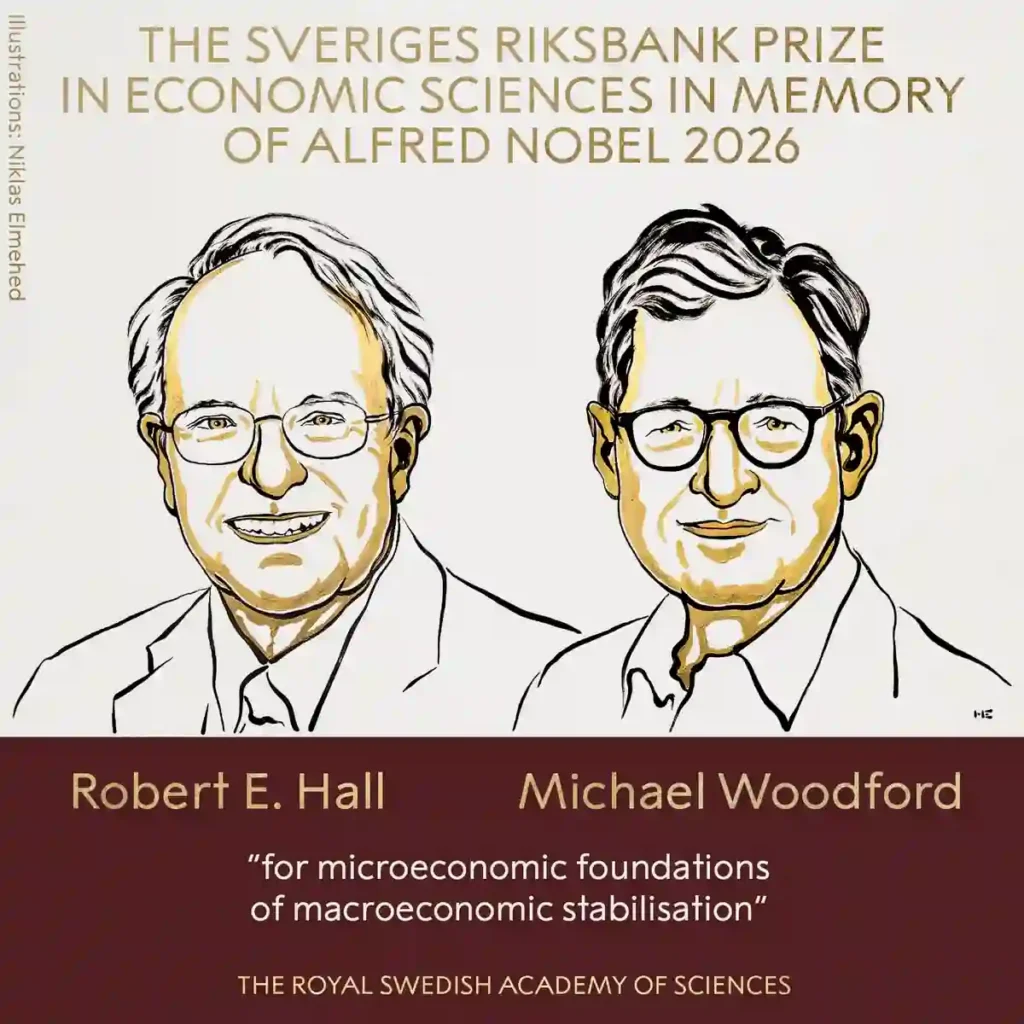

STOCKHOLM, Oct. 12, 2026 — American economists Robert E. Hall and Michael Woodford have won the 2026 Nobel Memorial Prize in Economic Sciences for research that has helped central banks and governments respond to inflation, recessions and unexpected economic shocks.
BREAKING NEWS The Royal Swedish Academy of Sciences has decided to award the 2026 Sveriges Riksbank Prize in Economic Sciences in Memory of Alfred Nobel to Robert E. Hall and Michael Woodford “for microeconomic foundations of macroeconomic stabilisation.” #NobelPrize https://t.co/2i7ktB1Q2b
— The Nobel Prize (@NobelPrize) October 12, 2026
The Royal Swedish Academy of Sciences announced the winners on Monday, recognizing their contributions to the “microeconomic foundations of macroeconomic stabilisation.” Their work strengthened economic models used to examine consumer spending, employment, interest rates and financial instability.
Hall, of Stanford University in California, and Woodford, of Columbia University in New York, will share 12 million Swedish kronor, approximately $1.2 million.
Hall and Woodford Honored for Economic Stabilization Research
The Academy recognized the economists for developing theoretical foundations that connect individual financial decisions with changes across the broader economy.
Their contributions helped advance modern macroeconomic models that examine consumer expectations, business behavior, inflation and monetary policy.
John Hassler, chair of the Committee for the Prize in Economic Sciences, said their research provides a foundation for models used by governments and central banks worldwide.
He highlighted its importance during economic disruptions, including energy crises and sudden changes in household consumption.
The Royal Swedish Academy of Sciences’ official announcement provides additional information about the research recognized in this year’s award.
Robert E. Hall: Stanford Economist’s Career and Research
Robert E. Hall is an American economist known for his research on consumer spending, unemployment, labor markets and economic fluctuations.
He has served as president of the American Economic Association and chaired the National Bureau of Economic Research committee responsible for identifying the beginning and end of US recessions.
His research has examined how households adjust spending based on expectations about future income and how employment conditions change during economic downturns.
These contributions have helped economists understand why weak consumer demand and unemployment can persist during recessions.
Michael Woodford: Columbia Economist’s Influence on Monetary Policy
Michael Woodford, born in Chicopee, Massachusetts, in 1955, is a professor at Columbia University. He earned his doctorate from the Massachusetts Institute of Technology in 1983.
He is widely recognized for his 2003 book, Interest and Prices: Foundations of a Theory of Monetary Policy, which contributed to modern research on central bank policy and inflation expectations.
His work examines how expectations about future interest rates influence consumer spending, investment and pricing decisions.
Speaking by telephone from New York after the announcement, Woodford described the award as a tremendous honor and a surprise.
Anne Carson and the 2026 Nobel Prize in Literature: Key Details
Evelyn Araluen Wins $100,000 Victorian Prize for Literature for The Rot in 2026
Economic Stabilization Research and the Lessons of the 1970s
The economists’ contributions form part of broader advances in macroeconomic research following the economic turmoil of the 1970s.
During that period, several major economies experienced stagflation, a combination of high inflation, weak growth and elevated unemployment.
Earlier economic models struggled to explain these conditions consistently, prompting researchers to develop approaches incorporating household behavior, business decisions and expectations.
Hall and Woodford’s work contributed to this development, strengthening economists’ ability to assess monetary and fiscal policy responses.
Impact on Inflation, Interest Rates, Employment and Households
The research has practical relevance because central bank decisions affect borrowing costs, household purchasing power, business investment and employment.
Higher interest rates can help control inflation but may also weaken spending and investment. Lower rates can support economic activity while potentially increasing inflationary pressures.
These policy trade-offs matter internationally, including in India, where Reserve Bank of India decisions influence lending rates and economic activity.
Corporate developments such as Nippon Paint’s $1.35 billion AkzoNobel acquisition illustrate investment decisions made within changing economic conditions.
Financial pressures can also lead to corporate restructuring, as seen in BT’s rescue acquisition of TalkTalk and PlatformX.
However, economic models cannot eliminate recessions or guarantee that every policy decision will succeed.
2026 Nobel Economics Prize Money, Ceremony and Previous Winners
Hall and Woodford will each receive 6 million Swedish kronor from the total 12 million kronor award.
The prize ceremony is scheduled for December 10, the anniversary of Alfred Nobel’s death in 1896.
Established by Sweden’s central bank in 1968 and first awarded in 1969, the economics prize was created separately from the five original Nobel Prizes.
In 2025, Joel Mokyr, Philippe Aghion and Peter Howitt were honored for research explaining innovation-driven economic growth.
The 2026 economics announcement concluded this year’s Nobel prize announcements, following awards in medicine, physics, chemistry, literature and peace.

Make Swikblog your go-to source on Google for reliable updates, smart insights, and daily trends.