
While most mobile games compete for your attention with flashing lights and loud noises, 7 Little Words has found a massive audience by doing the exact opposite. It is a game built on a simple premise: seven clues, twenty letter groups and no ticking clock.
In the crowded world of free word games, it has become a staple for millions. It doesn’t try to be a social media sensation or a high-stakes competition. It just tries to be a good puzzle. This “no-frills” approach is precisely why it’s winning.
What is 7 Little Words? A Simple Guide for Beginners
If you are looking for a mental workout that is satisfying but won’t take up your entire afternoon, 7 Little Words is the perfect entry point. Created by Christopher York in 2011, it has become a staple for puzzle lovers because it bridges the gap between a casual word search and a challenging crossword.
What Do We Know about 7 Little Words?
Think of 7 Little Words as a hybrid. It takes the clues of a crossword, the letter-hunting of a word search and the structural challenge of an anagram. Then it mixes them into a clean, 20-tile grid. It’s designed to be easy to learn but offers enough variety to keep your brain engaged.
The Anatomy of a Puzzle
Every game follows the same clear structure:
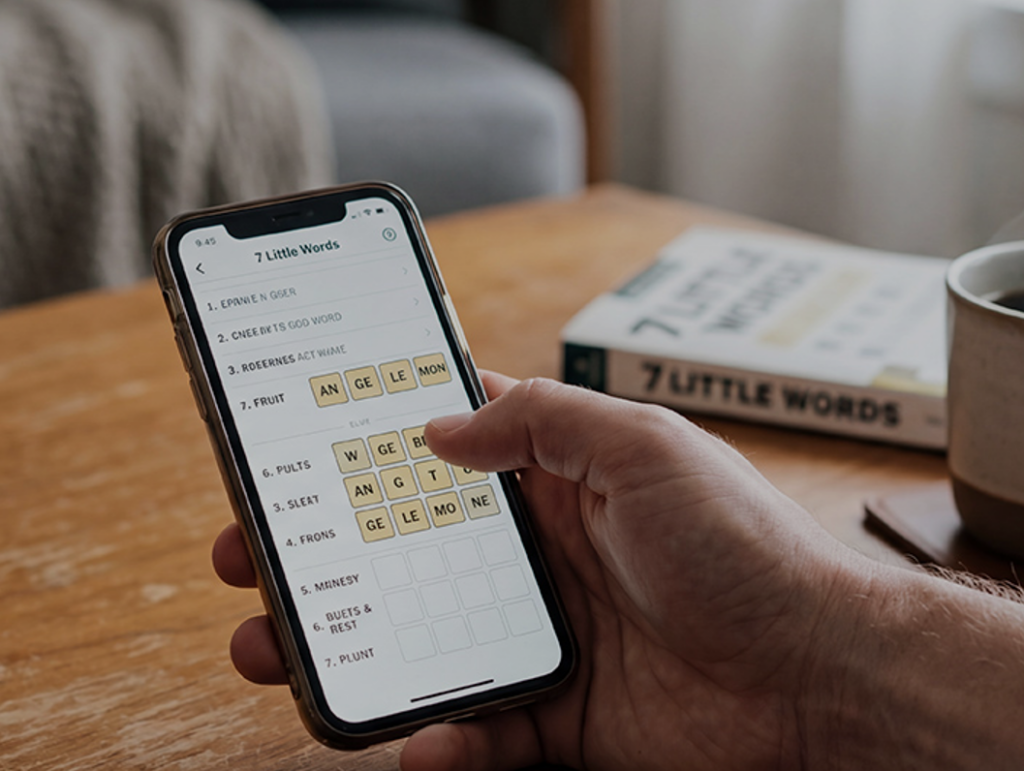
- 7 Clues: You are given seven definitions or descriptions to solve.
- 20 Tiles: Instead of an QWERTY keyboard, you have 20 tiles, each containing a small group of letters (usually 2 or 3 letters per tile).
- The Solution: Each answer is broken into these chunks. Your job is to find the right tiles and tap them in the correct order to build the “mystery word.”
How to Play 7 Little Words: Step-by-step guide
Pick any of the seven clues. Beside the clue, you will see the number of letters in the answer (e.g., “A citrus fruit). Then, look at the 20-tile grid. To solve the “citrus fruit” clue, you might tap the tiles OR, AN and GE.
Once you correctly identify a word, those tiles disappear from the board. This makes the remaining clues easier to solve by process of elimination.
If you hit a wall, you can Shuffle the tiles to see them from a new perspective or use a Hint to reveal a piece of the puzzle.
How the Game Combines Crosswords and Anagrams?
At first glance, crosswords and anagrams seem like complete opposites. Crosswords rely on external knowledge and vocabulary to solve clues, while anagrams require internal logic and letter manipulation. 7 Little Words, created by Christopher York in 2011, found a sweet spot by combining these two approaches into a single, seamless puzzle experience.
The Crossword Element: The “What”
The game starts like a traditional crossword with seven numbered clues. These range from simple synonyms, like “Very cold,” to more complex trivia or “before-and-after” wordplay. The clues also tell you the length of the answer.
The Anagram Element: The “How”
Instead of blank spaces or a full keyboard, you’re given 20 letter-group tiles, usually 2–3 letters each, such as “FRI,” “GID” or “ENT.” These tiles are scrambled in a random grid and your brain has to visually search for the right chunks to assemble the word you’ve just identified. For example, for the word “FRIGID,” you look for the chunks “FRI” and “GID” among the other tiles. Once a set of tiles is used, it disappears. This narrows down the pool and makes the remaining clues easier to solve.
Why the Combination Works
This hybrid addresses the main frustrations of both puzzle types. If you know a crossword answer but aren’t sure of the spelling, the tiles guide you. Long anagrams, which can feel overwhelming, are broken into smaller chunks. By combining the “definition” aspect of a crossword with the “construction” aspect of an anagram, the game creates a mental rhythm that feels like building with blocks.
Is 7 Little Words the best free word game for seniors?
7 Little Words is widely praised as one of the best free word games for seniors. Its simple, non-competitive and low-stress design makes it both enjoyable and mentally stimulating. This helps seniors to exercise memory and practice problem-solving skills. The game features easy-to-read text. Moreover, it has no time limits and offers daily puzzles along with a variety of free puzzle packs.
Enhancing Memory Retention and Cognitive Focus
Playing 7 Little Words helps improve memory, focus and overall thinking skills by challenging players to solve clues using fragmented letter tiles. Each puzzle encourages active recall, which strengthens both short-term and long-term memory.
Regular play also expands vocabulary and improves problem-solving, as players must think logically to piece together the correct words. At the same time, focusing on multiple clues helps train attention and reduce distractions. Over time, this consistent mental exercise supports sharper thinking and better cognitive performance in everyday tasks.
Stress Reduction through Low-Pressure Gameplay
7 Little Words offers a low-pressure gameplay experience that helps reduce stress and promote relaxation. With no time limits or competitive elements, players can solve puzzles at their own pace without feeling rushed or overwhelmed.
This calm, distraction-free environment makes it easy to unwind while staying mentally engaged. Focusing on simple word challenges provides a gentle escape from daily stress. This allows the mind to relax while still getting a light cognitive workout.
How to Play: Quick Tips for Daily Solvers
Although the rules of the game are easy to understand, fully completing each level takes keen smart strategy. Here are some tips for demonstrating most effective ways to tackle the daily puzzles in 7 Little Words and helps you become a more confident and consistent solver.
Start with easy clues: Solve the ones that come to mind first to quickly narrow down the tile pool.
Look for prefixes and suffixes: Spot common endings like -ED, -ING -LY or beginnings like RE- and UN- in the tiles.
Watch for grouped tiles: Some tiles contain multiple letters (like SIL or TH), so treat them as chunks of a word.
Shuffle the tiles: If you’re stuck, reshuffle to reveal new combination.
Check word length: Use the number of blanks under each clue to figure out how many tiles you need.
Take breaks: Stepping away and coming back later can help you see the puzzle more clearly.
Use hints sparingly: Hints can help, but they come with a small time penalty, so use them wisely.
How to Use 7 Little Words Answers Strategically
To use 7 Little Words Answers Strategically, you should make a balance between self-involvement in the puzzle and employing external tools to overcome the deadlocks. The most effective strategy is to check the answers regularly to learn the patterns of recurring items.
Begin by trying to solve each clue on your own. If you get stuck, check the answer to learn the word instead of just inserting it. Focus on how the clue leads to the solution and how the letter tiles come together. You can also use answers to spot common prefixes, suffixes, and word patterns.

Make Swikblog your go-to source on Google for reliable updates, smart insights, and daily trends.