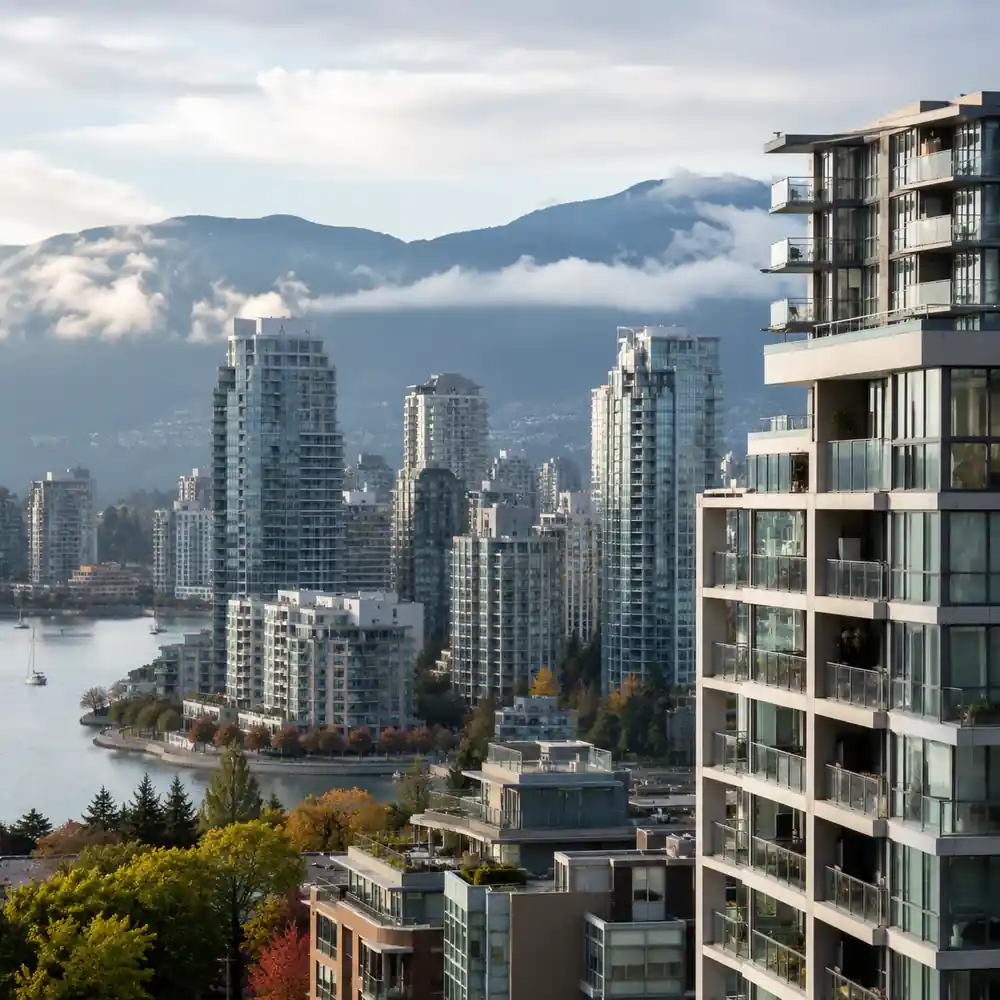

British Columbia renters are finally seeing some relief after years of punishing rent increases, with Vancouver now marking one of the clearest signs yet that Canada’s rental market has shifted.
The latest National Rent Report from Rentals.ca and Urbanation shows B.C. leading the country in annual apartment rent decreases, while Vancouver has now posted year-over-year asking rent declines for 30 consecutive months.
For renters searching for the latest rent in B.C., the headline number is striking: apartment rents in British Columbia are down 5.4% from a year earlier, the steepest provincial decline in Canada. That puts B.C. ahead of Ontario, where apartment rents fell 5%, and Alberta, where rents dropped 4.7%.
Latest Vancouver rent prices show clear cooling
Vancouver remains one of Canada’s most expensive rental markets, but the direction has changed. The average asking rent in Vancouver now sits at $2,712 per month, making it the second-priciest city among Canada’s major rental markets.
A one-bedroom rental in Vancouver now averages $2,385 per month, down 6.3% compared with May 2025. A two-bedroom rental averages $3,330 per month, down 0.8% year over year.
That decline does not make Vancouver cheap, but it does mark a meaningful change for tenants who had grown used to annual rent increases far above wage growth. For many households, even a modest reduction can affect monthly budgeting, especially when food, insurance, transit, utilities and other living costs remain elevated.
The city’s latest numbers also show why Vancouver’s rental market is still difficult for many renters despite the decline. A tenant paying the current average one-bedroom asking rent would still need a large share of monthly income just to cover housing, while families or roommates looking for a two-bedroom unit continue to face prices above $3,000.
North Vancouver remains Canada’s most expensive rental market
Vancouver was beaten only by North Vancouver, where the average rent now stands at $2,927 per month. That keeps North Vancouver at the top of Canada’s most expensive rental markets and shows how high the cost of renting remains across Metro Vancouver.
Other B.C. cities also remain near the top of the national list. Coquitlam, Burnaby, Langley and Victoria were all among the 20 most expensive places to rent in the country, underlining how the affordability challenge has spread beyond Vancouver’s city limits.
That wider Metro Vancouver pressure matters because many renters who leave Vancouver in search of cheaper housing often find that nearby cities are also expensive. A move to Burnaby, Coquitlam or North Vancouver may offer more space or a different commute, but it does not always deliver a major reduction in rent.
Victoria’s place among the country’s most expensive markets also shows that B.C.’s rental affordability problem is not limited to the Lower Mainland. Demand from students, workers, retirees and newcomers has kept pressure on rental housing across several parts of the province.
Canada’s rental market records 20th straight annual decline
The national rental market is also cooling. Canada has now recorded 20 consecutive months of year-over-year asking rent declines, according to the latest report.
The shift is being driven by several forces at once. A weaker economic backdrop, slower population growth and a record level of apartment completions are adding more balance to a market that had previously been stretched by intense demand and limited supply.
Population trends are especially important for housing demand, as Canada has already seen signs of slower growth after tighter immigration settings and fewer temporary residents, a shift explained in this report on Canada’s first population decline since the pandemic.
Urbanation president Shaun Hildebrand said the market is entering the peak summer rental season with softer conditions than usual, as lower population growth and new supply help keep rent increases subdued after years of outsized inflation.
For renters, that means the current market may offer more negotiating room than in recent years, especially compared with the tight rental conditions seen during the post-pandemic surge. However, prices remain historically high, and the relief is uneven depending on city, building type and neighbourhood.
Nova Scotia has now overtaken British Columbia as the most expensive province for purpose-built and condominium apartments, with average apartment rent of $2,343. Saskatchewan continues to stand out for long-term rent growth, with apartment rents up 26.2% over the past three years.
B.C. is also one of only two provinces where rents have declined over the past three years, a major reversal for a province that had long been viewed as one of Canada’s most overheated rental markets.
Lower rents do not solve Vancouver’s housing affordability problem
The latest rent decline gives tenants some breathing room, but it does not erase Vancouver’s deeper housing affordability problem. Ownership remains out of reach for many households, and the gap between local incomes and home prices continues to shape the rental market.
Recent housing affordability analysis from Desjardins has compared Vancouver and Toronto with global cities such as London, New York and Sydney, where homeownership has become much harder for middle-income households. The concern is that renting in Vancouver may no longer be a temporary stage before ownership for many families, but a long-term or permanent housing reality.
That matters because a cooling rental market does not automatically create a path into ownership. A renter may save a few hundred dollars compared with last year’s asking rent, but still face home prices and borrowing costs that make buying unrealistic.
The affordability gap is especially visible in Vancouver, where starter-home prices have remained far beyond many household budgets, reflecting the same long-term pressure outlined in this analysis of Canada’s starter home price surge.
At the same time, new apartment towers and rental completions are beginning to change the supply picture. More units can help soften asking rents, especially when demand slows. But construction costs, financing pressures and local affordability limits remain major challenges for builders and renters alike.
The latest numbers point to a rental market that is no longer moving in only one direction. B.C. rents are falling faster than anywhere else in Canada, Vancouver has reached a 30-month decline milestone, and renters are seeing more relief than they did during the sharpest phase of the affordability crunch.
Still, the province remains expensive by national standards. For Vancouver renters, the latest market shift is welcome, but it is not a return to cheap housing. It is a sign that one of Canada’s toughest rental markets has cooled — while staying costly enough to keep affordability at the centre of the city’s housing debate.

Make Swikblog your go-to source on Google for reliable updates, smart insights, and daily trends.