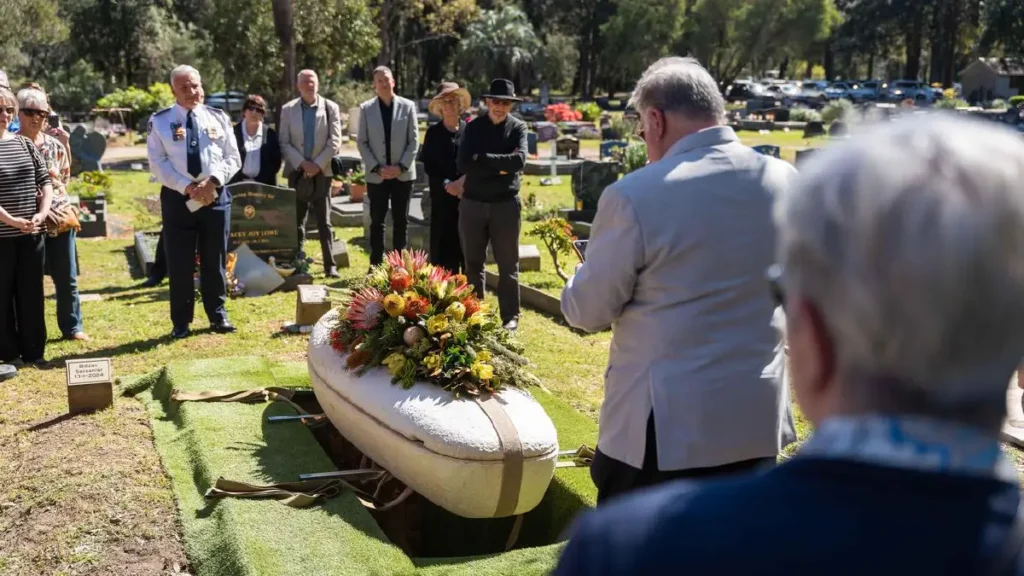

SYDNEY, Australia — A woman in her 70s has become the first person in Australia to be buried in a coffin grown from mushroom roots, marking a striking new step in the country’s shift toward greener funeral options.
Carolyn, whose surname has been withheld at her family’s request, was buried at Springwood Cemetery in the Blue Mountains on Friday, September 4, after a service in nearby Faulconbridge.
Her coffin was made from mycelium — the underground root-like network of fungi — combined with upcycled hemp fibres. It takes about seven days to grow and, under ideal burial conditions, can biodegrade into the surrounding soil in roughly 45 days.
The 45-day figure applies to the coffin itself, not to the complete decomposition of the human body.
Why Carolyn’s family chose a mushroom coffin
Carolyn’s husband, Donald, said the choice reflected the way she lived and her desire to help others.
Her family saw the biodegradable coffin as a way for her final farewell to give something back to nature. Carolyn was also laid on a bed of moss inside the coffin, creating a noticeably different appearance from a conventional casket.
Her longtime friend Christine described the farewell as almost whimsical and said it felt as though Carolyn was already becoming part of the earth.
How a mushroom coffin is grown
The coffin, known as the Loop Living Cocoon, was developed by Dutch company Loop Biotech.
Mycelium is mixed with hemp fibres from agricultural waste and arranged around a coffin-shaped mould inside a climate-controlled environment. Over about seven days, the fungal network grows through the fibres and binds the structure together.
The finished adult coffin weighs about 30kg.
According to Loop Biotech, its mycelium funeral products are designed to return naturally to the environment rather than remain underground for decades.
Founder Bob Hendrikx began developing the idea while studying at Delft University of Technology in the Netherlands. The technology has since been used by families in Europe and the United States.
What happens after burial?
Once underground, moisture, microbes and soil conditions begin breaking down the natural coffin material.
Loop says the structure can become part of the soil in around 45 days under ideal conditions. Real-world decomposition can vary depending on temperature, moisture and the cemetery environment.
That makes the coffin fundamentally different from many conventional caskets made with processed timber, metals, synthetic fabrics and coatings that can take far longer to deteriorate.
Importantly, the coffin does not force the body to decompose within the same timeframe. Human decomposition depends on many separate factors, including burial depth, soil conditions, preparation of the body and temperature.
Why Australia’s first matters
Carolyn’s burial comes as Australian families show increasing interest in lower-impact funeral choices.
About seven in 10 Australians are cremated, while recent environmental analysis cited in Australian reporting has estimated a typical gas cremation at roughly 125kg of carbon dioxide equivalent.
Natural burial can have a much smaller footprint depending on the materials and process used. Interest in sustainability is also visible in wider environmental issues across Australia, including the protection of southern right whales and their calves along the NSW coast.
Merrylands Shooting: Man Dead in Suspected Case of Mistaken Identity
Matt Dee Bondi Rescue Cause of Death: Tributes and What We Know
Mushroom burial is not human composting
The growing number of green funeral options can be confusing because they use very different processes.
A mushroom coffin is still used in a conventional burial. The difference is that the casket itself is biodegradable.
Human composting, also known as natural organic reduction, places a body inside a controlled vessel with organic material such as wood chips and straw so that microbial activity transforms the remains into soil-like material.
New South Wales is separately considering legislation that would allow natural organic reduction, but that process is not what happened in Carolyn’s case.
Another alternative is alkaline hydrolysis, sometimes called aquamation or water cremation, which uses water and an alkaline solution instead of flame.
Could mushroom coffins become common in Australia?
The technology is now moving beyond an overseas novelty. Australian memorial company Arrow Bronze announced a partnership with Loop Biotech in August 2026 to distribute mycelium funeral products in Australia and New Zealand.
Whether the coffins become mainstream will depend on price, cemetery rules, funeral-home availability, cultural traditions and personal preference.
Environmental concern is also being reflected in other Australian wildlife stories, including investigations into dead penguins and other seabirds washing up on Australian beaches.
For Carolyn’s family, however, the significance was simpler. Australia’s first mushroom-coffin burial allowed them to choose a farewell they believed matched her values — using a casket grown in days and designed to return naturally to the earth soon after burial.

Make Swikblog your go-to source on Google for reliable updates, smart insights, and daily trends.