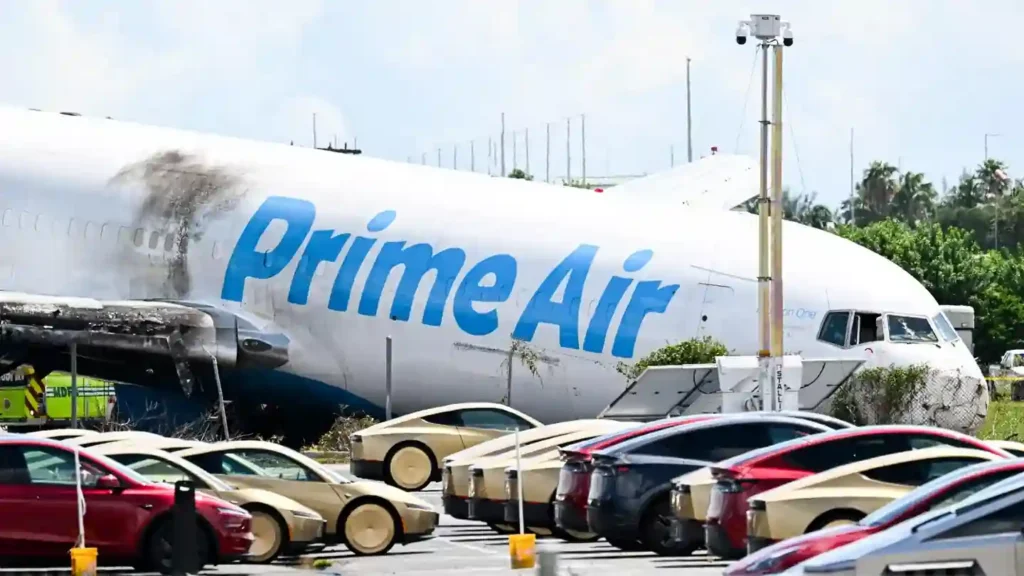

MIAMI — Investigators have recovered both black boxes from the Amazon-branded Boeing 767 that overran a runway at Miami International Airport, struck airport equipment and vehicles, and left five people dead. The recorders could now provide the clearest evidence yet of what happened during the cargo jet’s final approach, touchdown and runway overrun.
The September 6 crash involved Flight 7598, operated by 21 Air for Amazon’s cargo network. The aircraft was returning from San Juan, Puerto Rico, when it failed to stop on Runway 30. Five other people were injured, including three reported in critical condition.
Flight recorders recovered from 'devastating' Amazon cargo plane crash https://t.co/o6V5ANeDG1
— BBC News (World) (@BBCWorld) September 7, 2026
Amazon cargo jet went 1,300 feet beyond runway
NTSB Chair Jennifer Homendy said the Boeing 767 traveled about 1,300 feet beyond the paved end of Runway 30.
The aircraft struck navigational aids and other airport equipment before hitting a white Ford Econoline van used by an aircraft-cleaning company. Seven people were inside the van.
The jet then broke through the airport perimeter fence and struck a Toyota SUV outside the airport. Investigators documented tire marks, damaged fencing and debris scattered along the aircraft’s path.
Five people on the ground were killed and five others were injured. The two crew members aboard the Boeing survived. Authorities had not identified all of the victims when investigators provided their initial detailed briefing.
Amazon Plane Crash: NTSB Finds Black Boxes And Says Jet Struck Cleaning Crew Vanhttps://t.co/jX1UskHlb0 pic.twitter.com/btMTdh6uGl
— Forbes (@Forbes) September 8, 2026
Black boxes could answer the biggest questions
The National Transportation Safety Board recovered the aircraft’s flight data recorder and cockpit voice recorder.
The flight recorder can show investigators crucial parameters including speed, engine settings, aircraft configuration and braking information. The cockpit recorder can provide additional context about communications and decisions during the approach and landing.
The National Transportation Safety Board is examining the wreckage, runway evidence, weather, aircraft systems, air traffic control information and human-performance factors.
No probable cause has been announced.
Speed and touchdown point under scrutiny
One of the most important questions is exactly where the Boeing touched down and how much runway remained to bring the aircraft to a stop.
Public flight-tracking data has prompted questions about the aircraft’s speed near the runway’s end, but investigators are expected to rely on the flight data recorder for verified figures.
The NTSB will also examine whether circumstances during the approach could have warranted a go-around, when pilots abandon a landing and climb away for another attempt.
That does not mean investigators have identified pilot error. Braking performance, aircraft systems, runway conditions, weather and crew decisions all remain areas of examination.
Weather and Miami runway safety also examined
Storms and strong winds were reported around Miami near the time of the accident. Investigators will compare those conditions with aircraft and airport data, but there is currently no official finding that weather caused the crash.
Runway 30 also did not have an Engineered Materials Arresting System (EMAS), a crushable surface installed beyond some runways to help stop aircraft during overruns.
The absence of EMAS may be examined as part of the airport-safety investigation, but it does not establish why Flight 7598 overran the runway or mean the airport violated applicable requirements.
Boeing 767 was on its third flight of the day
The aircraft had flown from Cincinnati to Miami and Miami to San Juan before beginning the return trip to Miami.
The Boeing 767-300 was approximately 32 years old and was originally built for passenger service before being converted into a freighter. Aircraft age alone does not indicate a safety problem; investigators will examine maintenance records and relevant systems for evidence of any mechanical issue.
Why the plane carried Amazon branding
Although the aircraft displayed Amazon branding, Flight 7598 was operated by cargo airline 21 Air. Amazon uses contracted airlines as part of its air-freight network.
Readers following the incident from its first hours can review the initial Amazon cargo plane crash report from Miami International Airport for details of the first emergency response.
Crash disrupted Miami International Airport
Roughly 200 emergency personnel responded as firefighters dealt with flames, smoke, damaged vehicles and leaking aviation fuel. Airport operations were initially halted, while runway restrictions contributed to flight cancellations, delays and diversions.
The disruption illustrates the wider impact a serious runway accident can have at a major international hub. A separate recent incident involving a DHL cargo plane fire during landing at Los Angeles International Airport also required an emergency airport response, although there is no connection between the causes of the two events.
Investigation now turns to the final seconds
Investigators will combine black-box data with runway marks, wreckage, radar information, weather records, air traffic control communications and crew interviews to reconstruct the landing.
The critical questions are how fast Flight 7598 was traveling, where it touched down, how its braking systems performed and why it continued beyond the runway.
Until those records are analyzed, claims blaming the pilots, weather, aircraft age or a mechanical failure remain unconfirmed. The recovered black boxes are now expected to provide the strongest evidence about how an ordinary cargo arrival became a deadly runway overrun.

Make Swikblog your go-to source on Google for reliable updates, smart insights, and daily trends.