
NYT Connections #1229 for Thursday, October 22, 2026, brings a fresh challenge with four hidden word groups involving everyday objects, sculptures, American football positions and clever bedding-related wordplay.
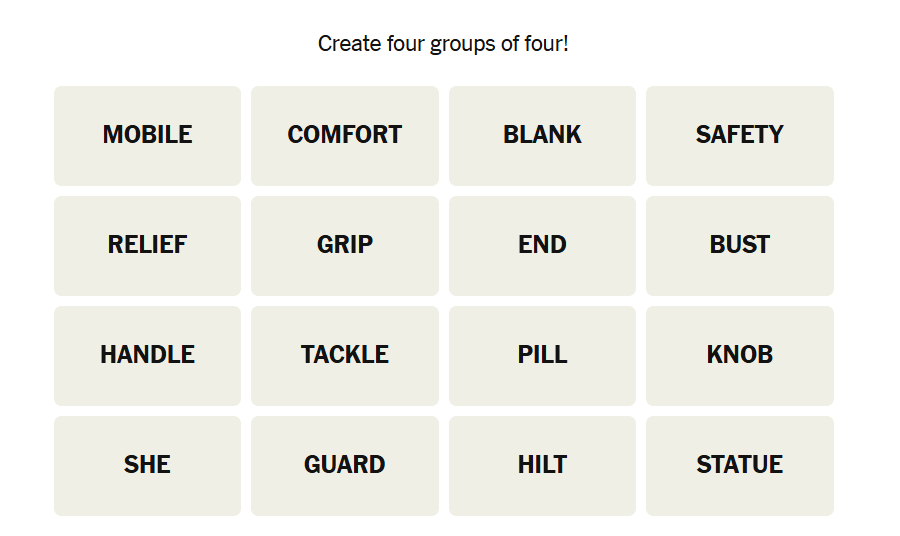
NYT Connections hints for October 22
- Yellow: Think about parts of everyday objects designed to be held, turned or grasped. These components appear on tools, doors, equipment and other familiar items. Their common purpose is to provide a convenient place for someone to take hold of an object.
- Green: Look for different forms of three-dimensional artwork. Some represent human figures, others extend from flat surfaces, and some incorporate movement. These artistic forms are commonly associated with museums, galleries, monuments and public displays.
- Blue: Focus on American football terminology. The four answers identify positions occupied by players on the field. Some are associated with blocking and protecting the quarterback, while others involve defending against passes or stopping opposing players.
- Purple: Think about ordinary words that become familiar bedroom items when additional letters are added. Each answer provides the beginning of a longer word associated with sleeping. The key is recognizing the spelling pattern rather than interpreting the original words literally.
Main trap: Today’s Connections puzzle #1229 uses familiar words with several possible meanings. GRIP and TACKLE could suggest physical actions, while GUARD and SAFETY might appear connected through protection. MOBILE may suggest a telephone, and RELIEF could describe the easing of discomfort rather than an artistic technique. The purple category creates another complication because BLANK, COMFORT, PILL and SHE appear unrelated when read as complete words. Players must recognize their hidden relationship to bedding rather than relying on their ordinary definitions.
Blue clue: GUARD and TACKLE are useful starting points for players familiar with American football. A guard plays on the offensive line, while tackle can describe either an offensive or defensive line position. END also appears in offensive and defensive position names, including tight end and defensive end. SAFETY is a defensive backfield position responsible for helping defend against passing and running plays. The important connection is that all four words identify football positions, even though several have different meanings in everyday language.
Purple clue: BLANK and COMFORT provide useful starting points because they become BLANKET and COMFORTER when additional letters are added. PILL follows the same pattern by becoming PILLOW, while SHE becomes SHEET. All four completed words describe familiar bedding items. Recognizing that the answers are beginnings of longer words, rather than complete descriptions of bedding, reveals the intended relationship.
Today’s NYT Connections answers
Reveal the Yellow Group
Category: Parts to be grasped
Answers: GRIP, HANDLE, HILT, KNOB
Each answer describes a part of an object intended to be held, grasped or manipulated. Although these components appear on different types of objects, they share a practical connection to how people physically handle things.
GRIP refers to a section or surface designed to provide a secure hold on an object.
Grips are commonly found on tools, bicycles, sporting equipment and other objects requiring controlled handling.
They may feature textured surfaces, rubber coverings or specially shaped designs intended to improve control.
The word GRIP can also describe the act of holding something firmly, creating a possible distraction for players who initially interpret it as a verb.
HANDLE is a part of an object designed to be held when lifting, carrying, pulling, pushing or operating it.
Handles appear on doors, bags, cookware, tools and numerous household items.
Their designs vary depending on the intended function, but they generally provide a convenient point of contact.
HANDLE can also mean managing a situation or dealing with a problem, which may encourage players to search for figurative connections.
HILT is the part of a sword, dagger or similar bladed weapon used to hold and control it.
A hilt typically includes the grip and may incorporate a guard or other fittings.
Its design helps the user maintain control of the weapon.
Unlike HANDLE or KNOB, HILT is associated with a particular category of objects, making it potentially less familiar to some players.
The expression “to the hilt” may also distract players from the word’s physical meaning.
KNOB is a rounded or projecting component that can be grasped, turned or pulled.
Knobs commonly appear on doors, cabinets, drawers and mechanical controls.
They often allow users to open something or adjust a mechanism through a turning movement.
GRIP and HANDLE are useful starting points because both clearly relate to holding objects.
HILT strengthens the connection because it identifies the part of a bladed weapon used for gripping.
KNOB completes the category because it also provides a point of contact for grasping or manipulating something.
However, the four components do not necessarily share the same appearance.
A GRIP may be textured or wrapped around another structure.
A HANDLE can be curved, straight or integrated into a larger object.
A HILT belongs to a sword or similar weapon, while a KNOB is generally rounded.
Their shared relationship therefore concerns function rather than shape.
Players might initially connect GRIP with TACKLE because both words can describe physical actions.
HILT and GUARD may also suggest weapons or protective equipment.
HANDLE could appear related to controlling a situation rather than holding an object.
KNOB might suggest household fixtures or mechanical components.
These alternative interpretations make the category less obvious when players focus on individual meanings.
The intended connection becomes clearer when the words are considered as physical parts designed to be held.
GRIP provides a secure holding surface, while HANDLE allows an object to be carried or operated.
HILT supplies the holding section of a bladed weapon, and KNOB provides a projecting part that can be grasped.
Unlike the green category, which concerns sculpture, the yellow group focuses on functional components.
The central connection is straightforward: GRIP, HANDLE, HILT and KNOB are all parts of objects designed to be grasped.
Reveal the Green Group
Category: Kinds of sculptures
Answers: BUST, MOBILE, RELIEF, STATUE
Each answer refers to a recognized form of sculpture. The four terms describe different approaches to creating three-dimensional artwork, ranging from representations of people to compositions involving movement or raised surfaces.
BUST is a sculptural representation of a person’s head and upper body, usually including the shoulders and chest.
Busts are frequently created to portray historical figures, political leaders, artists and other notable individuals.
They may be produced from marble, bronze, plaster or other sculptural materials.
Unlike a full-length statue, a bust concentrates attention on the subject’s face and upper torso.
The word BUST also has unrelated meanings, including breaking something or describing a failure.
Those meanings may distract players from its artistic definition.
MOBILE is a type of sculpture containing components designed to move.
Mobiles often feature suspended shapes balanced on rods or supporting structures.
Their movement may be produced by air currents or mechanical forces.
American artist Alexander Calder is especially associated with the development and popularization of modern sculptural mobiles.
Movement distinguishes this artistic form from many traditional stationary sculptures.
The word MOBILE can also describe a telephone or something capable of moving.
These familiar meanings make it one of the more deceptive answers in today’s green category.
RELIEF is a sculptural technique in which forms project from a background surface.
Relief sculptures appear on monuments, architectural structures, decorative panels and historical artworks.
In low relief, the forms project only slightly from the background.
High relief involves more pronounced projection, sometimes approaching the appearance of freestanding sculpture.
Unlike a statue that can be viewed from all sides, a relief remains connected to its supporting surface.
The word RELIEF can also describe the easing of pain, stress or difficulty.
That everyday meaning creates another possible interpretation.
STATUE is a sculptural representation commonly depicting a person, animal or other recognizable subject.
Statues can be created from stone, metal, wood and numerous other materials.
They are displayed in museums, public squares, gardens, memorials and religious settings.
Some commemorate historical figures or events, while others serve artistic or decorative purposes.
STATUE is likely the easiest starting point because its relationship to sculpture is widely understood.
BUST provides another recognizable example, particularly for players familiar with portrait sculpture.
MOBILE and RELIEF require more specific knowledge of artistic terminology.
However, the four forms differ considerably in appearance and construction.
A BUST concentrates on a person’s head and upper body.
A MOBILE incorporates movement as part of its artistic presentation.
A RELIEF projects from a supporting surface.
A STATUE is commonly a freestanding representation of a figure.
These differences can make the category difficult because the artworks do not share one specific subject or visual style.
BUST might suggest failure or damage.
MOBILE could suggest technology or transportation.
RELIEF might encourage players to think about emotions or physical comfort.
STATUE clearly points toward sculpture, but the other answers require more careful interpretation.
The intended relationship becomes clearer when players recognize all four as established artistic forms.
The category does not depend on a particular material, artistic movement or historical period.
Instead, it brings together different methods of producing sculptural artwork.
The central connection is straightforward: BUST, MOBILE, RELIEF and STATUE are all kinds of sculptures.
Reveal the Blue Group
Category: American football positions
Answers: END, GUARD, SAFETY, TACKLE
Each answer names a position used in American football. The challenge is recognizing their sporting meanings rather than interpreting them according to their everyday definitions.
END refers to a position located toward the outside of a football formation.
On offense, a tight end may line up near the offensive line and contribute as both a blocker and a pass-catching option.
Defensive ends traditionally operate toward the edges of the defensive line.
They may be responsible for pressuring the quarterback, containing outside runs and disrupting offensive plays.
The word END ordinarily refers to the conclusion or final part of something.
That familiar meaning makes its football connection less immediately obvious.
GUARD is an offensive line position located between the center and a tackle.
Guards help protect the quarterback during passing plays and create running lanes for ball carriers.
The position requires strength, coordination and an understanding of blocking assignments.
Outside football, GUARD commonly means protecting someone or something.
It can also refer to a person responsible for security.
That ordinary meaning may encourage players to connect GUARD with SAFETY through the idea of protection.
SAFETY is a defensive backfield position responsible for helping defend against passing plays and supporting the defense against running attacks.
Safeties frequently operate behind other defenders and must react quickly to developments across the field.
Depending on the defensive scheme, a safety may cover receivers, assist with tackling or move closer to the line of scrimmage.
The word SAFETY usually refers to protection from danger.
In American football, it can also describe a scoring play worth two points.
However, the intended meaning in this category is the defensive player position.
TACKLE is another established football position.
Offensive tackles line up outside the guards and are responsible for protecting the quarterback and blocking during running plays.
Defensive tackles generally operate along the interior defensive line.
They attempt to disrupt blocking schemes, pressure opposing players and stop running plays.
The word TACKLE also describes bringing an opposing ball carrier to the ground.
This dual sporting meaning makes it deceptive because players may initially think of an action rather than a position.
GUARD and TACKLE are useful starting points because both are recognized offensive line positions.
END strengthens the grouping through its use in offensive and defensive formations.
SAFETY completes the category as a defensive backfield position.
However, the four answers do not belong exclusively to one unit of a football team.
GUARD is an offensive position, while SAFETY is a defensive position.
END and TACKLE can refer to positions on either side of the ball when used with additional terminology.
This distinction matters because the category is not limited to offensive or defensive players.
The shared relationship concerns established position names used throughout American football.
Players unfamiliar with the sport might search for connections involving protection, physical contact or directions.
GUARD and SAFETY both suggest protection.
TACKLE could suggest stopping someone physically.
END might appear unrelated because its ordinary meaning concerns the conclusion of something.
These alternative interpretations create distractions when the words are considered separately.
The intended relationship becomes clearer when all four are recognized as football terminology.
GUARD and TACKLE are associated with line play, while END can identify players on the outside of formations.
SAFETY refers to a defensive player operating farther back in the formation.
The central connection is straightforward: END, GUARD, SAFETY and TACKLE are all American football positions.
Reveal the Purple Group
Category: Starts of bedding
Answers: BLANK, COMFORT, PILL, SHE
Each answer forms the beginning of a longer word describing an item commonly associated with bedding.
Unlike the other categories, the purple group does not depend on complete words sharing a common definition.
Instead, players must recognize that adding letters transforms four apparently unrelated words into familiar bedroom items.
BLANK is the beginning of BLANKET.
A blanket is a covering commonly used on a bed to provide warmth during sleep.
Blankets are made from numerous materials, including cotton, wool, fleece and synthetic fabrics.
They may be used independently or layered with sheets and other bedding.
However, the word BLANK ordinarily means empty, unmarked or lacking information.
That familiar definition does not immediately suggest a connection to sleeping.
Adding the letters ET transforms BLANK into BLANKET.
The completed word identifies a familiar bed covering and reveals the first part of the intended pattern.
COMFORT is the beginning of COMFORTER.
A comforter is a thick, filled bed covering designed to provide warmth.
Comforters commonly feature fabric shells containing down, feathers or synthetic filling.
They are frequently used as an upper layer of bedding.
The word COMFORT ordinarily describes physical ease, reassurance or a feeling of well-being.
Although that meaning may be associated with sleeping, it does not independently identify a bedding item.
Adding ER creates COMFORTER, completing the second example of the word pattern.
PILL is the beginning of PILLOW.
A pillow is a cushioned support commonly placed beneath the head or neck during sleep.
Pillows may contain memory foam, down, feathers, polyester fibers or other materials.
They vary in firmness, shape and construction according to their intended use.
On its own, PILL usually refers to a small solid form of medication.
This makes the answer particularly deceptive because its familiar meaning appears unrelated to bedroom furnishings.
Adding OW transforms PILL into PILLOW.
The completed word identifies another common bedding item.
SHE is the beginning of SHEET.
A sheet is a piece of fabric used as part of a bed covering arrangement.
Fitted sheets cover mattresses, while flat sheets may be placed between a sleeper and an upper blanket or comforter.
Sheets are commonly made from cotton, linen, polyester and other textile materials.
The word SHE ordinarily functions as a pronoun referring to a female person or animal.
Nothing about that independent meaning directly suggests bedding.
Adding ET transforms SHE into SHEET.
This completes the four-word pattern and establishes the intended category.
BLANK and COMFORT provide useful starting points because their extended forms, BLANKET and COMFORTER, are closely related bedding items.
However, their original meanings may lead players toward unrelated categories.
BLANK might suggest emptiness, missing information or an unmarked surface.
COMFORT could suggest emotions, reassurance or physical well-being.
PILL may encourage players to search for medication-related terminology.
SHE might suggest pronouns or grammatical categories.
These different meanings make the purple group especially difficult because the four answers appear unrelated when interpreted literally.
Unlike the yellow category, which identifies physical components designed to be held, the purple group uses incomplete bedding-related words.
The green category relies on recognizing established sculpture terms.
The blue category requires familiarity with American football positions.
The purple category instead depends on spelling and word formation.
Players must examine how each answer functions as the opening sequence of a longer word.
BLANK becomes BLANKET, COMFORT becomes COMFORTER, PILL becomes PILLOW, and SHE becomes SHEET.
All four completed words refer to familiar items associated with beds and sleeping.
The connection therefore does not depend on the original words being synonyms.
BLANK, COMFORT, PILL and SHE each retain their own independent meanings.
Their relationship emerges only when additional letters are supplied.
This distinction explains why the category can remain difficult even after players solve the other three groups.
Recognizing BLANK as the beginning of BLANKET provides one useful way into the pattern.
COMFORT strengthens the relationship because COMFORTER is another familiar bed covering.
PILL and SHE complete the group through PILLOW and SHEET.
The four extended words are not identical types of bedding, but they all belong to the same broad household category.
BLANKET and COMFORTER provide coverings, PILLOW provides support, and SHEET is commonly used to cover a mattress or separate layers of bedding.
The intended relationship is therefore based on their shared association with bedding rather than their precise functions.
The central connection is straightforward: BLANK, COMFORT, PILL and SHE are the beginnings of BLANKET, COMFORTER, PILLOW and SHEET, respectively.
Players can attempt the official daily puzzle and check their results on the New York Times Connections page.

Make Swikblog your go-to source on Google for reliable updates, smart insights, and daily trends.