
Updated July 21, 2026: Microsoft will deploy AMD’s Helios rack-scale artificial intelligence systems in Azure, adding another source of high-end computing capacity for AI inference, search and autonomous-agent workloads. AMD confirmed that shipments to Microsoft and other customers are scheduled to begin in the second half of 2026.
The July 20 agreement puts AMD in more direct competition with Nvidia’s integrated AI systems. It also expands a long-standing partnership that already includes AMD processors in Azure servers, Surface devices and Xbox consoles, along with Instinct MI300X accelerators used in Microsoft’s cloud infrastructure.
What is AMD Helios?
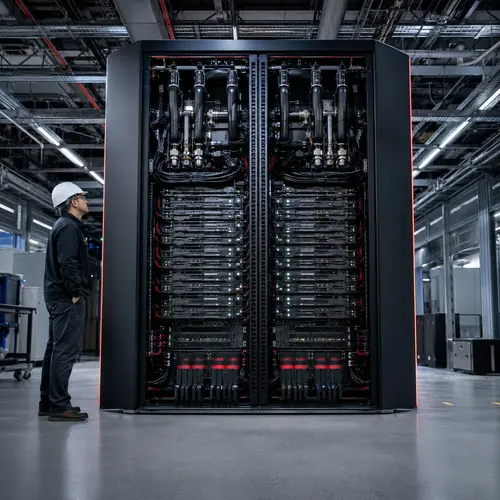
Helios is AMD’s first complete rack-scale AI reference design. Instead of selling only a GPU or CPU, AMD has created a blueprint that combines processors, networking, cooling and software in one coordinated platform.
Helios is not a single off-the-shelf product sold directly by AMD. Cloud providers and equipment manufacturers can use the design to build customised systems for their data centres.
A full Helios rack includes 72 AMD Instinct MI455X accelerators, sixth-generation EPYC processors code-named Venice, Pensando networking hardware and AMD’s ROCm software platform. It supports both AI training and inference, the process used by a trained model to generate text, images, code or predictions.
Confirmed AMD Helios specifications
According to the official AMD Helios specifications, the platform is built around the next-generation CDNA 5 accelerator architecture.
- Accelerators: 72 Instinct MI455X GPUs
- GPU memory: Up to 432GB of HBM4 per accelerator
- Total rack memory: Up to 31TB of HBM4
- Memory bandwidth: Up to 19.6TB per second for each GPU
- FP4 performance: Up to 2.9 exaFLOPS per rack
- FP8 performance: Up to 1.4 exaFLOPS per rack
- Scale-up bandwidth: 260TB per second
- Networking: Pensando Vulcano 800Gbps AI network adapters
- Cooling: High-density liquid-cooled design
These are AMD’s peak specifications, not independently measured performance results. Actual output will depend on the model, software, network configuration, power limits and number of connected racks.
How Microsoft will use Helios in Azure
Microsoft is developing ND MI455X v7 virtual machines based on Helios. The new instances will support production-scale inference for frontier models, Azure AI services and customer applications.
The company says the machines are intended for reasoning, search and agentic AI. Agentic systems can perform a sequence of actions, call software tools and coordinate tasks instead of producing only a single response.
Microsoft has not disclosed the number of racks it will install, their data-centre locations, the value of the contract or a date when customers can begin using ND MI455X v7 instances. Regional availability and Azure pricing therefore remain unknown.
New AMD-powered Azure virtual machines
The expanded partnership includes two additional Azure machine families powered by sixth-generation EPYC processors.
Azure HDv2 is designed for data preparation, search, reinforcement learning and the coordination of AI agents. Microsoft says each virtual machine will provide nearly 500 physical CPU cores, 4TB of RAM, 32TB of local NVMe storage and 400Gb Azure Boost networking.
Azure HXv2 will target semiconductor design, engineering analysis and scientific simulations. It will include 176 EPYC cores operating above 5GHz, almost 2TB or 4TB of memory and 800Gb InfiniBand connectivity.
No customer release date or price has been announced for HDv2 or HXv2.
When will AMD Helios launch?
AMD says initial Helios shipments remain on schedule for the second half of 2026. The first deliveries are expected to support large customers and system partners, while wider production and cloud availability may follow on separate schedules.
This distinction matters because the start of hardware shipments does not mean Azure customers will immediately be able to rent Helios-powered virtual machines. Microsoft must install, test and integrate the systems before making them commercially available.
Who has committed to AMD Helios?
Microsoft joins several organisations working with AMD on Helios-based infrastructure.
Meta has signed a multi-year agreement covering up to six gigawatts of AMD Instinct GPU capacity. Shipments for its first one-gigawatt deployment are expected to begin in the second half of 2026 using a customised MI450-based accelerator, Venice CPUs and ROCm.
OpenAI has a separate agreement covering up to six gigawatts across multiple AMD GPU generations. Its initial one-gigawatt MI450 deployment is scheduled to start during the same period.
Hewlett Packard Enterprise plans to offer systems based on Helios, using HPE Juniper Networking technology. Tata Consultancy Services is working with AMD to develop Helios-based AI infrastructure and services in India.
The gigawatt figures describe the maximum capacity planned over several years. They should not be interpreted as systems that are already installed or operating.
AMD Helios versus Nvidia Vera Rubin
Helios is designed to compete with Nvidia at the complete-system level. Both companies are integrating GPUs, CPUs, memory, networking, cooling and software into rack-scale platforms for large AI clusters.
AMD’s main architectural difference is its emphasis on open standards. Helios follows Meta’s double-wide Open Rack Wide format and uses Open Compute Project specifications, Ethernet networking and UALink-based connectivity.
Nvidia’s Vera Rubin platform uses Nvidia GPUs, Vera CPUs, NVLink connectivity, networking equipment and CUDA software. Nvidia’s tightly integrated ecosystem can simplify deployment for organisations already running CUDA applications, while AMD argues that open hardware and networking can provide more supplier choice.
There is not yet enough independently verified production data for a reliable Helios-versus-Vera-Rubin performance or cost comparison. Both platforms can be customised, and neither company has published a universal rack price. Reported multimillion-dollar estimates should not be treated as official pricing.
Power, cooling and installation requirements
Helios is a double-wide, liquid-cooled rack intended for hyperscale facilities. A data centre may require reinforced floors, compatible cooling loops, high-capacity electrical connections and suitable network infrastructure before installation.
AMD has not published one fixed power figure for every Helios configuration. Electricity and water requirements will depend on the system built by each manufacturer and how heavily it is operated.
These infrastructure demands are becoming a policy issue as governments assess grid and water capacity, including proposals examined in this report on Australia’s data-centre energy rules.
Read More:
- Australia’s new data centre energy rules: Could they slow the country’s AI boom?
- Kimi K3 vs Claude Opus 4.8: Features, performance and pricing compared
- Visit the Swikblog homepage for more latest news
ROCm software is the key test for AMD
Helios runs AMD’s open-source ROCm platform, which supports widely used tools including PyTorch, TensorFlow, JAX, Hugging Face, vLLM and DeepSpeed.
Nvidia continues to benefit from CUDA, its mature and widely adopted development platform. Organisations moving established workloads to AMD hardware may need to test code, libraries and model performance before deployment.
Microsoft’s adoption gives AMD an important production-scale opportunity, but the final measure will be practical performance. Delivery timing, reliability, energy use, ROCm compatibility and cost per AI output will determine whether Helios becomes a strong alternative to Nvidia infrastructure.

Make Swikblog your go-to source on Google for reliable updates, smart insights, and daily trends.