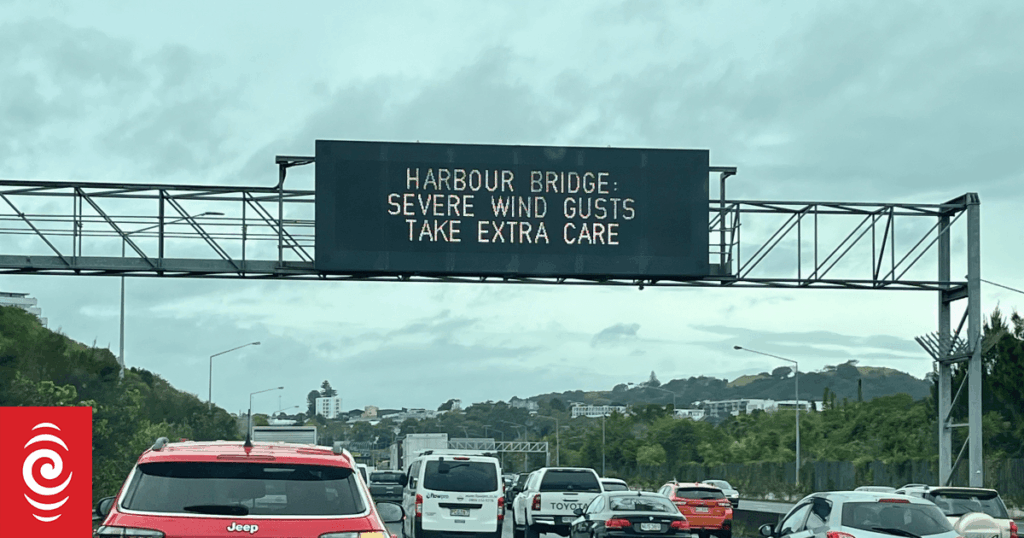

Auckland drivers were hit with a familiar kind of summer frustration on Saturday: a bridge that usually feels like the city’s fast lane suddenly becoming the bottleneck. High winds sweeping across the Waitematā forced repeated closures on the Auckland Harbour Bridge, triggering long queues on both sides and turning routine trips into slow-motion crawls.
Live update
What’s happening: Traffic has been repeatedly stopped on the Harbour Bridge due to strong gusts, with lane restrictions and reduced speeds also used to manage risk.
How bad is it: Motorway approaches have backed up for kilometres, with congestion stretching well beyond the bridge ramps.
When it may improve: Forecasts have suggested gusts may stay stubborn through the afternoon, with conditions expected to ease later.
The Harbour Bridge is uniquely exposed, and that matters. When gusts build over open water, high-sided vehicles can be pushed sideways in a way that’s hard to predict. That’s why closures can happen suddenly, sometimes lasting only minutes at a time, and why the bridge can look “open” one moment and effectively locked down the next as controllers respond to changing wind strength.
On Saturday afternoon, traffic was briefly stopped more than once, with one shutdown lasting nine minutes around lunchtime and another lasting roughly a quarter of an hour later in the afternoon. Even short closures can cause outsized disruption because the bridge is a choke point: once the flow breaks, the queue grows quickly, and the recovery is slow as vehicles funnel back into narrowed lanes under reduced speed limits.
Drivers heading south from the North Shore reported long tailbacks that stretched deep into the motorway network, while northbound traffic also jammed up from central-city approaches. If your map app is showing solid red lines that seem to “stick” in place, it’s because the delay isn’t just the bridge deck — it’s the ripple effect through feeder ramps, merging points, and traffic lights on surface streets as people try to detour at the same time.
Why the bridge keeps closing: When winds reach a point where sudden gusts can destabilise vehicles, operators may temporarily stop traffic, reduce speeds, and adjust lane configurations. You may see electronic message boards warning of restrictions, and those instructions can change quickly as conditions shift. In wind events, “drive to the conditions” isn’t a slogan — it’s the difference between a manageable slowdown and a chain-reaction crash.
What motorists can do right now: If you’re not already committed to the bridge approaches, the best move is often the simplest: delay travel. Even 30–60 minutes can make a meaningful difference when a queue is building. If you must cross, keep extra space in front, avoid hard braking on the bridge deck, and be especially careful if you’re driving a van, ute with a canopy, or towing anything that catches the wind.
Detour options: For some trips, the Western Ring Route can be the calmer choice, but it can also fill fast when everyone makes the same decision. If you’re heading between the Shore and the west or northwest, consider whether SH18 via Upper Harbour can reduce time stuck on the bridge approaches. Public transport may also be worth a look during wind closures — buses can be impacted too, but they may still be faster than crawling in a single-occupant car.
Watch for the safety tells: A reduced speed limit is often a sign that gusts are strong enough to cause sudden movement in vehicles, especially on exposed sections. If lanes are restricted or the moveable barrier is being managed, expect stop-start traffic and avoid last-second lane changes. The most dangerous moments in wind disruption aren’t always the gusts — they’re the impatience that follows them.
If you want a reliable place to check official guidance as conditions change, NZTA Waka Kotahi publishes travel bulletins and warnings for Auckland’s key routes, including the Harbour Bridge, and it’s often the quickest way to confirm whether restrictions are escalating or easing. You can read the latest updates directly via NZTA’s Harbour Bridge wind travel bulletin.
For readers tracking the broader pattern of disruptive weather and how it affects travel, we’re also following major wind-and-storm impacts across regions on Swikblog, with quick explainers designed for commuters who just need the essentials without the noise.
The key takeaway for Saturday is straightforward: when winds build over the harbour, closures can come in bursts — and each burst can reset the queue. If you can shift your trip, do it. If you can’t, treat the bridge like a high-risk zone: slower, steadier, and with more space than you think you need.

Make Swikblog your go-to source on Google for reliable updates, smart insights, and daily trends.