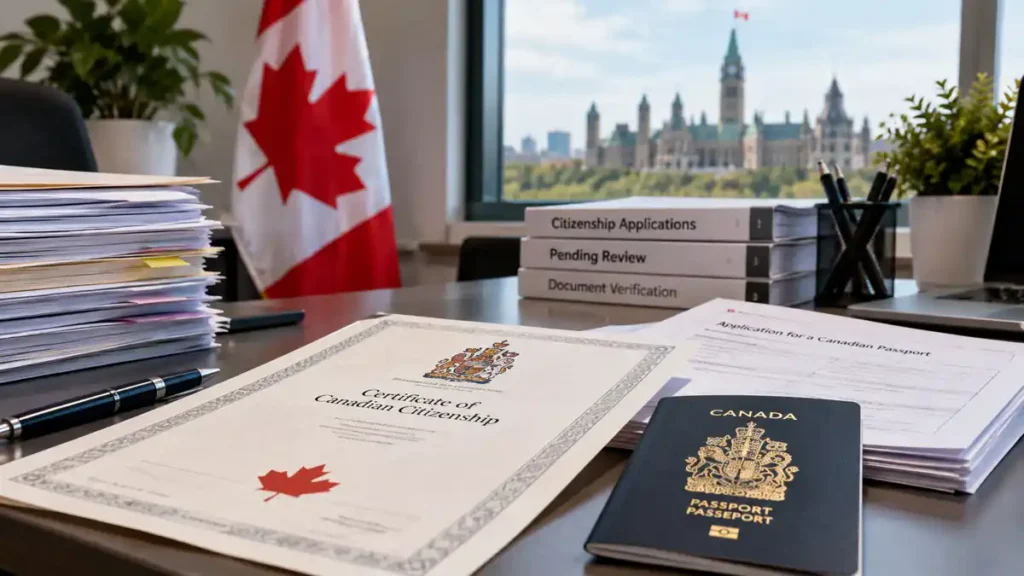

Canada’s proof of citizenship processing time has reached 33 months in September 2026, while the number of people waiting for a decision has grown to about 136,000. The latest estimate is eight months longer than August’s 25-month wait, putting new applicants close to a three-year timeline.
The change mainly affects people seeking a citizenship certificate to officially prove Canadian status, including many citizenship-by-descent applicants. A proof-of-citizenship application is different from the regular process of applying to become a Canadian citizen.
Processing Time Climbs From 12 to 33 Months
The increase has accelerated since spring. Processing time was 12 months in May, 15 months in June, 19 months in July and 25 months in August before reaching 33 months in September.
For comparison, the estimate was nine months in December 2025. September’s eight-month increase represents a 32% jump from August, considerably larger than the monthly increases recorded earlier in the year.
Citizenship Certificate Queue Reaches 136,000
The application inventory has expanded just as quickly. About 40,400 people were waiting for decisions in December 2025, compared with 70,400 in May, 99,500 in July, 121,800 in August and 136,000 in September.
That means another 14,200 people were added to the queue between the August and September readings alone. Demand had already accelerated after proof-of-citizenship applications increased sharply following Canada’s new citizenship rules.
Why Applications Have Increased
A major factor is the citizenship-by-descent reform that took effect on December 15, 2025. The change expanded eligibility for people affected by the previous first-generation limit, allowing a larger group with Canadian ancestry to establish their citizenship status.
For eligible people, a citizenship certificate confirms a status they may already hold under Canadian law. It can then be used as official evidence for purposes such as applying for a Canadian passport.
IRCC Review Added Pressure to Processing
Application growth was not the only factor affecting output. IRCC paused finalizing citizenship-by-descent applications for about a month while reviewing documentation linked to certificates that had already been issued.
The review ended on June 30 and processing resumed, but the pause came while the pending inventory was already increasing. Earlier reviews of certificates issued under the expanded “Lost Canadians” framework showed how document verification can affect citizenship cases.
What the 33-Month Wait Means for Applicants
If the current estimate applied throughout a new case, someone filing now could potentially receive a decision around mid-2029. However, IRCC processing times are estimates rather than guaranteed completion dates.
Timelines can change with application volumes, processing capacity and the complexity of individual files. Applicants should therefore check the official IRCC processing times tool before making plans around a particular date.
Complete Records Can Prevent Avoidable Delays
Citizenship-by-descent applications may require birth, marriage, death or name-change records covering several generations. Missing documents or mismatched names can result in requests for additional evidence, adding more time to an already lengthy process.
A complete application cannot guarantee faster approval, but accurate and well-organized records can reduce avoidable delays caused by missing information.
Urgent Processing Is Available in Limited Cases
IRCC may consider urgent processing for qualifying circumstances such as employment or education needs, serious illness or death-related travel, statelessness, certain situations involving minor children, citizenship-renunciation deadlines or access to essential benefits.
Applicants must provide supporting evidence, and an urgent request does not guarantee expedited processing or approval.
Why Delaying an Application May Not Help
The continuing growth of the queue means waiting to apply does not automatically produce a shorter timeline. A later application enters behind files already received, while future processing times will depend on how many new applications arrive and how many IRCC can finalize.
For eligible applicants who need proof of Canadian citizenship, the practical focus should be submitting complete documentation and following current IRCC processing estimates rather than relying on older timelines.

Make Swikblog your go-to source on Google for reliable updates, smart insights, and daily trends.