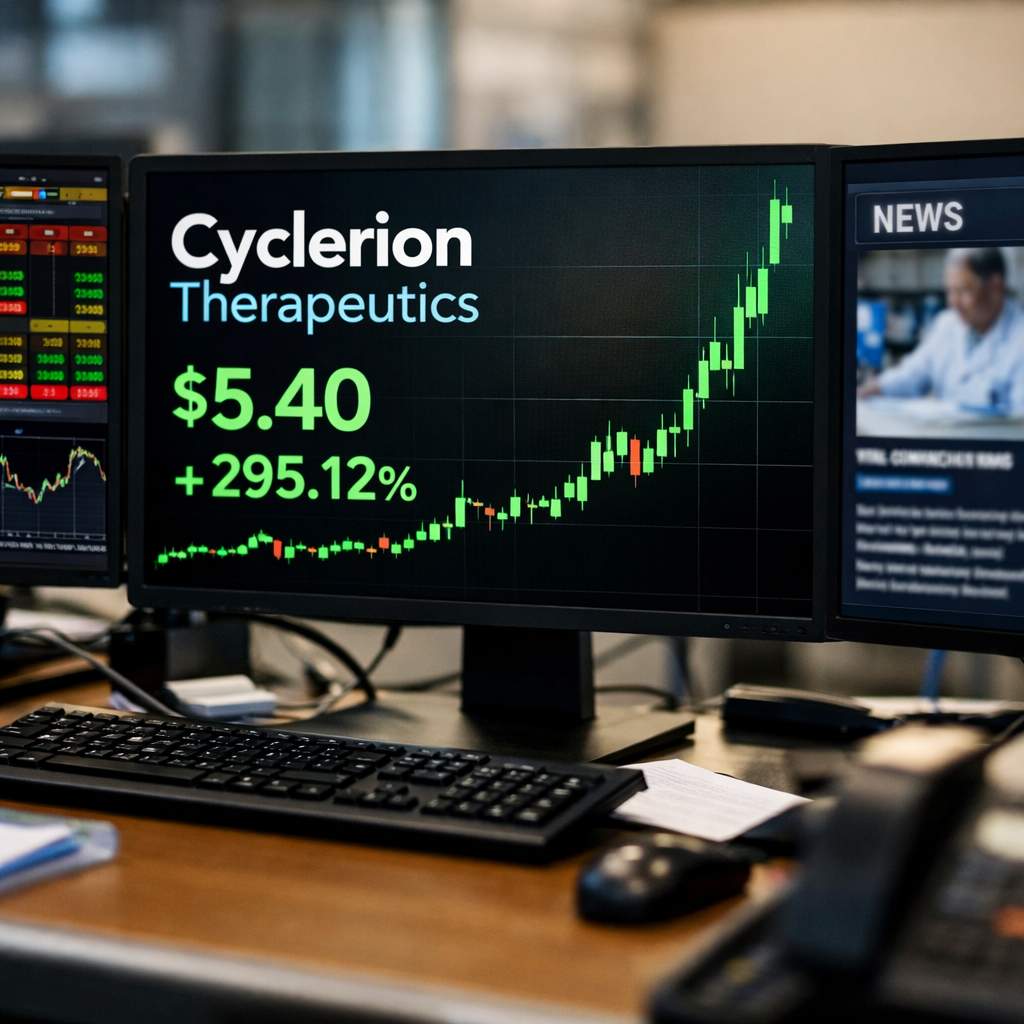

Cyclerion Therapeutics stunned the market after its stock surged 295% to $5.40, driven by a headline-grabbing merger agreement with Korsana Biosciences and a massive $380 million private financing round. The move instantly turned a relatively quiet biotech name into one of the most talked-about stocks of the day, as investors rushed to understand what triggered such an explosive rally.
The answer lies in a complete transformation story. Cyclerion isn’t just merging with another company — it is effectively becoming a new entity. Once the deal closes, the combined company will operate under the name Korsana Biosciences and trade on Nasdaq under the ticker symbol KRSA. Leadership will also shift, with Korsana CEO Jonathan Violin set to lead the combined business.
At the heart of investor excitement is Korsana’s lead program, KRSA-028, a next-generation monoclonal antibody targeting amyloid beta for Alzheimer’s disease. The drug is built using the company’s proprietary THETA platform, which is designed to improve drug delivery across the blood-brain barrier — a key challenge in treating neurological conditions. The platform uses transferrin receptor (TfR1) and Fc engineering, aiming to enhance brain penetration, reduce side effects like amyloid-related imaging abnormalities (ARIA), and improve patient convenience through a low-volume subcutaneous injection.
Alzheimer’s disease remains one of the largest unmet needs in healthcare, and any new approach in this space tends to attract strong investor interest. KRSA-028 is expected to enter key development stages over the next few years, with Phase 1 healthy volunteer data anticipated by mid-2027 and early proof-of-concept data in Alzheimer’s patients expected by the end of 2027. These milestones are critical, and investors are clearly betting that positive data could significantly boost the company’s valuation.
Another major driver behind the rally is the scale and credibility of the financing backing the merger. Korsana has secured commitments for approximately $380 million in an oversubscribed private investment, led by top-tier biotech investors including Fairmount, Venrock Healthcare Capital Partners, General Atlantic, RA Capital, RTW Investments, Vivo Capital, Wellington Management, and Sanofi Ventures. The presence of such heavyweight institutional investors adds a layer of confidence that the science and strategy have undergone serious due diligence.
This funding is expected to provide the combined company with a strong cash runway through 2029, allowing it to advance its pipeline without immediate pressure to raise additional capital. In biotech, that kind of financial visibility can be a major advantage, as it enables companies to focus on clinical development rather than short-term survival.
However, beneath the excitement lies a critical detail that investors need to understand. Under the terms of the merger, existing Cyclerion shareholders will own only about 1.5% of the combined company, while Korsana’s current shareholders and new investors will control approximately 98.5%. This means that although Cyclerion’s stock surged sharply, its shareholders are effectively being diluted into a much smaller ownership stake in a larger, better-funded entity.
This structure is not unusual in biotech reverse merger deals, where a struggling public company combines with a well-funded private biotech seeking market access. The trade-off is clear: shareholders exchange a larger stake in a weaker company for a much smaller stake in a potentially stronger one. The market’s reaction suggests that investors believe the upside from Korsana’s pipeline and funding outweighs the dilution risk.
The deal has already received approval from the boards of both companies and is expected to close in the third quarter of 2026, subject to shareholder approvals, regulatory clearances, and other customary conditions. Until then, the stock may remain volatile as traders react to new developments and assess the probability of the transaction closing on schedule.
Beyond KRSA-028, Korsana is also building a broader pipeline of therapies targeting other neurodegenerative diseases using its THETA platform. While details of these additional programs have not been fully disclosed, the strategy points toward a long-term effort to establish a portfolio of brain-targeting treatments.
The competitive landscape in Alzheimer’s treatment is intense, with several large pharmaceutical companies already advancing therapies in the space. This means Korsana will need to demonstrate clear advantages in safety, efficacy, or convenience to stand out. As with any early-stage biotech program, there are risks — including clinical trial delays, unfavorable results, or regulatory hurdles — all of which could impact future valuation.
For now, the market is focused on the bigger picture: a small-cap biotech has reinvented itself overnight through a merger, secured significant funding, and positioned itself in one of the most high-profile areas of drug development. That combination was enough to drive a 295% surge and put Cyclerion firmly on the radar of both retail and institutional investors.
Investors looking for more details on the merger and financing structure can refer to the official announcement on Business Wire. Additional filings related to the transaction are expected to be available via the SEC website as the deal progresses.
You may also like: Power Outages Surge in New Brunswick as Ice Storm Triggers School Closures

Make Swikblog your go-to source on Google for reliable updates, smart insights, and daily trends.