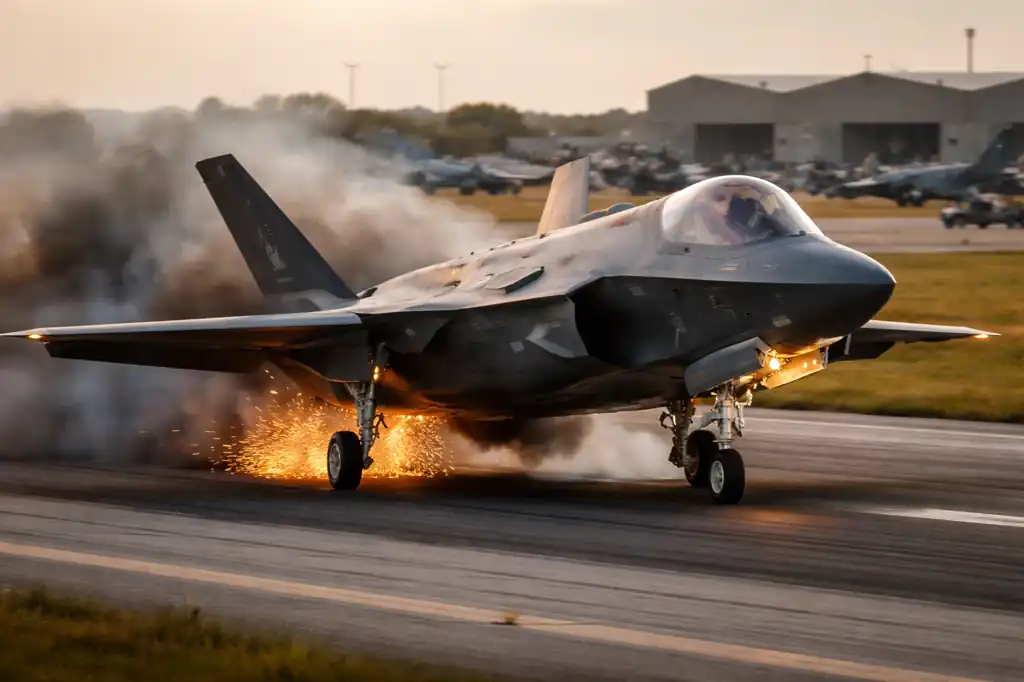

A mission involving one of America’s most advanced fighter jets took a dramatic turn after a U.S. F-35 was forced to make an emergency landing in the Middle East following damage believed to have come from Iranian fire.
According to reports citing sources familiar with the matter, the fifth-generation stealth aircraft was flying a combat mission over Iran when the incident happened. The jet was able to land safely at a U.S. air base in the region, while the pilot was reported to be in stable condition.
U.S. Central Command said the aircraft landed safely and confirmed that the matter is now under investigation. The episode has drawn immediate attention because it may mark the first reported instance of Iranian fire hitting a U.S. aircraft since the war began in late February.
The F-35 is widely seen as one of the most sophisticated aircraft in modern warfare, combining stealth, advanced sensors and strike capability in a platform that costs more than $100 million per jet. Its role in current operations has made it central to both U.S. and allied missions in the region. More detail on the aircraft’s design and capabilities is available through the official Lockheed Martin F-35 program page.
A costly aircraft at the center of a growing conflict
The emergency landing comes at a sensitive point in the conflict, with senior American officials continuing to project confidence in the campaign. Public statements from Washington have described the operation as highly successful, with repeated claims that Iran’s defensive capabilities have been severely weakened.
That is why this incident stands out. A successful strike, or even suspected strike, on an aircraft as advanced as the F-35 raises fresh questions about the level of risk in the airspace and the real-time challenge facing combat missions over Iran.
Even without a confirmed technical assessment, the incident adds a more complicated layer to the wider battlefield picture. It suggests that despite overwhelming technology and firepower, the operational environment remains volatile and potentially more dangerous than official messaging may imply.
Investigation now becomes the main focus
Military officials have not yet released further details on the extent of the damage, the exact cause of the impact, or whether the aircraft will be returned to service quickly. Those findings are likely to shape how this event is interpreted in the coming days.
For now, the most important detail is that the pilot survived and the aircraft was brought down safely. But the wider significance may lie in what investigators discover next. If the damage is confirmed as hostile fire, it would represent a notable moment in the conflict and could influence both mission planning and risk assessments across the region.
What began as a routine combat sortie for a stealth jet built to avoid detection has instead become one of the most closely watched military incidents of the week, underscoring how quickly the balance of confidence and vulnerability can shift in wartime.

Make Swikblog your go-to source on Google for reliable updates, smart insights, and daily trends.