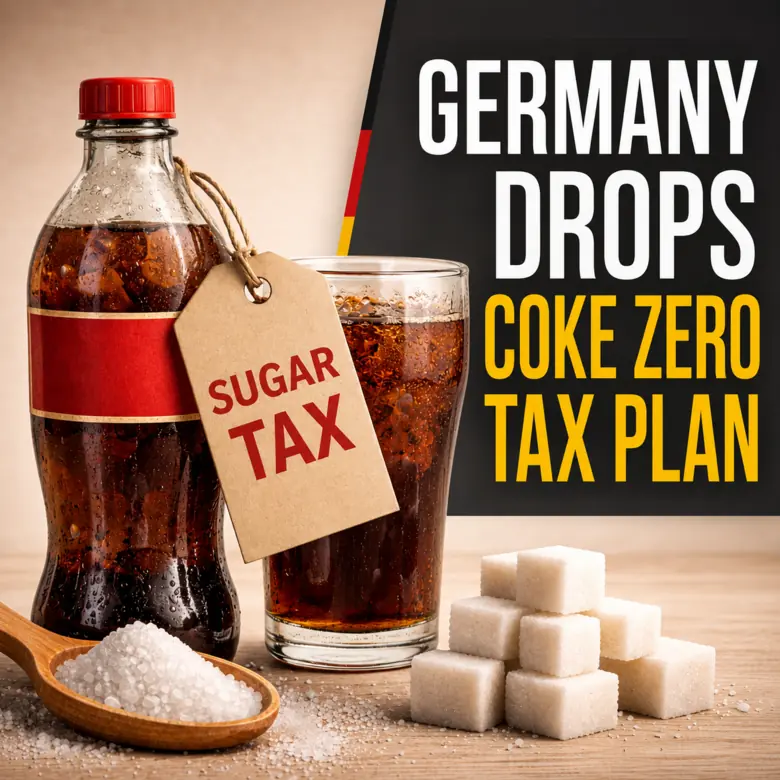

Germany’s planned sugar tax will not apply to Coke Zero or other sugar-free drinks, Finance Minister Lars Klingbeil confirmed on Wednesday, August 26, 2026, after the proposal faced political and business opposition.
The decision removes zero-sugar and artificially sweetened soft drinks from the proposed levy. Germany is still preparing a tax on beverages containing added sugar as part of an effort to reduce excessive sugar consumption and support its under-pressure healthcare system.
Why was Coke Zero included in Germany’s sugar tax debate?
The controversy began after proposals linked to Germany’s finance ministry suggested that the planned beverage tax could cover a wider range of products than initially expected.
Along with regular sugary soft drinks, the options reportedly included beverages made with artificial sweeteners, such as Coke Zero and other diet drinks. Flavoured milk, iced tea, oat drinks, ready-made coffee, alcohol-free wine and alcohol-free beer were also discussed.
The proposal quickly faced resistance from conservative members of Germany’s governing coalition and representatives of the food and drinks industries.
Critics argued that taxing a beverage without sugar under a “sugar tax” would be difficult to justify. Some politicians also warned that a broad levy could increase everyday prices while households were already dealing with higher living costs.
Critics also warned that beverage companies could pass the additional tax on to customers through higher retail prices. Similar pressures are already affecting the wider drinks industry, with rising beer prices and falling sales volumes creating challenges for established beverage companies.
Klingbeil then publicly rejected the inclusion of sugar-free drinks.
“As finance minister, I will not present a tax under which sugar-free drinks are taxed,” Klingbeil told reporters following a cabinet meeting in Neuhardenberg.
He described the idea as “nonsense” and posted a direct message on Instagram stating: “Sugar tax on Zero?… NO!”
The minister’s intervention means consumers should not face a new German tax specifically on Coke Zero, diet cola or comparable artificially sweetened drinks under the proposal currently being developed.
Germany sugar tax timeline and what happens next
| Date | Development |
|---|---|
| Earlier in 2026 | Germany’s governing coalition agreed to pursue a tax on sugar-sweetened beverages to address health concerns and raise additional revenue. |
| August 25, 2026 | Reports revealed that officials were considering a wider levy covering artificially sweetened drinks and several additional beverage categories. |
| August 25–26 | Coalition politicians and beverage businesses opposed the proposal, particularly the possible inclusion of sugar-free products. |
| August 26, 2026 | Finance Minister Lars Klingbeil ruled out taxing Coke Zero and other sugar-free beverages. |
| Next step | German officials will determine the tax rate, covered products, exemptions and implementation date before presenting the final proposal. |
The tax has not yet been fully finalised. Important details—including exactly which sugary drinks will be covered, how the levy will be calculated and when it will take effect—remain under discussion.
When the governing coalition initially agreed to pursue the measure, it estimated that the tax could generate approximately €650 million ($760 million) annually. The eventual amount will depend on the final tax rate and the range of products included.
Supporters believe the measure could encourage beverage manufacturers to reduce the amount of sugar in their products while motivating consumers to choose lower-sugar alternatives.
Health advocates argue that high sugar consumption contributes to obesity, type 2 diabetes and cardiovascular disease. They want revenue from the tax to support nutrition education, disease prevention and other public-health programmes.
Opponents question whether the levy would deliver major health improvements. They also argue that manufacturers and retailers could transfer the cost to consumers by raising drink prices.
Germany would not be the first European country to introduce such a measure. The United Kingdom, France and Poland already impose levies on certain soft drinks, although the products covered and the method used to calculate the tax vary between countries. France and Poland include some artificially sweetened beverages in their systems.
For now, Klingbeil’s statement provides a clear answer for people who regularly buy Coke Zero and similar diet drinks: Germany’s finance minister does not intend to include sugar-free beverages in the planned sugar tax.
Details of the wider levy on beverages containing sugar are still being developed and could change before the German government presents its final proposal.
Source: Tagesschau report on Germany’s proposed sugar tax.

Make Swikblog your go-to source on Google for reliable updates, smart insights, and daily trends.