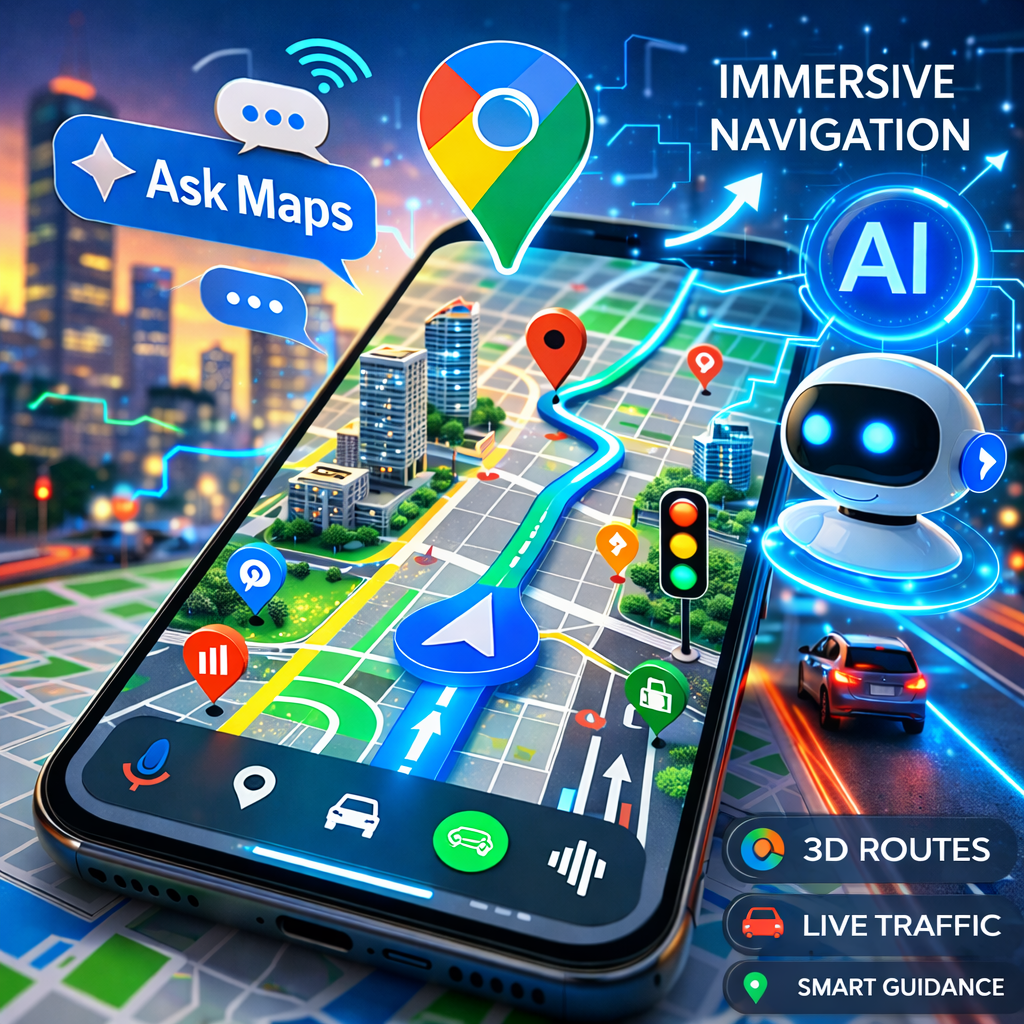

Google Maps is undergoing one of the most significant transformations in its history. Google has officially introduced a major upgrade powered by its advanced Gemini AI models, bringing two headline features to the platform: Ask Maps and Immersive Navigation. The update aims to transform how users explore places, plan trips, and navigate roads by turning Maps into a conversational AI-powered assistant rather than just a traditional navigation tool.
According to Google, the new features combine the world’s freshest mapping data with Gemini’s powerful AI capabilities to make finding places and navigating routes faster, smarter, and more intuitive. This update represents the biggest navigation redesign in more than a decade and could significantly change how millions of users interact with Google Maps daily.
Ask Maps introduces conversational AI inside Google Maps
The centerpiece of the update is Ask Maps, a new conversational search feature that allows users to ask complex real-world questions directly inside Google Maps. Instead of typing short search phrases like “coffee shop nearby,” users can now ask detailed questions such as:
“My phone is dying — where can I charge it without waiting in a long line for coffee?”
“Is there a public tennis court with lights where I can play tonight?”
Previously, finding this type of information required searching multiple places, reading reviews, and manually comparing results. With Ask Maps, Gemini analyzes Google’s vast database of locations and reviews to provide a conversational answer along with a visual map showing relevant places.
Google says the feature draws insights from more than 300 million places worldwide along with reviews and updates from a community of over 500 million contributors. This massive data network allows the AI to provide detailed suggestions, insider tips, and location recommendations before users even start their trip.
For example, if someone is planning a road trip and asks, “I’m heading to the Grand Canyon, Horseshoe Bend, and Coral Dunes — any recommended stops along the way?”, Ask Maps can generate route suggestions, show interesting attractions, estimate travel times, and highlight hidden local spots recommended by the community.
Results are also personalized. Google Maps uses information such as saved locations, previous searches, and user preferences to refine responses. If someone frequently searches for vegan restaurants, the system may prioritize restaurants offering vegan options when recommending meeting spots with friends.
Once a place is selected, Ask Maps allows users to quickly take action by booking reservations, saving locations to lists, sharing them with friends, or starting navigation immediately.
The feature is currently rolling out in the United States and India on Android and iOS devices, with desktop availability planned later.
Immersive Navigation brings the biggest driving upgrade in a decade
Beyond search and exploration, Google is also reinventing the driving experience in Maps. The new Immersive Navigation system completely redesigns how routes are displayed and how directions are delivered to drivers.
The navigation interface now features a vivid 3D view that reflects real-world surroundings such as buildings, overpasses, terrain, and road structures. This immersive visual experience helps drivers better understand the environment around them instead of relying on a simplified map layout.
When necessary, the system highlights critical road details including lanes, crosswalks, stop signs, and traffic lights. This added spatial awareness helps drivers prepare earlier for turns, merges, and lane changes.
Google says Gemini models help power this feature by analyzing updated imagery from Street View and aerial photos. This allows Maps to recognize real-world landmarks, road medians, and environmental features to create a more accurate visual representation of the route.
Smarter guidance and clearer route previews
One of the biggest improvements in the update is how Google Maps prepares drivers for upcoming decisions on the road. The new interface shows a broader preview of the route ahead using smart zoom features and transparent building overlays.
This expanded view helps drivers see complex turns or exits earlier, reducing last-second lane changes and confusion.
Voice guidance has also been redesigned to sound more natural. Instead of robotic navigation instructions, the system now delivers directions more like a friend guiding you through traffic.
For example, instead of hearing a generic instruction, users might hear something like:
“Go past this exit and take the next one for Illinois 43 South.”
The voice directions are paired with visual indicators on the map to clearly highlight upcoming moves.
Better alternate route insights and traffic updates
Road conditions can change quickly, which is why Google Maps constantly analyzes live traffic information from around the world. According to Google, Maps processes more than 5 million traffic updates every second.
With the new update, the app will not only suggest alternate routes but also explain the tradeoffs between them. Drivers may see options such as:
• A longer route with less traffic
• A faster route that includes toll roads
This added transparency helps drivers make better decisions about which route to take.
Google Maps also continues to rely heavily on its global driver community, which contributes more than 10 million real-time reports every day. These reports help alert drivers about road construction, accidents, and other disruptions along their route.
Improved destination guidance and parking assistance
The update also improves what happens during the final moments of a trip — a stage where many navigation apps still struggle.
Before leaving, drivers can preview their destination using Street View imagery to understand the surrounding area. The system can also recommend nearby parking locations.
As users approach their destination, Google Maps highlights the building entrance, nearby parking areas, and even indicates which side of the street the destination is located on. This guidance helps drivers move from the final turn directly to the correct entrance without confusion.
More details about the announcement can be found on the official Google Maps blog. Additional coverage of the driving features was also reported by 9to5Google.
Availability and rollout plans
Ask Maps is starting to roll out in the United States and India across Android and iOS devices, while Immersive Navigation is launching first in the United States.
Google says the navigation upgrade will expand to more devices in the coming months, including:
• Android phones
• iPhones
• Apple CarPlay
• Android Auto
• Cars with Google built-in
By combining Gemini AI with its global mapping infrastructure, Google is pushing Maps beyond traditional navigation into a more intelligent, conversational assistant for exploring the real world. As these features expand worldwide, Google Maps could soon become not just a tool for directions, but a fully integrated AI travel companion for everyday life.

Make Swikblog your go-to source on Google for reliable updates, smart insights, and daily trends.