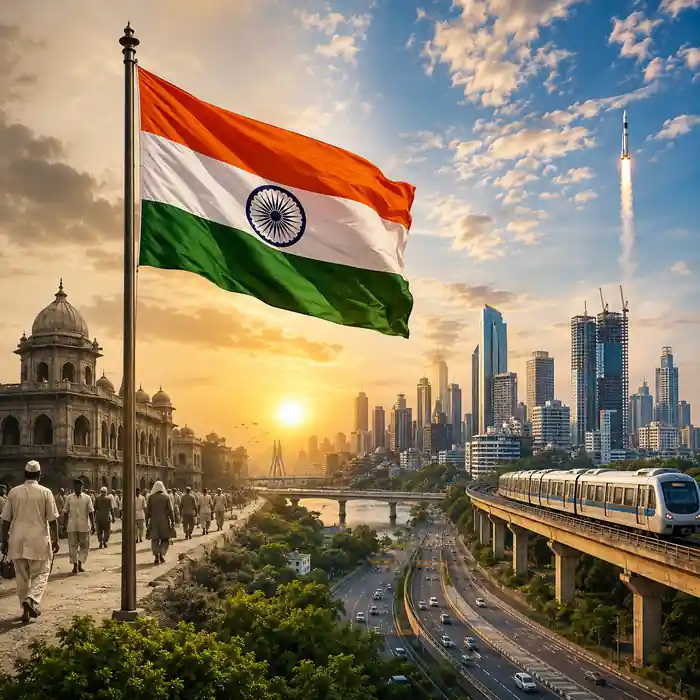

India reaches August 15, 2026 with 79 completed years since independence, a span that has changed almost every part of daily life. The country that emerged from British rule in 1947 was dealing with Partition, mass displacement, food shortages and the difficult work of building new institutions. Today, India is the world’s most populous country, a major digital economy and an increasingly visible global power.
The anniversary is therefore more than a date on the calendar. It offers a useful way to compare what India inherited in 1947 with what it has built since — and to look at the pressures that will shape the road to the centenary of independence in 2047.
From a new republic to a connected economy
India’s first decades were dominated by nation-building. The Constitution came into force in 1950, creating the framework for a federal parliamentary republic. Governments then faced the long-term tasks of expanding schools, hospitals, electricity, roads, railways and domestic industry across a vast country.
That transformation did not happen in a straight line. Economic policy changed substantially over the decades, while liberalisation in the early 1990s opened more sectors to competition and investment. Services, technology, manufacturing and finance gradually became much larger parts of the economy.
One of the clearest differences between 1947 and 2026 can be seen in everyday transactions. India now has a digital payments system operating at enormous scale. NPCI data show UPI processed more than 23 billion transactions in May 2026 alone, illustrating how quickly smartphones and instant payments have become part of ordinary commerce.
The country’s national celebrations have evolved as well. The history behind India’s Independence Day traditions and August 15 ceremonies shows how the Red Fort address, flag-hoisting and remembrance of the freedom struggle continue to connect modern India with 1947.
provide html to add this as internal link with text you may likeEconomic growth brings a different set of challenges
India enters the 2026 anniversary period with strong growth, but the global outlook has become less predictable. The World Bank estimated real GDP growth of 7.6% in FY2025-26 and projected 6.6% for FY2026-27, citing higher energy prices, supply-chain disruption and international uncertainty among the risks.
That forecast still keeps India among the fastest-growing major economies, but headline growth is only part of the story. The harder test is whether expansion creates enough productive jobs, raises household incomes and improves access to education, healthcare and reliable infrastructure.
The World Bank’s April 2026 India economic update stresses the importance of private investment and job creation, particularly as more young people enter the workforce.
India’s development ambitions are also increasingly tied to 2047. That makes the next 21 years especially important. Growing cities need housing and transport; industry needs reliable energy; and climate pressures add another layer to decisions on infrastructure, water and development.
Earlier national milestones help show how that long-term ambition has developed. The 2024 Independence Day focus on Viksit Bharat 2047 placed the centenary goal at the centre of the national celebration, linking the memory of independence with the country’s development targets.
Subhas Chandra Bose and his role in India’s freedom struggle
How National Unity Day reflects India’s nation-building story
What 79 years reveal about India’s next chapter
The contrast between 1947 and 2026 is dramatic, but it is not a simple before-and-after success story. India has built democratic institutions, expanded infrastructure, developed global technology businesses and pursued ambitious space missions. At the same time, employment, inequality, urban pressure, public services and environmental resilience remain central questions.
There is also a fresh Independence Day context in 2026. The government’s MY Bharat platform has launched a National Flag of India Quiz as part of the Har Ghar Tiranga campaign, with participation open until August 15. The initiative is aimed particularly at young people and focuses on the history and significance of the national flag.
For many Indians, that mix of history and future ambition is what August 15 now represents. The tricolour and the memory of the freedom movement look back to 1947, while discussions about jobs, technology, infrastructure and Viksit Bharat look ahead to 2047.
India at 79 is therefore best understood as a country between two milestones: far removed from the uncertainty of its first years of independence, but still in the middle of a much longer effort to turn economic scale and technological progress into broader opportunity.

Make Swikblog your go-to source on Google for reliable updates, smart insights, and daily trends.