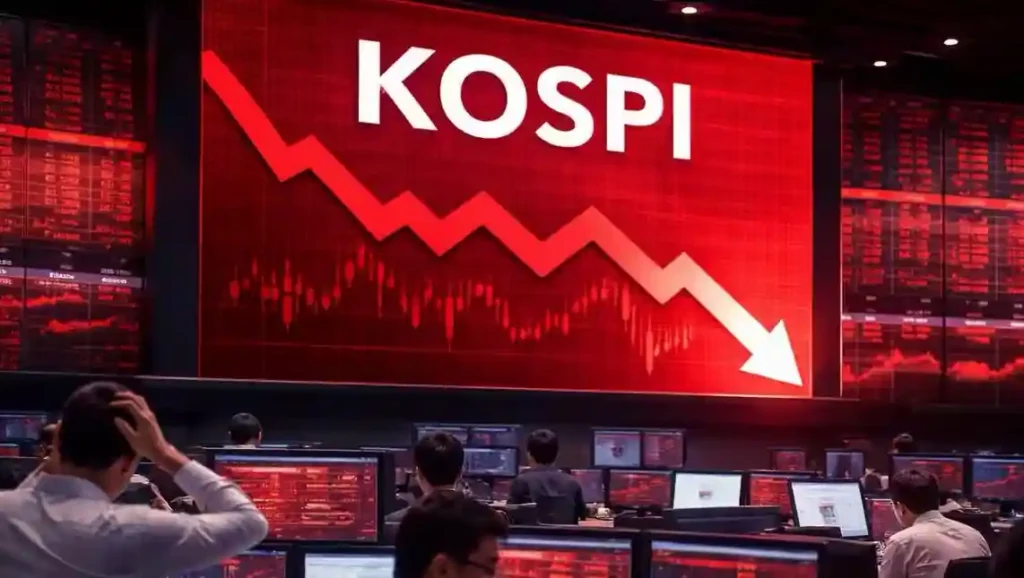

SEOUL, October 15, 2026 — South Korea’s benchmark KOSPI index plunged as much as 7.6% during Thursday morning trading, wiping 456.75 points off the previous close as heavy selling in Samsung Electronics and SK Hynix accelerated a wider Asian technology stock rout.
The KOSPI fell to 5,552.06 at 10:18 a.m. Korean time, compared with Wednesday’s closing level of 6,008.81. The index had already opened 5.59% lower at 5,673.01, reflecting substantial selling pressure before the regular session began.
The decline follows a steep reversal from the South Korean market’s June highs above 9,000 points. At 5,552.06, the benchmark was approximately 38.3% below the 9,000-point reference level, illustrating the scale of the correction in one of Asia’s most semiconductor-dependent equity markets.
KOSPI Crash: Samsung, SK Hynix and Asian Market Data
Semiconductor stocks accounted for much of the selling, with investors reducing exposure to companies closely linked to artificial intelligence infrastructure spending and high-bandwidth memory demand.
| Market / Stock | Reported Level | Change |
|---|---|---|
| KOSPI (10:18 KST) | 5,552.06 | -7.60% |
| Samsung Electronics (10:05 KST) | ₩214,250 | -7.65% |
| SK Hynix (10:05 KST) | ₩1,271,000 | -10.43% |
| SK Square | — | -10.09% |
| Samsung Electro-Mechanics | — | -14.63% |
| Hyundai Motor | — | -5.74% |
Source: The Asia Business Daily, October 15, 2026. All figures are intraday observations and may change.
The Korea Exchange activated sell-side sidecar mechanisms for both the KOSPI and KOSDAQ. The KOSPI restriction began at approximately 9:07 a.m., followed by the KOSDAQ at 9:12 a.m., suspending the effectiveness of certain program sell orders for five minutes.
The intervention did not represent a complete closure of South Korea’s stock market. It was a temporary volatility-control measure designed to limit the impact of automated selling.
Foreign capital outflows added to the pressure. By around 9:24 a.m., overseas investors had sold a net ₩759 billion ($0.76 trillion won) in South Korean shares, while institutional investors had purchased a net ₩702.7 billion. Retail investors were modest net buyers at approximately ₩11 billion, according to MoneyToday.
The figures suggest international investors were reducing risk even as domestic institutions absorbed part of the selling. They do not, however, establish how much of the outflow was directly caused by inflation concerns rather than broader portfolio adjustments.
US Inflation at 3.7%, AI Valuations and Global Market Pressure
The latest selling followed a hotter-than-expected US inflation report. September consumer prices increased 3.7% year over year, compared with the 3.6% market expectation, raising concerns that US interest rates could remain elevated for longer.
Higher interest rates can put pressure on technology stock valuations by reducing the present value investors assign to future earnings. Companies associated with rapid AI growth are particularly sensitive to changes in these expectations.
Wall Street had already weakened on Wednesday. The Nasdaq Composite lost approximately 1.9%, while the Philadelphia Semiconductor Index declined 4.3%, adding to losses accumulated over recent sessions.
Regional markets followed. Japan’s Nikkei 225 dropped approximately 4.8% to 64,489.06, while Taiwan’s Taiex fell around 3%, according to Associated Press market reporting.
Beyond inflation, the market is wrestling with a more fundamental question: whether the billions being invested in AI data centres, chips and computing infrastructure will generate returns quickly enough to justify current technology valuations.
Competition from China’s ChangXin Memory Technologies (CXMT), which has reported advances in memory-chip technology, is adding pressure on South Korean manufacturers. The potential for greater supply competition has raised questions about future memory prices and profit margins, although the commercial impact remains uncertain.
The pressure to demonstrate stronger returns on technology investment is also visible outside the semiconductor industry. Netflix’s reported decision to cut approximately 1,000 jobs ahead of its quarterly earnings reflects a separate example of a major technology-driven company facing scrutiny over expenditure, growth and shareholder returns. The restructuring is not identified as a cause of the Korean market selloff.
For equity investors, the immediate focus is on foreign fund flows, semiconductor earnings expectations and whether US inflation data changes the Federal Reserve’s policy outlook.
Samsung and SK Hynix remain central to global memory-chip supply, particularly for AI computing. Their share-price declines do not automatically signal an equivalent deterioration in company earnings, but they show how quickly investor expectations can shift when macroeconomic risks and valuation concerns rise together.
Market update: Figures reflect trading observations published on October 15, 2026, and are not final closing prices. Currency conversion into US dollars has been intentionally excluded because exchange rates fluctuate during the session.

Make Swikblog your go-to source on Google for reliable updates, smart insights, and daily trends.