
A climber has died on Longs Peak in Rocky Mountain National Park after an incident on Kiener’s Route, a serious alpine route on the mountain’s upper east face. The death has renewed attention on the risks of Colorado’s most famous national park summit, where popularity, altitude, exposure and fast-changing weather can create dangerous conditions even for prepared climbers.
Rocky Mountain National Park Search and Rescue teams responded Sunday after receiving a report of an incident involving a climber on Kiener’s Route. The climber was found dead on the upper east face of Longs Peak, according to reports citing park officials. The person’s identity and the exact circumstances of the death had not been publicly released at the time of reporting.
Longs Peak rises to 14,259 feet, making it the tallest mountain in Rocky Mountain National Park and one of Colorado’s most recognizable fourteeners. Its flat-topped summit is visible from many parts of the park, but the mountain’s reputation is not only about scenery. Longs Peak has a long record of serious accidents, rescues and fatal falls.
What happened on Longs Peak?
The incident happened on Kiener’s Route, a classic line on the east face of Longs Peak. Search and rescue teams were alerted in the early afternoon and later located the climber on the upper east face. The route was temporarily affected while recovery operations were carried out.
Officials have not said whether weather, a fall, a medical emergency, route conditions or another factor caused the climber’s death. Until more information is released, the key confirmed facts are limited: the incident involved a climber on Kiener’s Route, the climber was found dead, and the recovery was handled by Rocky Mountain National Park rescue personnel.
Why Longs Peak is not a normal hike
Longs Peak attracts thousands of climbers and hikers in summer, but the mountain should not be treated like a casual day hike. The National Park Service warns that even the popular Keyhole Route is not simply a hike, describing it as a climb involving exposed terrain, scrambling, falling rock risk and places where an unroped fall could be fatal. Official route and safety information is available through the National Park Service Longs Peak guide.
That warning matters because Longs Peak often draws a mixed crowd: experienced mountaineers, ambitious hikers, visitors chasing a first fourteener, and travelers who may underestimate the mountain because it is inside a national park. The setting can feel accessible, but the terrain above treeline is exposed, remote and unforgiving.
What makes Kiener’s Route risky?
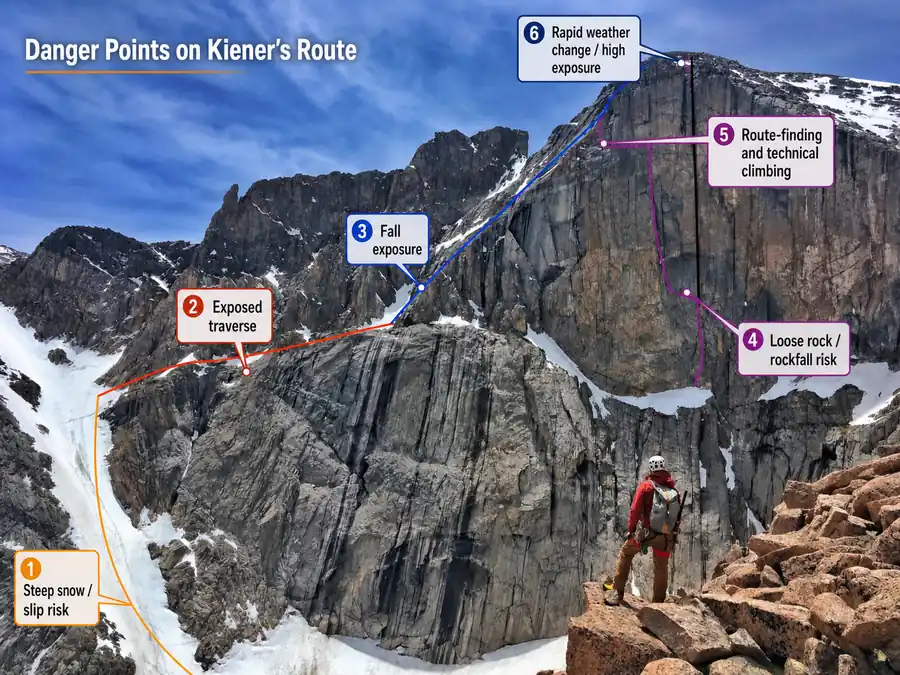
Kiener’s Route is often described as one of the more approachable ways up the east face of Longs Peak, but that does not mean it is easy or low-risk. The route requires alpine judgment, route-finding ability and comfort moving through exposed mountain terrain. Depending on conditions, climbers may encounter snow, ice, wet rock, loose rock, altitude fatigue and changing weather.
The phrase “easiest route on the east face” can be misleading for general readers. In mountaineering, “easiest” often means easiest compared with harder technical routes nearby — not safe for beginners. On Longs Peak, a small mistake can become serious because of the elevation, exposure and distance from quick rescue access.
Why weather changes matter on Longs Peak
Weather is one of the biggest dangers on Longs Peak. Conditions can shift quickly at high elevation, and summer does not remove all hazards. The latest park conditions report before the incident said Longs Peak was mostly in summer conditions, but also noted that small sections of snow and ice remained on some routes, requiring caution and conservative decision-making.
That kind of detail is important for readers because a mountain can look clear from a distance while still holding dangerous patches in gullies, shaded sections or upper-route terrain. Wind, lightning, afternoon storms and dropping temperatures can also turn a long climb into a rescue situation.
Recent rescues show how quickly a climb can change
The latest fatality follows other serious incidents on Longs Peak. In February 2026, two climbers on Kiener’s Route requested help after becoming stranded near 14,000 feet. Park officials said the men were unable to continue and had not planned to spend the night. Rescue efforts involved multiple teams, and aircraft attempts were affected by high winds before a Colorado National Guard Chinook helicopter helped complete the operation.
That rescue underlines a broader lesson: Longs Peak does not have to be in the middle of a major storm to become dangerous. A delayed start, slower-than-expected progress, route confusion, fatigue or one difficult section can push climbers into darkness, cold or conditions they did not plan for.
Longs Peak has a serious fatality history
Longs Peak has been the site of more than 70 climbing-related deaths since Rocky Mountain National Park was established in 1915, according to previous reporting. That history does not mean every climb is unsafe, but it does show why the mountain requires more preparation than many visitors expect.
The danger is not limited to obscure routes. Standard approaches, descent sections and familiar landmarks can all become hazardous when climbers are tired, weather changes or visibility drops. Many mountain accidents happen after the most exciting part of the climb, when people are descending and attention begins to fade.
The historic route carries a tragic backstory
Kiener’s Route is named after Swiss-born mountaineer Walter Kiener, who climbed the line with Agnes Vaille in 1925. Their ascent became part of Longs Peak history, but the descent turned tragic. Vaille died after a fall and exposure during the descent, while Kiener suffered severe frostbite.
That history remains relevant because it shows how Longs Peak’s risk is not new. The mountain has challenged climbers for generations, and its most famous routes carry both adventure and consequence.
What climbers should check before attempting Longs Peak
Anyone planning Longs Peak should check the latest park conditions, study the exact route, start early, carry layers, prepare for wind and cold, and be willing to turn around before conditions worsen. A summit attempt should also include enough food, water, navigation tools, emergency gear and realistic timing for the descent.
Visitors should also understand the difference between hiking fitness and alpine readiness. Being able to walk long distances is not the same as being prepared for exposed scrambling, altitude, loose rock or sudden weather above 14,000 feet.
For readers following broader outdoor risk stories, the Longs Peak death also fits into a wider pattern of national park safety incidents where remote terrain, weather and rescue access can shape the outcome of an emergency.
Why this death matters beyond one route
The death on Kiener’s Route is a reminder that Longs Peak’s popularity can sometimes hide its seriousness. The mountain is iconic, heavily photographed and widely discussed among Colorado climbers, but it remains a high-altitude alpine environment where conditions can punish small mistakes.
For experienced climbers, the incident is another reason to respect route conditions and descent planning. For visitors and first-time fourteener seekers, it is a warning not to confuse a famous destination with an easy one. Longs Peak may be inside one of America’s most visited national parks, but above treeline, it is still a mountain that demands caution.

Make Swikblog your go-to source on Google for reliable updates, smart insights, and daily trends.