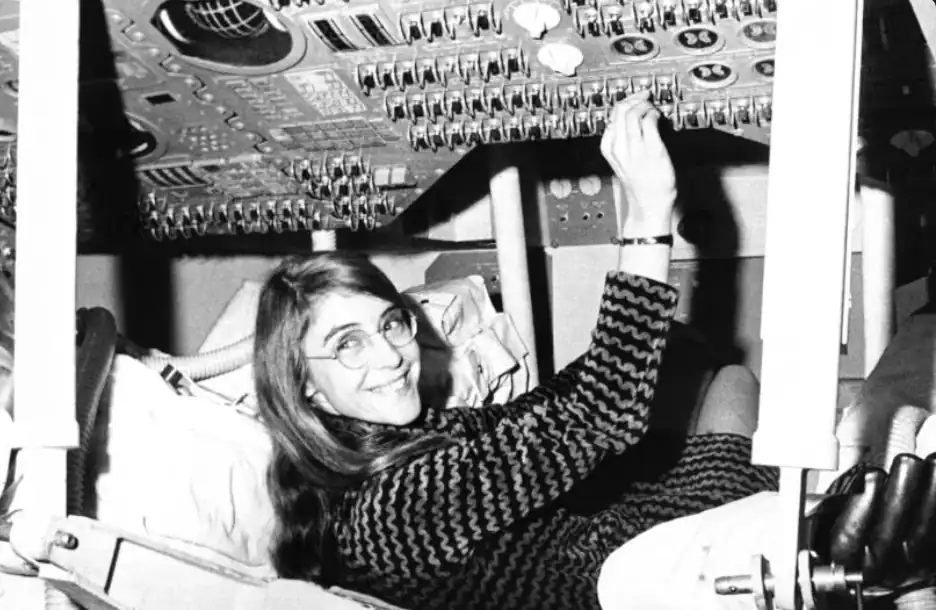

Margaret Hamilton, the pioneering computer scientist whose work helped guide NASA’s Apollo astronauts to the Moon, has died at the age of 90. The Massachusetts Institute of Technology announced her death on October 7, saying she died on September 30, 2026. Her death marks the loss of a major figure in both spaceflight history and the development of software engineering.
Hamilton became best known for leading key Apollo software teams at MIT’s Instrumentation Laboratory. Her work proved especially important during Apollo 11 in 1969, when the lunar module’s computer became overloaded shortly before touchdown but continued processing the tasks needed for landing.
MIT Confirms Margaret Hamilton’s Death
MIT said Hamilton worked at the institute from 1959 until the mid-1970s before becoming a technology entrepreneur. A cause of death has not been publicly disclosed.
According to MIT’s official announcement, she authored more than 130 publications and helped establish software engineering as a recognized professional discipline.
Hamilton is survived by her daughter Lauren Hamilton, son-in-law Richard Selesnick, two grandsons and four great-grandchildren. A memorial service is expected to take place in Cambridge, Massachusetts, in the spring.
Her Career Began Before Apollo
Born in Paoli, Indiana, in 1936, Hamilton studied mathematics before joining MIT in 1959. She initially worked with meteorologist Edward Lorenz on weather-prediction software, research connected with his later work on chaos theory.
She moved to MIT Lincoln Laboratory in 1961 and programmed for the SAGE air-defense project, gaining early experience with software used in systems where reliability mattered.
Hamilton joined the Apollo project in 1965 as its first programmer at MIT and its first female programmer. By 1968, she was assistant director responsible for the Command and Service Module software team. More than 400 people were involved across Apollo’s broader software effort.
Apollo 11 Tested the Software Under Pressure
On July 20, 1969, Neil Armstrong and Buzz Aldrin were descending toward the Moon aboard the lunar module Eagle when its guidance computer began producing alarms, including the well-known 1202 alert.
A hardware-related problem had overloaded the computer with more work than it could handle at once. The software developed by Hamilton’s team was designed to recognize priorities, stop unnecessary background work and preserve the calculations needed for the landing.
Mission controllers determined that the descent could continue, and Armstrong and Aldrin subsequently completed humanity’s first crewed Moon landing.
The episode is sometimes described as Hamilton personally saving Apollo 11, but it was a larger engineering achievement. Her role was central to leading teams that developed software capable of handling failures and unexpected conditions.
A Simulator Accident Exposed a Real Mission Risk
Hamilton’s approach to error prevention was also shaped by an incident involving her four-year-old daughter, Lauren. During a command-module simulation, Lauren accidentally activated the P01 pre-launch program while the simulated spacecraft was already in flight, causing the simulator to crash.
Hamilton proposed safeguards because she believed an astronaut could make the same mistake. During Apollo 8, Jim Lovell later activated the same type of program in flight, causing navigation data to disappear. Hamilton’s team helped recover from the problem, and additional protections were incorporated.
The incident became an early example of defensive programming: designing software to anticipate human mistakes instead of assuming users will always follow the expected sequence.
Hamilton Helped Give Software Engineering Its Identity
Hamilton pushed for software development to receive the same engineering recognition as hardware. Her approach emphasized rigorous testing, priority scheduling, fault tolerance and software capable of responding safely when something went wrong.
After Apollo, she founded Higher Order Software in 1976 and later Hamilton Technologies, continuing her work on reliable systems and error prevention.
NASA recognized her with the Exceptional Space Act Award in 2003. President Barack Obama presented her with the Presidential Medal of Freedom in 2016. She later became a Computer History Museum Fellow and was inducted into the National Aviation Hall of Fame.
Her Apollo-era ideas remain relevant during NASA’s renewed lunar exploration. The Artemis III Moon mission shows how lunar technology has evolved, while Artemis II’s journey around the Moon demonstrated a new generation of human deep-space flight.
Her Engineering Lessons Still Matter
Today’s spacecraft computers are vastly more powerful than Apollo-era systems, but Hamilton’s central lesson remains relevant: critical software must be designed not only for expected conditions, but also for human mistakes, hardware problems and events engineers cannot fully predict.
Her work helped prove that reliable software could be as important to a mission as the spacecraft itself, an idea that now influences aviation, medicine, vehicles, infrastructure and modern space exploration.

Make Swikblog your go-to source on Google for reliable updates, smart insights, and daily trends.