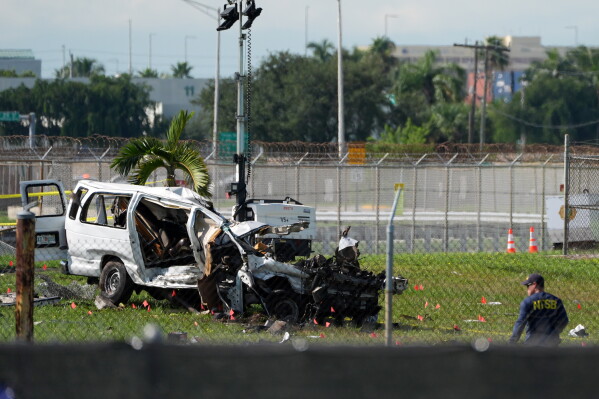

MIAMI — All five people killed when an Amazon cargo jet overran a runway at Miami International Airport were inside a van used to transport aircraft-cleaning crews, authorities have confirmed, revealing a devastating new detail about Sunday’s crash.
Miami-Dade Sheriff Rosie Cordero-Stutz identifies 5 dead after a cargo plane overran a runway at MIA and crashed into two vehicles pic.twitter.com/GMSZ0eg9wt
— WPLG Local 10 News (@WPLGLocal10) September 8, 2026
The Boeing 767 cargo aircraft, operated by 21 Air, was landing in Miami after a flight from San Juan, Puerto Rico, when it went beyond the end of Runway 30. The jet struck the cleaning-service van on airport property, continued through a fence and later collided with an SUV on a city street.
Five other people were injured in the crash. The pilot and co-pilot have since been released from the hospital, while two people remained in critical condition and another was in stable condition as of Tuesday, according to authorities.
The confirmation provides a clearer picture of the human toll from the Amazon cargo plane crash at Miami International Airport, as federal investigators continue trying to determine why the aircraft was unable to stop before reaching the end of the runway.
All five victims were inside plane-cleaning crew van
The five people who died were traveling in a van owned by Professional Ocean Service Corp., a company that provides aircraft-cleaning services.
Miami-Dade authorities identified those killed as:
- Rolando Aleman Leon, 55
- Yoel Rodriguez Narajo, 53
- Julio C. Pineda, 75
- Carlos Acosta Fajardo, 53
- Javierkys Reyes Quevedo, 47
The van was on airport property when the cargo jet struck it after overrunning the runway.
Professional Ocean Service Corp. said it would not discuss further details about the crash out of respect for the families of those who died.
The company said in a statement that its employees were much more than coworkers and expressed its support for the workers and families affected by the tragedy.
Amazon also expressed its condolences to the victims and their families and said it is cooperating with the investigation.
NTSB examines how the Boeing 767 overran the runway
The National Transportation Safety Board’s official investigation identifies the aircraft as 21 Air Flight 7598, a Boeing 767-33A operating a cargo flight from San Juan to Miami.
According to the NTSB, the aircraft overran the end of Runway 30 during landing. Federal investigators have not yet announced a probable cause for the accident.
Investigators recovered the flight data recorder, and information from it is being reviewed. Interviews with the pilots, air traffic controllers and other people connected with the flight are also expected to form part of the investigation.
Authorities said the aircraft traveled roughly 1,300 feet beyond the end of the runway, leaving wreckage and damaged airport infrastructure along its path.
One question investigators are expected to examine is why the aircraft landed as far down the runway as it did and whether the landing should have been discontinued in favor of another approach.
Weather and wind conditions around Miami at the time of the accident are also likely to receive close scrutiny. Aviation experts who reviewed footage of the landing have raised questions about whether a tailwind may have contributed to the aircraft traveling farther down the runway.
However, the NTSB has not determined the cause of the crash, and it would be premature to attribute the accident to wind, pilot actions, air traffic control or an aircraft problem while the investigation remains underway.
The airport’s runway-end protection is another issue drawing attention following the crash.
Miami International does not have the lightweight, crushable material known as an Engineered Materials Arresting System, or EMAS, at the end of the runway involved in the accident. Such systems are designed to help slow aircraft that overrun a runway.
The airport nevertheless appears to meet federal requirements because it has approximately 1,000 feet of safety area beyond the runway end.
NTSB Chair Jennifer Homendy has said runway excursions remain an important aviation-safety issue as investigators examine what could have prevented the Miami accident.
The aircraft involved was a 32-year-old Boeing 767 that was originally built as a passenger jet before later being converted for cargo operations. It was being operated by North Carolina-based cargo carrier 21 Air for Amazon.
The accident also caused major disruption at Miami International Airport, with more than 225 flights canceled across Sunday and Monday and hundreds of additional flights delayed.
Investigators continued working around the damaged aircraft and its path through the airport as portions of the airfield remained unavailable.
The recovery of flight-recording equipment could now provide investigators with crucial information about the final moments of Flight 7598. Read our earlier update on the Miami Amazon plane crash investigation and recovered flight recorders for more details.
Latest update: All five fatalities have now been confirmed as people who were inside the aircraft-cleaning service van. The NTSB investigation remains active, and no official probable cause for the runway overrun has yet been announced.

Make Swikblog your go-to source on Google for reliable updates, smart insights, and daily trends.