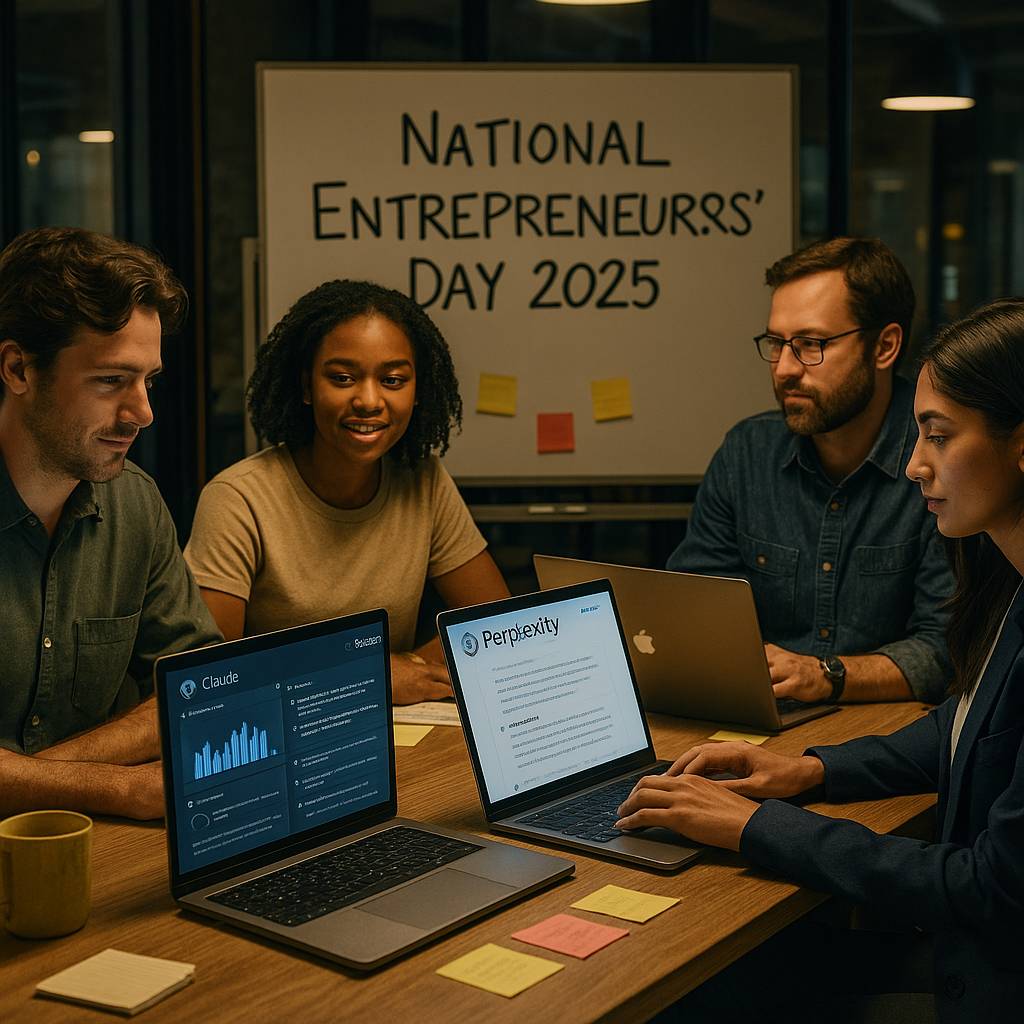

Location focus: United States • Date: National Entrepreneurs’ Day 2025 falls on November 18, the third Tuesday of November.
National Entrepreneurs’ Day 2025 AI tools aren’t just a buzz phrase – they’re quickly becoming the difference between US founders who are constantly firefighting and those who actually have space to think, build and grow. This special day, observed each year on the third Tuesday of November, celebrates the risk-takers and problem-solvers who power the American economy with new ideas, jobs and innovation.
In 2025, AI has moved from “interesting experiment” to a practical everyday co-founder. From writing investor emails to automating lead follow-ups and building entire landing pages in minutes, the right tools can save you hundreds of hours a year and help you run a leaner, smarter company.
What Is National Entrepreneurs’ Day 2025?
National Entrepreneurs’ Day is an unofficial US observance created to honor entrepreneurs who fuel innovation, employment and economic growth. It’s typically recognized during National Entrepreneurship Month initiatives from the U.S. Small Business Administration (SBA), which spotlight small business success stories, funding programs and training for founders.
For many US startup founders, 2025 is a year of rebuilding and reinventing. Funding cycles are tighter, customers expect faster responses, and teams are often smaller. That’s why this year’s National Entrepreneurs’ Day is the perfect moment to audit your tech stack and intentionally add AI tools that reduce busywork instead of adding more noise.
If you’re also interested in how women founders are reshaping the startup world, don’t miss your own in-depth piece on Women’s Entrepreneurship Day 2025: 10 Inspiring Female Founders Changing the World.
Why AI Tools Are Non-Negotiable for US Founders in 2025
The most successful entrepreneurs in 2025 aren’t necessarily the ones who work the longest hours. They’re the ones who build a lightweight AI stack around their core strengths. Instead of manually drafting every email or reporting every metric, they use AI to:
- Automate repetitive admin and reporting
- Respond faster to customers and leads
- Turn raw ideas into pitch decks, landing pages and marketing assets
- Test more experiments with less effort and smaller teams
You don’t need 50 different tools. Start with a few powerful, well-integrated platforms, and add new ones only when they clearly remove friction from your day.
10 AI Tools Every Founder Should Try in 2025
Here are ten carefully chosen AI tools that match real startup workflows – from idea stage to scaling. You can start with just two or three and build from there.
1. Claude 3.5 Sonnet – The Most Reliable AI Assistant for Founders in 2025
Best for: Strategic writing, product thinking, investor communications, legal-style drafting.
Claude 3.5 Sonnet by Anthropic has become the go-to AI assistant for US founders who need cleaner reasoning, safer outputs and deeply structured answers. It’s especially good for founders who want a “thinking partner” instead of just a text generator.
How Claude helps founders:
- Writes investor updates, pitch copy and policy documents with exceptional clarity.
- Understands complex instructions and business logic better than many AI tools.
- Helps refine your product vision, roadmaps and weekly planning.
Many founders prefer Claude because it can analyze sensitive topics while maintaining a strong safety guardrail — ideal for early-stage decisions.
2. Perplexity AI Enterprise – Your Real-Time Research and Market Intelligence Engine
Best for: Fast research, competitor analysis, market validation and summarizing public data.
Perplexity AI has become the “search engine for founders.” Instead of Googling endlessly, you get clean, sourced answers with citations, graphs and market summaries in seconds — perfect for US entrepreneurs who need quick clarity.
You can use it to:
- Check market demand and competitor positioning before launching a feature.
- Summarize long reports, regulations and industry trends.
- Get instant insights with links to credible sources.
Many US founders now treat Perplexity AI as their “research analyst,” especially for customer, pricing and growth strategy decisions.
5. Zapier with AI – Automate the Boring Glue Work
Best for: Non-technical founders who want automations between tools.
Zapier has added AI steps that let you clean up text, classify leads or generate custom replies before sending data into your CRM or inbox. You can, for example,:
- Score new leads based on their form answers.
- Auto-tag support tickets by topic or urgency.
- Send personalized first-touch emails when a prospect downloads a resource.
6. Canva with Magic Design & AI – Fast Visuals for Non-Designers
Best for: Social posts, pitch visuals, one-pagers and basic brand assets.
Canva’s AI features (like Magic Design and Magic Media) help you turn a short brief into slide decks, social carousels or simple demo graphics. For US founders without an in-house designer, it’s a lifesaver for investor meetings, product launches and campaign tests.
7. HubSpot AI – Smarter Sales and Marketing for Growing Startups
Best for: Founders who need a unified CRM plus AI-assisted marketing.
HubSpot’s AI tools can generate email sequences, suggest subject lines, score leads and forecast pipelines. If you’re scaling up an outbound motion in the US market, AI-powered CRM makes it easier to see which campaigns are actually converting and where to invest your limited budget.
8. Pomelli – Google’s AI Marketing Assistant for Small Businesses
Best for: Small US businesses without a dedicated marketing team.
Pomelli is an experimental AI marketing tool from Google Labs and Google DeepMind that analyzes your website, builds a “Business DNA” profile and then suggests ready-to-use marketing campaign ideas and assets. It’s especially helpful for founders who know their product deeply but struggle to translate that into consistent social posts, ads and email campaigns.
9. Synthesia – AI Video for Pitches, Demos and Onboarding
Best for: Quick explainer videos without cameras, studios or big budgets.
Synthesia lets you create professional-looking videos with AI avatars and voiceovers by simply typing a script. It’s ideal for:
- Short investor explainer videos.
- Customer onboarding clips for your app or service.
- Internal training content for new hires.
10. Pineapple Builder – Launch a Website in Minutes
Best for: Solo founders who need a clean, fast website without developers.
Pineapple Builder is an AI-driven website builder that can generate a responsive, SEO-ready site for your startup in just a few minutes. You describe your business, choose a goal (like capturing leads or selling a single product), and the tool creates layouts, copy ideas and sections you can refine.
If you’re still validating your idea or pivoting quickly, this kind of AI website builder prevents you from getting stuck in weeks of design decisions before you even talk to customers.
For a deeper dive into categories of AI tools – from writing and design to analytics – you can also browse Google Cloud’s overview of free AI tools and use cases, then plug the most relevant ones into your own stack.
How to Build Your Own AI Stack as a Founder
You don’t need to master all ten tools at once. Instead, use National Entrepreneurs’ Day 2025 as a simple checkpoint to design a lightweight, founder-friendly AI stack:
- Start with your biggest bottleneck. Is it content, leads, customer support, reporting or product documentation? Choose one area and fix that first.
- Pick 1–2 tools per problem, not per trend. For example, ChatGPT + Canva for content; Notion AI + Zapier for operations; HubSpot AI + Pomelli for marketing.
- Protect your time and your data. Learn the basic privacy settings of each tool and set clear rules for what your team can and cannot paste into external systems.
- Train your team in small steps. Run short internal “AI playbook” sessions so everyone knows which prompts, workflows and outputs you expect.
The goal isn’t to chase every shiny AI tool. It’s to free up your brain so you can spend more time on the uniquely human parts of entrepreneurship: building relationships, understanding customers and making smart bets.
Celebrating National Entrepreneurs’ Day 2025 with Smarter Systems
On this National Entrepreneurs’ Day, take an hour to map your workflows, choose a few AI tools from this list, and commit to testing them for the next 30 days. Even a handful of small automations – a clearer investor update, a faster landing page, a more consistent marketing schedule – can compound into real growth over the next year.
You don’t need to do it alone or overnight. But the founders who learn to collaborate with AI in 2025 will be the ones telling the success stories on future National Entrepreneurs’ Days.

Make Swikblog your go-to source on Google for reliable updates, smart insights, and daily trends.