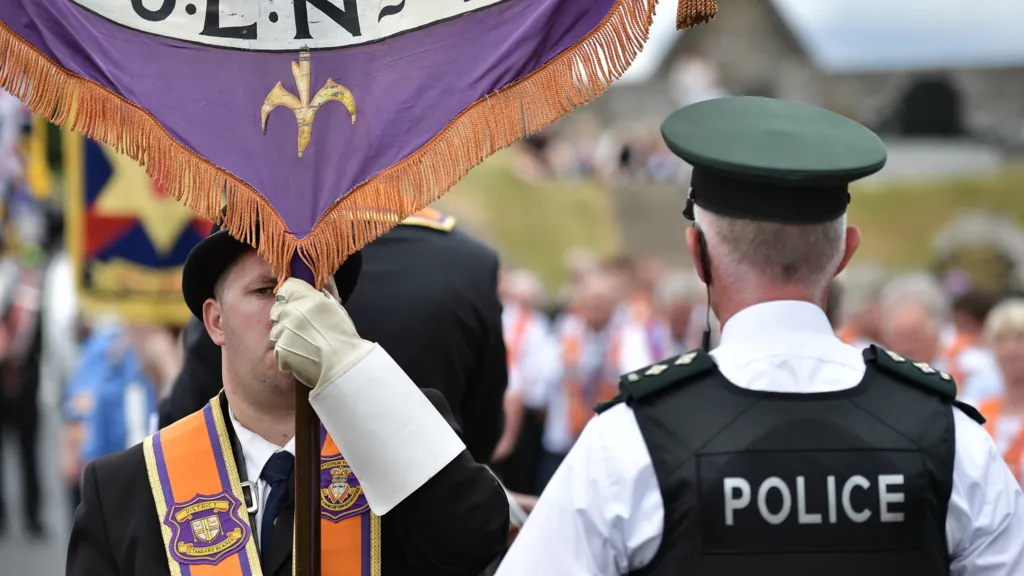

A controversial Orange Order parade in Northern Ireland has been cleared to proceed along Portadown’s Garvaghy Road for the first time in 28 years, following an extraordinary weekend of court hearings and appeals.
The procession, due to begin at 8am on Sunday, September 27, has become a major Northern Ireland story because Garvaghy Road was at the centre of some of the most serious parade disputes of the 1990s.
Sky News described the event as a “controversial loyalist parade”, while the procession itself is organised by members of the Orange Order’s Portadown District.
Only 35 participants are permitted to take part under conditions imposed by the Northern Ireland Parades Commission, after the original notification proposed 60 participants.
What is an Orange Order parade in Northern Ireland?
Parades have long been part of Northern Ireland’s religious, cultural and political landscape.
The Orange Order, formally known as the Loyal Orange Institution, is a Protestant fraternal organisation founded in Ireland in 1795. It is historically associated with Protestantism and British unionism.
Its members are organised into local lodges and regularly take part in church services, commemorations and public processions.
The most famous period is Northern Ireland’s traditional marching season, particularly around July, when Orange Order lodges hold processions connected to Protestant and unionist history, including commemorations of the Battle of the Boyne in 1690.
A UK Parliament research paper records the Orange Order’s foundation in 1795 and explains the historic importance of public parading in Northern Ireland.
Many Orange Order marches take place without major controversy. Disputes generally arise when a proposed route passes through or close to communities with a different political or religious identity.
That is what has made Garvaghy Road in Portadown particularly sensitive.
What is the Drumcree parade?
Parade date: Sunday, September 27, 2026
Start time: 8am UK time
Participants: 35 Orangemen are permitted to take part in the restricted procession. The Orange Order’s original notification proposed 60 participants.
Route: The notified route begins outside Drumcree Church before proceeding along Drumcree Road, Garvaghy Road, Parkmount and Victoria Terrace. The wider notified route then continues through Castle Street, Bridge Street, High Street, Market Street, Church Street and towards Carleton Street.
The parade at the centre of the latest dispute is connected to Drumcree Parish Church, outside Portadown.
Members of Portadown District Orange Lodge traditionally attend a church service at Drumcree before returning towards the centre of Portadown.
The historic return route includes Garvaghy Road, a predominantly nationalist area.
The Orange Order regards the route as part of a longstanding religious and cultural tradition. Many Garvaghy Road residents, however, have opposed the procession passing through their neighbourhood.
That disagreement over a relatively short stretch of road eventually developed into one of Northern Ireland’s best-known parading disputes.
Why did Garvaghy Road become so controversial?
During the 1990s, arguments over whether Orangemen should be allowed to complete the Drumcree route resulted in repeated stand-offs between marchers, residents and police.
Material archived by CAIN at Ulster University documents the history of the Drumcree dispute and the wider conflict surrounding contentious parades in Northern Ireland.
Garvaghy Road residents argued that they should not be required to accept a procession they opposed through their community.
The Orange Order maintained that its members should be allowed to complete what it regarded as a traditional route and exercise their right to parade peacefully.
Those competing positions produced increasingly serious confrontations.
In 1995, police initially prevented Orangemen from completing the route. A tense stand-off followed before an accommodation allowed a restricted procession to continue.
In 1996, another attempt to block the parade triggered a major confrontation at Drumcree and widespread disorder elsewhere in Northern Ireland. Police later allowed the procession to proceed.
A further major stand-off followed in 1997, accompanied by an extensive security operation.
The dispute unfolded during a particularly sensitive period in Northern Ireland’s peace process, shortly before the Good Friday Agreement was signed in 1998.
From 1998 onward, the Orange Order was prevented from completing the disputed Garvaghy Road section of its return route.
That is why Sunday’s procession carries such significance: it is the first time in 28 years that Orangemen have been cleared to complete this section of the route.
What does the Parades Commission do?
Northern Ireland has a dedicated body called the Parades Commission, which considers notified public processions and can impose conditions where necessary.
The Commission was established under legislation introduced in the late 1990s after years of disputes over contentious marches.
It can place conditions on issues including the route, timing, numbers, music and conduct of a procession.
For the September 27 parade, the Commission imposed conditions and reduced the proposed procession from 60 participants to 35 people at 8am.
The official Parades Commission record shows that the original notification proposed a return route beginning at Drumcree Church, travelling along Drumcree Road, Garvaghy Road, Parkmount and Victoria Terrace before continuing into central Portadown.
Why did the parade end up in court?
The Parades Commission’s decision was immediately challenged by representatives of Garvaghy Road residents.
On Saturday, Justice Patricia Smyth granted a temporary injunction preventing the procession from taking place.
She highlighted the depth of mistrust between the two sides and warned about the possibility of the dispute escalating.
“The level of mistrust between the residents and the Portadown Orange lodge cannot be overstated.”
The Orange Order then appealed.
During an emergency Court of Appeal hearing late on Saturday, the temporary injunction was overturned, reopening the way for Sunday’s procession.
A further application aimed at stopping the parade was then dismissed during another High Court hearing in the early hours of Sunday.
The result was an unusual sequence in which the parade was approved, temporarily blocked, restored on appeal and then survived another legal challenge within a matter of hours.
Why is the parade described as loyalist?
The term loyalist is commonly used in Northern Ireland for people and organisations strongly committed to Northern Ireland remaining part of the United Kingdom.
The Orange Order is historically connected with the Protestant unionist tradition, which is why some news organisations have described the Garvaghy Road procession as a loyalist parade.
However, the most precise description of Sunday’s event is an Orange Order or Drumcree parade, because not every loyalist organisation or public procession is part of the Orange Order.
What have both sides said?
The Orange Order has argued that the march is about completing what it considers a lawful and traditional route after decades of restrictions.
Portadown District originally described its September application as a “limited” parade and proposed 60 participants.
Garvaghy Road residents have opposed the procession and argued that the route’s history and the views of the local community should carry substantial weight.
Deputy First Minister Emma Little-Pengelly appealed for calm as the court battle intensified.
“I appeal for calm, and leadership. Both political and civic. Everyone should act to de-escalate any tensions.”
Unionist representatives welcomed the court outcome, while nationalist representatives criticised the decision and supported concerns raised by residents.
Why Sunday’s Northern Ireland parade matters
The significance of Sunday’s event goes far beyond the relatively small number of Orangemen taking part.
For the Orange Order, Garvaghy Road represents tradition, religious expression and the ability to complete a historic route.
For many residents, the same route is associated with memories of confrontation, policing operations and disorder during the Drumcree disputes.
The situation has therefore become another major public-order challenge involving competing rights, community concerns and the legacy of Northern Ireland’s divided past.
That wider question of policing and public safety has also featured in recent UK incidents, including the large emergency response in Bootle.
Nearly three decades after the height of the Drumcree dispute, the return of an Orange Order procession to Garvaghy Road shows why Northern Ireland’s parade tradition remains closely tied to questions of identity, history and community relations.

Make Swikblog your go-to source on Google for reliable updates, smart insights, and daily trends.