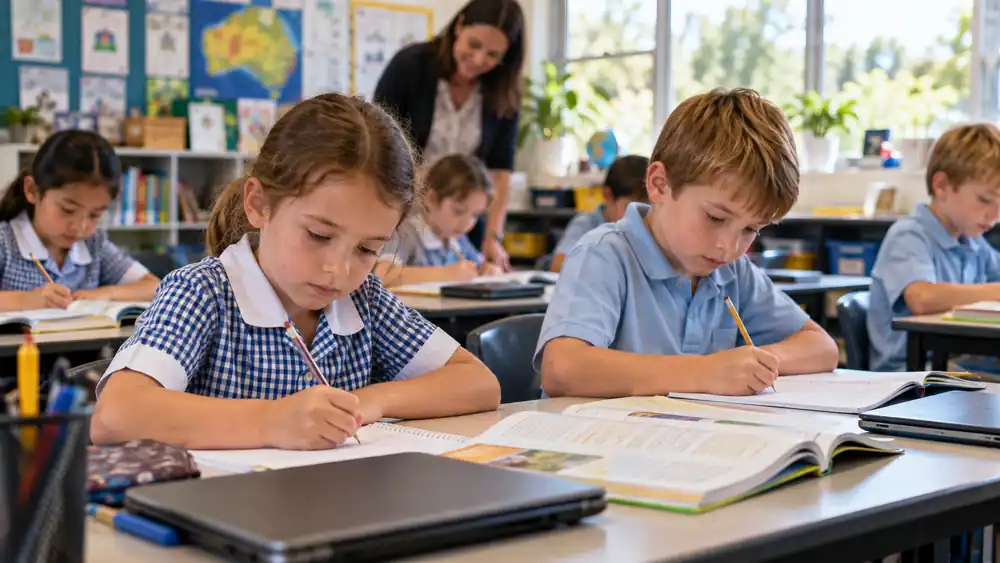

NSW public schools are preparing for a major shift in classroom technology use, with new state government guidelines set to limit some of the youngest students to just 15 minutes of screen-based learning a day.
The changes will apply from kindergarten through Year 12, although the limits become more flexible as students get older. The guidelines are due to begin in 2027 and become mandatory across NSW public schools in 2028.
The government says the goal is not to remove technology from classrooms, but to stop laptops and tablets becoming the default for everyday learning when handwriting, books and direct teacher interaction may be more effective.
Screen time limits will increase with each year group
Kindergarten to Year 2 students will face the strictest limit at 15 minutes a day. Years 3 and 4 will be allowed up to 30 minutes, while Years 5 and 6 will have up to 45 minutes of daily classroom screen use.
For Years 7 to 10, digital learning will be allowed to make up as much as 25% of a subject’s coursework. Students in Years 11 and 12 will be permitted to spend up to half of their class time using devices such as laptops and tablets.
The age-based approach recognises that senior students often need greater access to technology for research, assignments and exam preparation, while younger children may benefit from more handwriting, reading and face-to-face learning.
Government wants pen and paper back at the centre
NSW Education Minister Prue Car said there was too much screen time in the school system and argued that pen and paper should once again become the default for more classroom activities.
Education Secretary Murat Dizdar said technology would continue to play an important role, but limiting unnecessary screen exposure could help students avoid distractions and concentrate more effectively.
The NSW Department of Education already sets expectations for the safe and responsible use of laptops, tablets, wearable technology and online services through its official digital devices and online services procedures.
PISA results have added pressure for change
The announcement comes amid concern about academic performance in Australia and NSW. The government has cited OECD PISA data showing Australian students were nearly twice as likely as the OECD average to spend more than two hours a day learning through digital devices.
Recent PISA results also showed weaker reading and mathematics performance among 15-year-olds in NSW, while Australian students recorded their lowest-ever results in reading and maths. Science results improved.
The figures do not prove that screens alone caused weaker results. Academic outcomes are influenced by teaching quality, attendance, curriculum, family circumstances and how technology is used.
Technology has also become central to national testing, highlighted earlier this year when a NAPLAN website outage disrupted online exams across Australia.
Chatswood High School reports benefits from less screen use
Some NSW schools have already been reducing their reliance on digital devices. Chatswood High School principal Robin Chand said staff noticed improvements in handwriting and student engagement after cutting back on screen use.
Seventeen-year-old student Archie Newman said digital technology could easily distract him, while using physical books and handwriting helped him slow down and think more deeply about his work.
For older students, digital tools will remain important around assessments and final exams. Families can also check the NSW HSC 2026 exam timetable and key dates when planning for the senior examination period.
New rules are separate from the mobile phone ban
The new limits should not be confused with NSW’s existing mobile phone restrictions. Phones are already restricted during the public-school day, while the new guidelines focus on legitimate educational use of laptops, tablets and other screens during lessons.
Schools will have a transition period during 2027 to adjust lesson plans and decide where digital tools genuinely add value before the rules become compulsory in 2028.
Top NSW Schools in the 2025 HSC Rankings: The Confirmed Top 10
Australia’s Best Private Primary Schools Revealed in 2026 Rankings
What the changes mean for families
For parents of younger children, the biggest practical change will be much clearer boundaries around classroom screen exposure. A kindergarten student, for example, will be limited to 15 minutes a day under the new framework.
Secondary schools will retain substantially more flexibility, particularly for Years 11 and 12. The policy is designed to preserve digital learning where it serves a clear educational purpose while giving students more time for handwriting, books, classroom discussion and direct interaction with teachers.

Make Swikblog your go-to source on Google for reliable updates, smart insights, and daily trends.