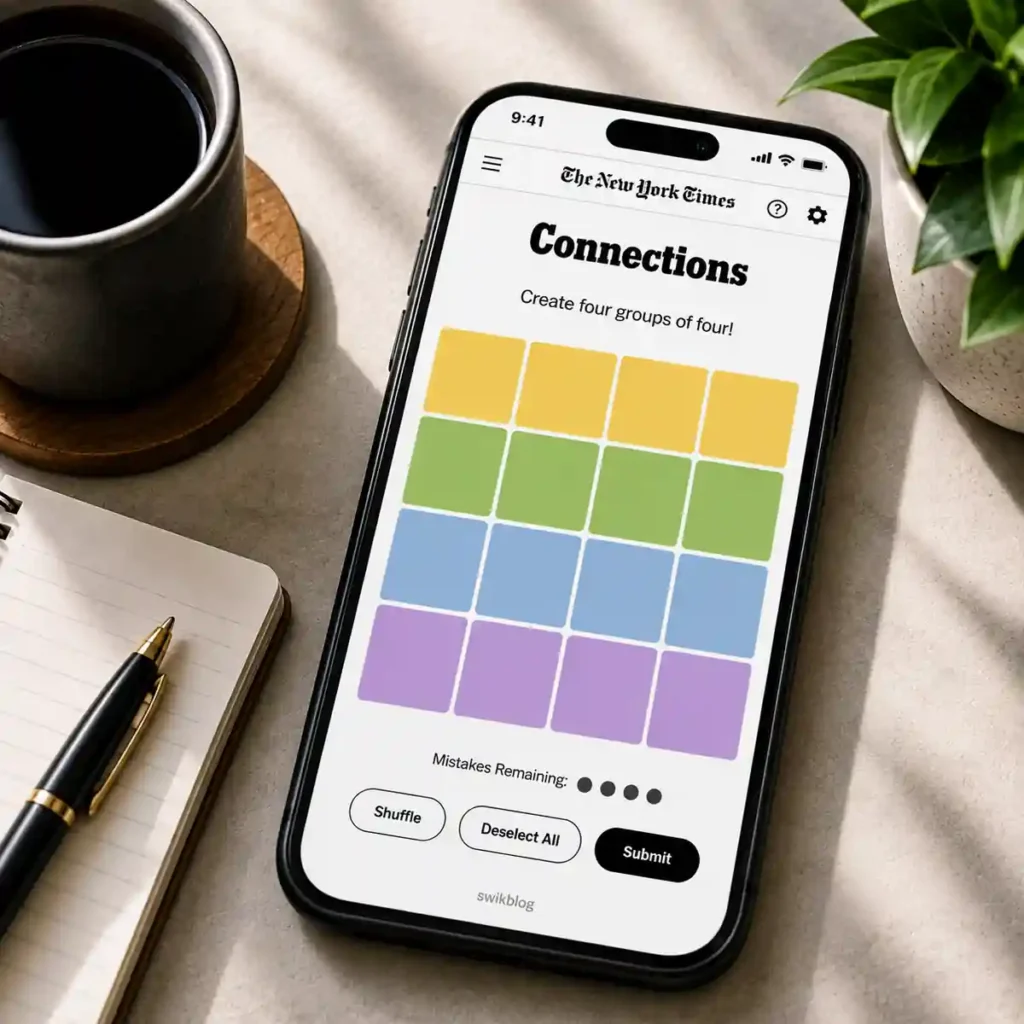

NYT Connections #1223 for Friday, October 16, 2026, brings a tricky mix of geography, wordplay and hidden meanings. Two groups involve countries, while the remaining categories test your ability to spot surface imperfections and words associated with style.
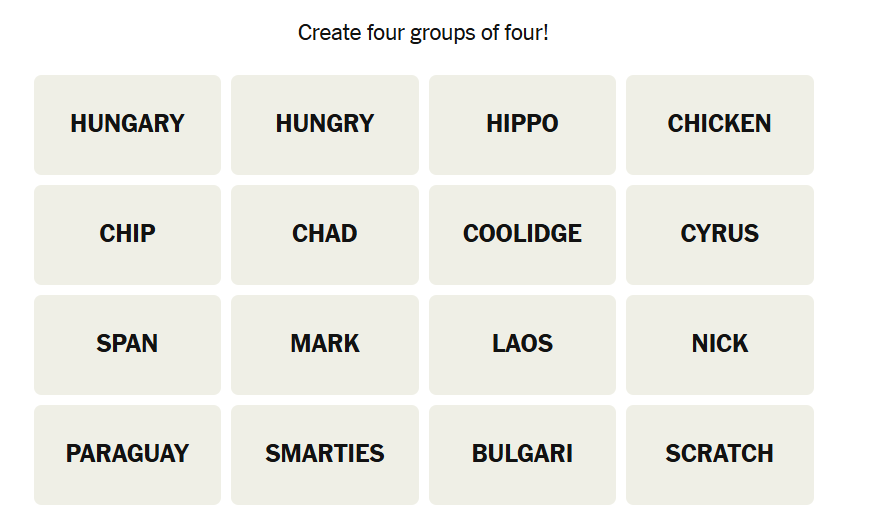
NYT Connections hints for October 16
- Yellow: Think about small defects or imperfections that appear on the surface of an object. These may result from everyday wear, accidental contact or minor physical damage.
- Green: Look for countries without direct access to an ocean coastline. These nations are surrounded by neighboring countries rather than having their own ocean-facing shores.
- Blue: Focus on words that become the names of European countries when exactly one missing letter is added. The existing letters must remain in their original order.
- Purple: Examine the beginning of each word rather than its complete meaning. The opening letters form familiar expressions associated with being fashionable, trendy or stylish.
Main trap: Today’s Connections puzzle #1223 includes two categories involving countries, making geography the biggest potential source of confusion. HUNGARY is an actual landlocked country in the green group, while HUNGRY belongs to the blue category because adding one letter produces HUNGARY. BULGARI and CYRUS also resemble proper names rather than obvious geographical clues. The purple group introduces another distraction because CHICKEN and HIPPO may suggest an animal-related category, even though their real connection involves words hidden at the beginning.
Blue clue: HUNGRY and SPAN are useful starting points because adding one letter transforms them into HUNGARY and SPAIN. Think about two additional words that become European country names through the same process. One resembles the name of a luxury fashion brand, while the other is commonly recognized as a person’s name.
Purple clue: CHICKEN and COOLIDGE appear unrelated, but their first letters spell CHIC and COOL. Both can describe something fashionable or stylish. HIPPO and SMARTIES follow the same pattern, beginning with HIP and SMART. The challenge is identifying these shorter descriptive words rather than grouping the complete answers by their ordinary meanings.
Today’s NYT Connections answers
Reveal the Yellow Group
Category: Surface imperfections
Answers: CHIP, MARK, NICK, SCRATCH
Each answer describes a small imperfection, visible defect or form of damage that can appear on the surface of an object.
CHIP refers to a small piece broken away from a larger object, leaving an irregular edge or visible defect. Chips frequently appear on ceramic dishes, painted furniture, glass and other hard materials.
MARK describes a visible spot, line, stain or other indication left on a surface. Marks can result from pressure, contact, dirt or ordinary wear.
NICK means a small cut, notch or indentation on an object’s surface or edge. A nick may appear on a knife blade, wooden table, metal object or piece of furniture.
SCRATCH refers to a narrow line or shallow groove created when a sharp or rough object moves across a surface. Scratches commonly appear on vehicle paint, phone screens, floors and furniture.
CHIP and SCRATCH are useful starting points because both are immediately recognizable forms of physical damage.
MARK may be harder to identify because the word has several unrelated meanings, including a grade, symbol, target or personal name.
NICK can also be confusing because it is commonly used as a person’s name and may refer to stealing something in informal British English.
CHIP presents another distraction because it can describe a snack, a computer component or a gambling token rather than damage to a surface.
SCRATCH may suggest an itch, a starting point or the act of canceling something, depending on the context.
MARK and NICK are particularly close in meaning when referring to small visible defects left by physical contact.
The main challenge is recognizing that all four words describe surface imperfections, even though their everyday meanings extend beyond physical damage.
Reveal the Green Group
Category: Landlocked countries
Answers: CHAD, HUNGARY, LAOS, PARAGUAY
Each answer names a country without a coastline on an ocean. These nations depend on overland connections or routes through neighboring territories to access maritime trade.
CHAD is a landlocked country in north-central Africa. It shares borders with Libya, Sudan, the Central African Republic, Cameroon, Nigeria and Niger. Its geographical position places it far from the nearest ocean coastline.
HUNGARY is a landlocked country in Central Europe. It borders Austria, Slovakia, Ukraine, Romania, Serbia, Croatia and Slovenia. The Danube River passes through Hungary and provides an important international waterway.
LAOS is a landlocked country in Southeast Asia. It shares borders with China, Vietnam, Cambodia, Thailand and Myanmar. Laos is the only country in mainland Southeast Asia without a coastline.
PARAGUAY is a landlocked country in South America, bordered by Argentina, Brazil and Bolivia. Despite lacking an ocean coastline, Paraguay uses major river systems for commercial transportation.
CHAD and PARAGUAY are strong starting points because both are familiar examples of landlocked nations in their respective continents.
HUNGARY may be confusing because the word HUNGRY also appears in today’s puzzle, creating an unusually direct spelling overlap between two categories.
LAOS may be less immediately recognizable to players who are unfamiliar with Southeast Asian geography.
HUNGARY creates another possible distraction because it is a European country, while the blue group also involves European country names.
However, the blue category contains words with a letter missing, whereas the green group consists of correctly spelled country names.
PARAGUAY may also surprise players because its extensive river connections provide access to international shipping routes despite its landlocked position.
The important distinction is geographical: all four countries lack an ocean coastline, regardless of their continent, climate or transportation networks.
The key is identifying the actual countries rather than confusing them with the altered country names appearing elsewhere in the puzzle.
Reveal the Blue Group
Category: European countries minus a letter
Answers: BULGARI, CYRUS, HUNGRY, SPAN
Each answer becomes the name of a country associated with Europe when exactly one letter is added without changing the order of the existing letters.
BULGARI becomes BULGARIA when an A is added at the end. Bulgaria is a country in southeastern Europe, located in the Balkans and bordering the Black Sea.
CYRUS becomes CYPRUS when a P is inserted between Y and R. Cyprus is an island country in the eastern Mediterranean, geographically situated in Western Asia but commonly associated with Europe through its political and cultural connections.
HUNGRY becomes HUNGARY when an A is inserted between G and R. Hungary is a landlocked country in Central Europe.
SPAN becomes SPAIN when an I is inserted between A and N. Spain occupies most of the Iberian Peninsula in southwestern Europe.
HUNGRY and SPAN are particularly useful starting points because both are familiar English words that transform into recognizable country names after adding one letter.
BULGARI may be confusing because it is also the name of an internationally recognized luxury brand associated with jewelry, watches and fashion accessories.
CYRUS presents another challenge because it is commonly used as a personal name and has historical associations with Persian rulers.
HUNGRY is perhaps the strongest distraction because HUNGARY appears as a separate answer in the green group.
SPAN can also mislead players because its everyday meaning relates to distance, duration, measurement or the extent of something.
The four transformations are BULGARI → BULGARIA, CYRUS → CYPRUS, HUNGRY → HUNGARY and SPAN → SPAIN.
Unlike categories based on synonyms or shared definitions, this group depends entirely on recognizing a spelling pattern.
The original words do not need to share similar meanings because their relationship becomes apparent only after the missing letters are restored.
The presence of HUNGARY and HUNGRY in separate categories makes this puzzle particularly unusual and increases the likelihood of an incorrect guess.
Once HUNGRY becomes HUNGARY and SPAN becomes SPAIN, the same one-letter addition rule can be applied to the remaining two answers.
The key is adding exactly one letter to each word without deleting, replacing or rearranging any existing letters.
Reveal the Purple Group
Category: Starting with words for “stylish”
Answers: CHICKEN, COOLIDGE, HIPPO, SMARTIES
Each answer begins with a shorter word that can describe someone or something fashionable, stylish, trendy or smartly presented.
CHICKEN begins with CHIC, a word commonly used to describe an elegant, fashionable or sophisticated appearance. Chic is frequently associated with clothing, interior design and personal style.
COOLIDGE begins with COOL, an informal expression used to describe something fashionable, appealing or admired. Coolidge is also a surname, most famously associated with former US President Calvin Coolidge.
HIPPO begins with HIP, a word meaning fashionable, trendy or aware of current cultural styles. The full word hippo refers to a hippopotamus, a large semiaquatic mammal.
SMARTIES begins with SMART, which can describe someone who is neatly or fashionably dressed, particularly in British English. Smarties is also the name of a familiar confectionery product.
CHICKEN and HIPPO may initially suggest an animal-related category because both words refer to recognizable animals.
COOLIDGE can be misleading because players may associate it with American history or presidential names rather than fashionable vocabulary.
SMARTIES may lead players toward candy, sweets or brand names instead of words describing personal appearance.
The hidden words are CHIC in CHICKEN, COOL in COOLIDGE, HIP in HIPPO and SMART in SMARTIES.
CHIC and COOL are strong starting points because both are widely recognized descriptions of fashionable or appealing styles.
HIP may be slightly harder to identify because its use as a synonym for fashionable is less common in some everyday conversations.
SMART may be the most unexpected connection because its primary meaning often relates to intelligence rather than clothing or appearance.
The purple category is particularly challenging because the complete answers do not share an obvious common meaning.
Unlike the blue group, which requires adding letters to form country names, the purple group requires identifying complete words already hidden at the beginning of longer answers.
Players do not need to rearrange or remove any letters. They simply need to recognize the fashionable expressions that appear at the start of each word.
The apparent animal connection between CHICKEN and HIPPO is one of the most tempting distractions in this category.
COOLIDGE and SMARTIES add difficulty because their familiar associations with history and confectionery can obscure the hidden descriptive words.
Once CHIC and COOL are recognized, HIP and SMART complete the four-word pattern.
The key is focusing on the opening letters rather than the definitions of the complete words.
Players can attempt the official daily puzzle and check their results on the New York Times Connections page.

Make Swikblog your go-to source on Google for reliable updates, smart insights, and daily trends.