

Looking for NYT Connections hints for October 17, 2026? Puzzle #1224 features four tricky word groups. Get spoiler-free clues before revealing today’s answers.
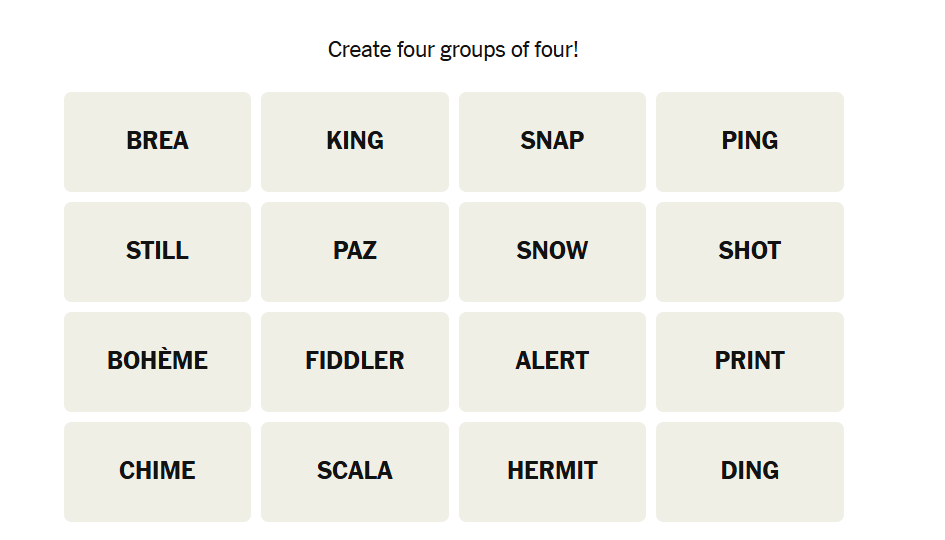
NYT Connections hints for October 17
- Yellow: Think about the sounds, signals and messages that appear when a digital device wants your attention. These familiar notifications can come from phones, computers and messaging applications.
- Green: Look for words commonly associated with photography. Each answer can describe a photograph or a particular form of photographic image.
- Blue: Focus on different varieties of a familiar crustacean. These creatures have hard outer shells, multiple legs and claws, but their names often come from distinctive physical characteristics or habitats.
- Purple: Consider a short two-letter word placed before each answer. Together, the combinations form recognizable names associated with music, geography and well-known places.
Main trap: Today’s Connections puzzle #1224 includes several short words with overlapping meanings. PING, DING and CHIME suggest sounds, while SHOT and SNAP can describe either photography or sudden actions. KING and SNOW may initially appear unrelated to marine life, and the purple category introduces names that look disconnected until the same word is placed before each one. The challenge is identifying the intended relationship rather than relying on the most familiar meaning of each answer.
Blue clue: HERMIT and KING provide useful starting points because both become recognizable crab names. FIDDLER refers to a crab known for the enlarged claw found on males, while SNOW identifies another commercially important variety. The four answers belong together because each can be followed by the word CRAB.
Purple clue: BREA and PAZ may appear to be unrelated geographical references, while BOHÈME and SCALA have strong connections to the performing arts. However, placing LA before each word creates familiar names: La Brea, La Paz, La Bohème and La Scala. The important clue is the shared word that comes before all four answers.
Today’s NYT Connections answers
Reveal the Yellow Group
Category: Digital notifications
Answers: ALERT, CHIME, DING, PING
Each answer describes a signal, sound or notification commonly associated with digital devices. Phones, computers, applications and online services use these alerts to inform users about messages, reminders and other activities.
ALERT refers to a notification designed to attract attention or communicate important information. Digital alerts may appear as banners, pop-up messages or warning sounds on smartphones and computers.
CHIME describes a short, often pleasant ringing sound. Electronic devices frequently use chimes to announce incoming messages, calendar reminders or completed actions.
DING represents a brief bell-like sound commonly associated with notifications. The word is also used informally to describe the sound produced when a message arrives or a device signals an event.
PING refers to a short electronic signal or notification. In everyday digital communication, someone might say they received a ping when a messaging application or workplace platform sends an alert.
CHIME and DING are useful starting points because both immediately suggest short notification sounds.
PING may also be easy to recognize for people familiar with messaging platforms, where the term is frequently used to describe contacting someone or receiving an electronic notification.
ALERT may be slightly harder to identify because it is a broader term that can describe a warning, a state of awareness or a notification rather than a particular sound.
CHIME can create confusion because it also refers to the sound of bells or other musical instruments.
DING may suggest a small dent or mark on a physical object, particularly a vehicle, instead of an electronic notification.
PING also has a technical meaning in computer networking, where it describes a method used to test connectivity between devices.
The key is recognizing that all four answers can describe ways digital technology gets a user’s attention.
Reveal the Green Group
Category: Photo
Answers: PRINT, SHOT, SNAP, STILL
Each answer can refer to a photograph or a photographic image. Although the words have different everyday meanings, they share a direct connection to photography and visual media.
PRINT refers to a physical reproduction of a photograph, typically produced on photographic paper or another printable surface. Before digital photography became widespread, printed photographs were one of the most common ways to preserve and share images.
SHOT describes a photograph or an image captured by a camera. Photographers commonly use the word when discussing a particular picture, camera angle or photographic composition.
SNAP is an informal term for a photograph, especially one taken quickly or casually. The word is closely associated with snapshots, which capture everyday moments without elaborate preparation.
STILL refers to a single stationary image, particularly when distinguished from moving pictures or video footage. Still photography captures individual moments rather than continuous motion.
SHOT and SNAP are useful starting points because both are widely used as informal alternatives to the word photograph.
PRINT may initially seem different because it describes a physical copy of an image rather than the act of taking a picture.
STILL can also be confusing because its more familiar meanings include remaining motionless, being quiet or continuing in a particular state.
SHOT has several unrelated meanings, including an attempt in sports, a small serving of alcohol or the discharge of a weapon.
SNAP may suggest breaking something suddenly, making a sharp sound or responding angrily rather than taking a photograph.
PRINT can also refer to written text, publishing, handwriting or patterns on fabric.
The connection becomes clearer when all four words are considered in the context of photography rather than their unrelated everyday uses.
The central idea is simple: PRINT, SHOT, SNAP and STILL can all describe photographic images.
Reveal the Blue Group
Category: Kinds of crabs
Answers: FIDDLER, HERMIT, KING, SNOW
Each answer identifies a type of crab. The four names refer to different groups of crustaceans, some recognized for unusual physical features and others for their importance in commercial seafood markets.
FIDDLER refers to a fiddler crab, a small crab commonly found in coastal mudflats, salt marshes and mangrove environments. Male fiddler crabs are especially recognizable because one claw is significantly larger than the other and is used in displays and communication.
HERMIT refers to a hermit crab, a crustacean known for occupying empty shells to protect its soft abdomen. As a hermit crab grows, it typically needs to find a larger shell.
KING refers to a king crab, a large marine crustacean valued in commercial fisheries. King crabs are particularly associated with cold northern waters, including parts of the North Pacific and Bering Sea.
SNOW refers to a snow crab, a commercially harvested crustacean found in cold ocean waters. Snow crabs are recognized for their relatively long legs and are widely sold as seafood.
HERMIT and KING are strong starting points because both are familiar crab names, even among people who do not regularly study marine animals.
FIDDLER may be less immediately recognizable because the word is also associated with someone who plays the fiddle, a musical instrument similar to a violin.
SNOW presents another distraction because its primary meaning relates to frozen precipitation rather than marine wildlife.
KING may suggest royalty, leadership, chess or playing cards instead of a type of crab.
HERMIT can also describe a person who lives in isolation or avoids social contact.
FIDDLER and HERMIT are particularly interesting because their names reflect recognizable characteristics or behaviors.
Male fiddler crabs are named for the appearance of their enlarged claw, while hermit crabs are associated with their habit of living inside borrowed shells.
KING and SNOW may be easier to connect for players familiar with seafood because both appear on restaurant menus and in commercial fishing discussions.
The four answers do not describe identical animals or habitats, but each forms the name of a recognized crab variety.
The simplest way to confirm the category is to place CRAB after every answer: FIDDLER CRAB, HERMIT CRAB, KING CRAB and SNOW CRAB.
Reveal the Purple Group
Category: La ____
Answers: BOHÈME, BREA, PAZ, SCALA
Each answer completes a recognizable name or expression when preceded by the word LA. The resulting combinations refer to places or well-known works and institutions associated with culture, geography and the performing arts.
BOHÈME completes the title La Bohème, the famous opera composed by Giacomo Puccini. The work follows the lives and relationships of young artists in Paris and remains one of the most frequently performed operas internationally.
BREA forms La Brea, a name associated with Los Angeles, California. The La Brea Tar Pits are particularly famous for their prehistoric fossils and natural asphalt deposits, which have preserved evidence of animals from the Ice Age.
PAZ forms La Paz, the name of Bolivia’s seat of government and a major city located high in the Andes. La Paz is known for its mountainous setting and distinctive urban geography.
SCALA forms La Scala, the internationally renowned opera house in Milan, Italy. Officially known as Teatro alla Scala, the venue has played a major role in the history of opera and classical music.
BREA and PAZ are useful starting points because both form recognizable geographical names when preceded by LA.
BOHÈME and SCALA provide another connection through the performing arts, although they refer to different things: an opera and an opera house.
BOHÈME may be difficult for players unfamiliar with classical music because the word is most recognizable as part of Puccini’s opera title.
BREA can be confusing because it rarely appears alone in everyday conversation outside specific place names.
PAZ may suggest the Spanish word for peace, while SCALA may be associated with the programming language of the same name.
SCALA also resembles the word scale, potentially leading players toward measurement, music or technical terminology.
One of the biggest distractions is that BOHÈME and SCALA share a musical connection, while BREA and PAZ are geographical names.
Players may therefore attempt to divide these answers into separate categories instead of identifying their shared opening word.
Unlike the yellow and green groups, which rely on related meanings, the purple category depends on completing familiar names using a common prefix.
The four combinations are LA BOHÈME, LA BREA, LA PAZ and LA SCALA.
The challenge is recognizing that the same two-letter word connects all four answers, despite the resulting names referring to different subjects.
Once LA is identified as the shared element, the purple category becomes straightforward.
Players can attempt the official daily puzzle and check their results on the New York Times Connections page.

Make Swikblog your go-to source on Google for reliable updates, smart insights, and daily trends.