
NYT Connections #1225 for Sunday, October 18, 2026, features tricky word groups, famous perfumes and hidden patterns.
NYT Connections hints for October 18
- Yellow: Think about places where you keep clothing when it is not being worn. These can include bedroom furniture, storage containers and larger spaces designed to hold shirts, jackets and other garments.
- Green: Look for everyday products and other materials that are commonly available in long, narrow forms. The answers come from very different categories, including food, personal care and items that are burned or ignited.
- Blue: Focus on famous fragrances. These words may initially suggest people, emotions or other familiar concepts, but each is also the name of a well-known perfume.
- Purple: Examine the beginning of each word rather than its complete meaning. The opening letters form words associated with foggy, hazy or misty conditions that can make the air appear cloudy.
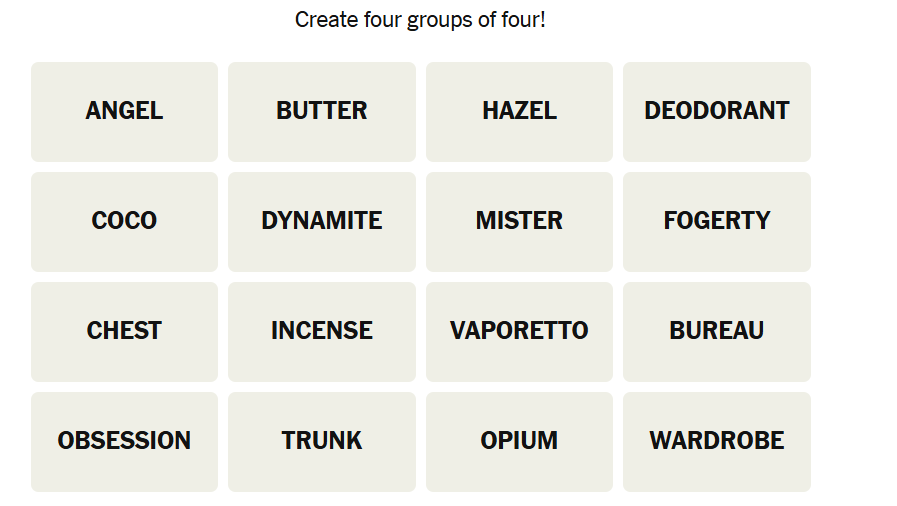
Main trap: Today’s Connections puzzle #1225 uses familiar words that can easily lead players toward the wrong categories. CHEST and TRUNK may suggest parts of the body or luggage, while BUTTER and INCENSE appear to have little in common. ANGEL and OBSESSION may look like emotional or abstract concepts rather than perfume names. The purple group adds another complication because its answers are connected through hidden beginnings rather than their complete meanings. The challenge is recognizing the intended relationships without being distracted by the most obvious interpretations.
Blue clue: COCO and OPIUM are useful starting points for players familiar with classic fragrances. ANGEL and OBSESSION complete the group because all four are established perfume names. The important connection is not their literal meanings but their association with recognizable fragrance products.
Purple clue: FOGERTY and HAZEL may initially appear unrelated, while MISTER and VAPORETTO seem to belong to entirely different subjects. However, their opening letters reveal the pattern: FOG in FOGERTY, HAZE in HAZEL, MIST in MISTER and VAPOR in VAPORETTO. Each beginning refers to something that can make the air cloudy or reduce visibility. Recognizing this hidden-word relationship is the key to solving the purple category.
Today’s NYT Connections answers
Reveal the Yellow Group
Category: Places to store clothes
Answers: BUREAU, CHEST, TRUNK, WARDROBE
Each answer describes furniture or a container that can be used to store clothing. Although these items differ in size, appearance and purpose, they all provide a place to keep garments organized when they are not being worn.
BUREAU refers to a chest of drawers commonly used in bedrooms for storing folded clothes. Depending on regional usage, the word may also describe an office, department or administrative organization.
CHEST describes a large storage box or a piece of furniture designed to hold clothing, blankets and other household belongings. A chest may have a hinged lid or drawers, depending on its design.
TRUNK refers to a large, sturdy container traditionally used for storing and transporting clothing and personal belongings. Trunks were especially common during long-distance travel before modern suitcases became widespread.
WARDROBE describes a tall cupboard or closet used for storing clothes. It commonly includes hanging space for shirts, dresses, coats and other garments, sometimes alongside shelves or drawers.
BUREAU and WARDROBE are useful starting points because both immediately suggest bedroom furniture designed for clothing storage.
CHEST may be slightly harder to identify because its most familiar meaning refers to the upper front portion of the human body.
TRUNK can also be misleading because it may describe the main stem of a tree, an elephant’s elongated nose or the luggage compartment of a car.
BUREAU has another common meaning in government and business, where it refers to an administrative office or organization.
WARDROBE can describe someone’s entire collection of clothing rather than the furniture used to store it.
CHEST and TRUNK may initially appear connected through anatomy because both can refer to the main part of the body.
However, the intended relationship is not anatomical. All four answers identify places where clothes can be kept.
The central connection is straightforward: BUREAU, CHEST, TRUNK and WARDROBE are all used for clothing storage.
Reveal the Green Group
Category: Things that come in sticks
Answers: BUTTER, DEODORANT, DYNAMITE, INCENSE
Each answer identifies something commonly available in stick form. The four items serve very different purposes, but their shared physical shape connects them in today’s puzzle.
BUTTER is a dairy product made primarily from churned cream. In the United States, butter is commonly packaged in rectangular sticks, making it convenient to measure portions for cooking and baking.
DEODORANT is a personal care product used to control body odor. Many deodorants are sold as solid sticks that can be applied directly to the underarms.
DYNAMITE is an explosive material historically manufactured in cylindrical sticks or cartridges. Its recognizable stick-like appearance is frequently depicted in historical illustrations and popular culture.
INCENSE refers to aromatic material burned to release a fragrance. Incense is commonly manufactured as thin sticks, although cones, coils and other forms are also available.
BUTTER and DEODORANT are strong starting points because both are familiar consumer products commonly sold in stick-shaped packaging.
INCENSE may be easy to recognize for people familiar with incense sticks used for fragrance, ceremonies or meditation.
DYNAMITE is likely to be the most unexpected answer because it belongs to a completely different category from food, personal care and fragrance products.
BUTTER may initially suggest other dairy products or cooking ingredients rather than a particular physical shape.
DEODORANT could lead players toward hygiene products, while INCENSE might suggest perfume, candles or other scented materials.
That possible fragrance connection creates an additional distraction because the blue group contains actual perfume names.
DYNAMITE may suggest explosions, mining or construction rather than an item that shares a shape with everyday products.
Unlike categories based on meaning or function, the green group depends on recognizing a common form in which these items are available.
The simplest way to confirm the category is to place STICK after each answer: BUTTER STICK, DEODORANT STICK, DYNAMITE STICK and INCENSE STICK.
Reveal the Blue Group
Category: Famous perfumes
Answers: ANGEL, COCO, OBSESSION, OPIUM
Each answer is the name of a well-known fragrance. The challenge is recognizing these words as perfume names rather than interpreting their everyday meanings.
ANGEL refers to Angel, the fragrance introduced by French fashion designer Thierry Mugler in 1992. It became particularly recognizable for its distinctive star-shaped bottle and sweet gourmand fragrance profile.
COCO refers to Coco, the perfume introduced by Chanel in 1984. Named in honor of Gabrielle “Coco” Chanel, the fragrance is associated with the fashion house’s long history in luxury perfumery.
OBSESSION refers to Obsession, a fragrance introduced by Calvin Klein in 1985. It became one of the brand’s recognizable perfume names and was supported by prominent advertising campaigns.
OPIUM refers to Opium, the perfume launched by Yves Saint Laurent in 1977. The fragrance became widely recognized for its distinctive name and rich oriental-style scent composition.
COCO and OPIUM provide useful starting points because both are established names associated with major French luxury fashion houses.
ANGEL may initially suggest a supernatural or religious figure rather than a fragrance.
OBSESSION can be misleading because its everyday meaning describes an intense or persistent preoccupation with someone or something.
COCO might also suggest coconut, a nickname or a person’s name rather than the Chanel fragrance.
OPIUM has a separate meaning as a narcotic substance derived from the opium poppy, making its connection to perfume less obvious to unfamiliar players.
ANGEL and OBSESSION may appear to form a category involving emotions, relationships or abstract concepts, but that interpretation does not explain all four words.
Another potential distraction comes from INCENSE in the green group, which is also associated with scent and fragrance.
However, INCENSE is not one of the four perfume names in today’s intended blue category.
All four blue answers are associated with established fragrance brands and products.
The connection becomes clear when the names are considered together: ANGEL by Mugler, COCO by Chanel, OBSESSION by Calvin Klein and OPIUM by Yves Saint Laurent.
Players familiar with classic perfume advertising, department-store fragrance counters or major fashion houses may find this category easier than expected.
The key is recognizing these four words as specific perfume names rather than general descriptions of scents or emotions.
Reveal the Purple Group
Category: Starting with things that cloud the air
Answers: FOGERTY, HAZEL, MISTER, VAPORETTO
Each answer begins with a word associated with substances or conditions that can make the air appear cloudy. Unlike the other categories, the purple group does not depend on the meaning of each complete answer. Instead, players must identify a shorter word hidden at its beginning.
FOGERTY begins with FOG, a collection of tiny water droplets suspended near the ground that can significantly reduce visibility. Fog is commonly associated with cool, humid conditions and can affect road, rail and air travel.
FOGERTY is also a surname, notably associated with American musician John Fogerty, known for his work with Creedence Clearwater Revival.
HAZEL begins with HAZE, a condition in which fine particles or droplets in the atmosphere make the air appear less clear. Haze can reduce visibility and may be associated with dust, smoke or atmospheric pollution.
HAZEL is also a familiar name, a type of tree and a term used to describe certain eye colors. These unrelated meanings can make its hidden beginning easy to overlook.
MISTER begins with MIST, which consists of tiny water droplets suspended in the air. Mist resembles fog but is generally associated with less severe reductions in visibility.
MISTER can also refer to a device that sprays a fine mist of water. The word may additionally be confused with the spoken title “Mr.,” making it an especially interesting answer.
VAPORETTO begins with VAPOR, referring to a substance in its gaseous state. In everyday language, vapor can also describe visible clouds of condensed droplets associated with steam or other airborne moisture.
VAPORETTO is an Italian term commonly associated with the public water buses that operate in Venice. Its complete meaning has little to do with cloudy atmospheric conditions.
FOGERTY and HAZEL may initially look like names, which could encourage players to search for a category involving people or surnames.
MISTER may suggest titles, forms of address or spraying equipment, while VAPORETTO may lead players toward Italian transportation.
These interpretations create a deliberate distraction because the complete words do not belong to one obvious everyday category.
FOG and HAZE provide a useful starting point because both are closely associated with reduced atmospheric visibility.
MIST offers a third connection through tiny airborne water droplets, while VAPOR completes the pattern with another term associated with airborne moisture or gas.
The hidden words are positioned at the beginning of each answer, making this a prefix-based wordplay category.
Unlike the yellow group, which connects physical storage items, or the blue group, which connects recognizable products, the purple group requires players to examine spelling and word structure.
The four hidden beginnings are FOG in FOGERTY, HAZE in HAZEL, MIST in MISTER and VAPOR in VAPORETTO.
The challenge is identifying the smaller atmospheric words without being distracted by the meanings of the complete answers.
Once the shared pattern is recognized, the purple category becomes much easier to understand.
Players can attempt the official daily puzzle and check their results on the New York Times Connections page.

Make Swikblog your go-to source on Google for reliable updates, smart insights, and daily trends.