
Today’s NYT Connections puzzle #1231 for Saturday, October 24, 2026, brings a tricky mix of familiar words, with food-related distractions and unexpected connections that could easily lead to wrong guesses.
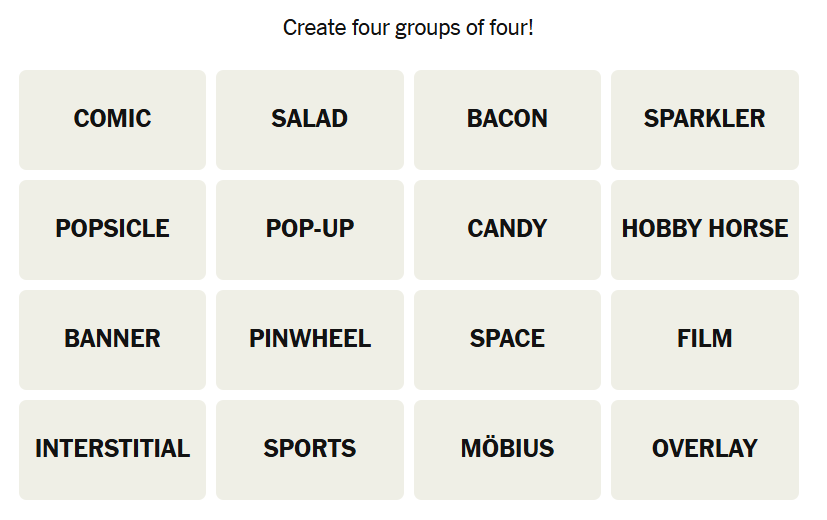
NYT Connections hints for October 24
- Yellow: Think about different things that can be described as strips. Some are familiar from breakfast or newspaper entertainment, while others are associated with photography and mathematics. The four answers come from unrelated subjects, but each forms a recognizable expression when followed by the same word.
- Green: Look for objects that are attached to sticks or supported by stick-like handles. Some are popular at fairs and celebrations, while another is a traditional children’s toy. Their purposes differ, but the way they are constructed or held provides the connection.
- Blue: Focus on the different formats used to display advertisements on websites and digital applications. Some appear within designated advertising spaces, while others cover content or interrupt the browsing experience. The four words describe ways advertisements are presented rather than the products being advertised.
- Purple: Think about ordinary words that form familiar expressions when followed by the same three-letter word. The completed phrases include two food-related terms, a type of entertainment venue and a familiar computer keyboard term. The key is identifying the shared ending rather than grouping the words by their individual meanings.
Main trap: Today’s Connections puzzle #1231 contains several food-related words that could suggest a single category. BACON, CANDY, POPSICLE and SALAD might initially appear to belong together, but they are deliberately separated. BACON belongs to the yellow category because it forms BACON STRIP, while POPSICLE belongs to the green category because it is served on a stick. CANDY and SALAD belong to the purple category because both form familiar expressions ending in BAR. COMIC and SPORTS may also appear related through entertainment, while BANNER, OVERLAY and POP-UP have meanings outside advertising. Recognizing the specific relationship behind each group is essential to avoiding incorrect guesses.
Blue clue: BANNER and POP-UP provide useful starting points because both are familiar online advertising formats. A BANNER typically occupies a designated area of a webpage, while a POP-UP appears in a separate window or over the current interface. OVERLAY refers to advertising displayed on top of existing content, and INTERSTITIAL describes an advertisement appearing between content views or during a transition. All four terms belong together because they identify ways digital advertisements are displayed, even though their placement and behavior differ.
Purple clue: CANDY and SALAD are useful starting points because they form CANDY BAR and SALAD BAR. SPORTS follows the same pattern through SPORTS BAR, an establishment where customers commonly watch sporting events. SPACE completes the category through SPACE BAR, the familiar keyboard term usually written as SPACEBAR. Although these completed expressions describe different objects and places, they all share the same final word. Recognizing this word-combination pattern reveals the intended relationship.
Today’s NYT Connections answers
Reveal the Yellow Group
Category: Kinds of strips
Answers: BACON, COMIC, FILM, MÖBIUS
Each answer forms a recognizable expression involving a strip. The four words come from food, entertainment, photography and mathematics, but they share the same final word.
BACON forms BACON STRIP.
A bacon strip is a long, narrow slice of cured pork.
Bacon is commonly served as part of breakfast meals and is also used in sandwiches, salads and other dishes.
Its familiar sliced form makes BACON one of the more straightforward yellow answers.
However, BACON can also mislead players because several other food-related words appear in today’s puzzle.
CANDY, POPSICLE and SALAD might initially seem connected to BACON.
Although all four involve food, they do not belong to the same Connections category.
BACON specifically belongs to the group involving strips.
COMIC forms COMIC STRIP.
A comic strip is a short sequence of illustrated panels that tells a story or presents a joke.
Comic strips have traditionally appeared in newspapers, magazines and other printed publications.
Many are also published online.
Some comic strips feature recurring characters and continuing storylines.
Others present a complete joke or situation in only a few panels.
The word COMIC can also refer to a comedian or something humorous.
That broader meaning may encourage players to search for a category involving entertainment.
Because SPORTS also appears in today’s puzzle, players may initially consider a connection involving leisure activities.
However, the intended expression is COMIC STRIP.
FILM forms FILM STRIP.
A filmstrip is a length of photographic film containing a sequence of images.
Filmstrips were historically used in educational presentations, photography and visual instruction.
They could display a series of still images in a particular order.
The physical film itself is typically a long, narrow band.
This makes FILM a natural fit for the category.
However, FILM also commonly refers to movies and cinema.
That meaning might encourage players to associate FILM with COMIC because both can involve visual storytelling.
Although that connection is understandable, the category specifically concerns kinds of strips.
MÖBIUS forms MÖBIUS STRIP.
A Möbius strip is a mathematical surface with only one side and one boundary component.
It can be made by taking a strip of paper, giving one end a half-twist and joining the ends together.
The resulting shape has unusual geometric properties.
For example, someone tracing a continuous path along its surface can return to the starting point after traveling over what initially appears to be both sides.
The Möbius strip is studied in mathematics and is also used as an inspiration in art and design.
MÖBIUS may be the least familiar yellow answer because it refers to a specialized mathematical concept.
Unlike BACON, COMIC and FILM, it does not immediately suggest an everyday strip.
However, MÖBIUS STRIP is a well-established mathematical term.
BACON STRIP refers to a narrow slice of food.
COMIC STRIP refers to a sequence of illustrated panels.
FILM STRIP refers to a length of photographic film.
MÖBIUS STRIP refers to a mathematical surface.
The completed expressions have different meanings, but all share the word STRIP.
The central connection is straightforward: BACON, COMIC, FILM and MÖBIUS can all be followed by STRIP to form established expressions.
Reveal the Green Group
Category: Things on sticks
Answers: HOBBY HORSE, PINWHEEL, POPSICLE, SPARKLER
Each answer describes an object commonly attached to a stick or supported by a stick-like handle.
The four objects serve different purposes, but their physical construction provides the intended relationship.
HOBBY HORSE is a traditional children’s toy consisting of a horse’s head attached to a long stick.
Children can hold or straddle the stick and pretend to ride a horse.
The toy encourages imaginative play and has existed in different forms for generations.
Some hobby horses have wooden heads, while others feature soft fabric or plush materials.
The stick provides the central structure that allows the toy to be held and used.
HOBBY HORSE may initially suggest animals, riding or children’s games.
However, its construction makes it a clear example of something on a stick.
PINWHEEL is a small rotating toy or decoration commonly attached to a stick.
It usually consists of folded paper or plastic blades arranged around a central point.
When wind moves across the blades, the pinwheel spins.
Pinwheels are often used as children’s toys, garden decorations and festive accessories.
The supporting stick allows the object to be held or positioned upright.
Unlike a hobby horse, which is used for pretend riding, a pinwheel is designed to rotate.
However, both objects share the same general construction feature.
POPSICLE is a frozen treat commonly served on a wooden or plastic stick.
The stick allows someone to hold the frozen dessert without touching the icy portion directly.
Popsicles may be made from flavored water, fruit juice or other ingredients.
They are particularly popular during warm weather and outdoor events.
POPSICLE is one of the most deceptive green answers because it also belongs to the broader subject of food.
Players might initially group it with BACON, CANDY or SALAD.
However, the intended category does not concern edible products.
It concerns objects that are attached to sticks.
Recognizing the handle used to hold a popsicle reveals the correct connection.
SPARKLER is a handheld pyrotechnic device that produces bright sparks while burning.
A typical sparkler consists of a thin metal wire coated with a combustible composition.
The uncoated portion serves as a handle.
Sparklers are commonly associated with celebrations, festivals and holiday events.
They produce visible sparks as the coated material burns.
Unlike a pinwheel, which moves because of wind, a sparkler produces light through combustion.
However, both are commonly supported by a narrow stick-like structure.
Sparklers can remain extremely hot after burning and should be handled carefully.
HOBBY HORSE uses a stick as part of a children’s riding toy.
PINWHEEL uses a stick to support a rotating decoration.
POPSICLE uses a stick as a handle for a frozen treat.
SPARKLER uses a wire handle to support its burning composition.
The four objects do not share one purpose.
Instead, they share a recognizable physical feature.
This makes the green category easier once players stop looking for connections involving food, toys or celebrations alone.
The central connection is straightforward: HOBBY HORSE, PINWHEEL, POPSICLE and SPARKLER are all things commonly found on sticks.
Reveal the Blue Group
Category: Online ad formats
Answers: BANNER, INTERSTITIAL, OVERLAY, POP-UP
Each answer identifies a format used to display advertising on websites, applications or other digital platforms.
The intended relationship concerns the presentation of advertisements rather than the products or services being promoted.
BANNER refers to an advertisement displayed within a designated area of a webpage or application.
Banner advertisements commonly appear near the top, bottom or sides of online content.
They may contain text, images, animations or interactive elements.
Advertisers use banners to promote products, services, events and brands.
Some banner advertisements remain in a fixed location, while others move with the page or adapt to different screen sizes.
The word BANNER also refers to a flag, sign or large piece of material displaying a message.
That everyday meaning can distract players from the digital advertising connection.
However, BANNER AD is a widely recognized online advertising term.
INTERSTITIAL describes an advertisement displayed between content views or during a transition within a website or application.
Interstitial advertisements often occupy a substantial portion of the screen.
They may appear when a user moves between pages, opens a new section or reaches a natural break in an application.
Some interstitial advertisements contain images, videos or interactive content.
Unlike ordinary banner advertisements, interstitials may temporarily interrupt the user’s activity.
This can make them more noticeable, but it can also affect the browsing experience.
Websites and applications must consider usability when displaying these advertisements.
INTERSTITIAL is likely one of the harder blue answers because the term is less familiar outside advertising and technology.
However, it clearly belongs to the category of online advertising formats.
OVERLAY refers to advertising content displayed over another element on a webpage, video or application screen.
Overlay advertisements may partially cover the content underneath.
For example, an advertisement might appear across the lower portion of a video player.
Some overlays remain visible until dismissed.
Others disappear automatically after a certain period.
The term OVERLAY also has broader meanings in graphic design, mapping and software interfaces.
It can describe one visual layer placed over another.
That meaning may initially suggest a general technology category rather than advertising.
However, an overlay advertisement is an established digital advertising format.
POP-UP describes an advertisement or promotional message that appears in a separate window or over the current interface.
Pop-up advertisements became widely associated with web browsing as online advertising developed.
Modern browsers often include features designed to block unwanted pop-up windows.
Some websites also display promotional messages in pop-up interfaces within the webpage itself.
These advertisements may promote subscriptions, products, discounts or other offers.
POP-UP also has everyday meanings unrelated to advertising.
It can describe temporary stores, events or objects that suddenly appear.
Those alternative meanings may lead players toward unrelated categories.
However, the intended meaning concerns digital advertising.
BANNER and POP-UP provide useful starting points because both are familiar online advertising terms.
OVERLAY strengthens the relationship because it describes promotional content displayed over existing material.
INTERSTITIAL completes the group because it identifies advertising presented between content views.
The formats differ in placement and behavior.
A BANNER typically occupies a designated advertising area.
An INTERSTITIAL appears between content views or during transitions.
An OVERLAY appears on top of existing content.
A POP-UP appears in a separate window or over the current interface.
Although their implementations may overlap, all four describe recognized digital advertising formats.
The main distraction is that several words also describe ordinary interface elements.
A banner can be a general website header.
An overlay can be a visual layer unrelated to advertising.
A pop-up can be a notification or dialog box.
However, the advertising meaning provides the intended connection.
The central connection is straightforward: BANNER, INTERSTITIAL, OVERLAY and POP-UP are all formats used to display online advertisements.
Reveal the Purple Group
Category: ____ bar
Answers: CANDY, SALAD, SPACE, SPORTS
Each answer forms a familiar expression when followed by the word BAR.
Unlike the other categories, the purple group does not depend on the original words sharing a common definition.
Instead, players must recognize that adding the same word creates four recognizable expressions.
CANDY forms CANDY BAR.
A candy bar is a packaged sweet commonly made with chocolate, caramel, nuts, nougat or other confectionery ingredients.
Candy bars are widely sold in grocery stores, convenience stores and vending machines.
They are often produced in elongated shapes that can be held and eaten individually.
The word BAR describes the familiar solid form of the product.
CANDY is one of the most tempting distractions in today’s puzzle because several other food-related words appear.
BACON, POPSICLE and SALAD might initially seem connected to CANDY.
However, the intended relationship is the expression CANDY BAR.
SALAD forms SALAD BAR.
A salad bar is a self-service food station offering vegetables, greens, dressings and other ingredients.
Salad bars are commonly found in restaurants, cafeterias, supermarkets and buffet-style dining establishments.
Customers can select ingredients and assemble their own salads.
The term BAR refers to the serving counter or station rather than a solid rectangular object.
This distinction matters because BAR does not need to have the same meaning in every completed expression.
SALAD may initially appear connected to BACON or POPSICLE because all three are foods.
However, SALAD BAR is the intended phrase.
SPACE forms SPACE BAR.
A spacebar is the long key on a computer keyboard used to insert spaces between words or other characters.
It is generally one of the longest keys on a standard keyboard.
Pressing the spacebar moves the typing position forward by inserting a blank space.
The term is normally written as one word, SPACEBAR, although the puzzle separates SPACE and BAR to create the shared-word pattern.
SPACE may initially suggest astronomy, distance or empty areas.
Those meanings do not obviously connect with CANDY, SALAD or SPORTS.
However, recognizing the keyboard term reveals the intended connection.
SPORTS forms SPORTS BAR.
A sports bar is a restaurant or drinking establishment where customers commonly watch sporting events on television.
Sports bars often feature multiple screens showing football, basketball, baseball and other competitions.
They may serve food and drinks while providing a social setting for fans.
The term is widely recognized in entertainment and hospitality.
SPORTS may initially suggest athletic activities, competitions or physical exercise.
Because COMIC also appears in today’s puzzle, players might consider a broader entertainment category.
However, SPORTS BAR provides the intended connection.
CANDY BAR refers to a confectionery product.
SALAD BAR refers to a self-service food station.
SPACE BAR refers to the familiar keyboard key, normally written as SPACEBAR.
SPORTS BAR refers to an establishment where people watch sporting events.
These completed expressions have different meanings.
That variation explains why the purple category can be difficult.
The original words also suggest unrelated subjects.
CANDY suggests sweets and confectionery.
SALAD suggests vegetables and prepared dishes.
SPACE suggests astronomy or empty areas.
SPORTS suggests athletic competition.
When considered separately, these meanings may lead players toward incorrect categories.
The intended relationship becomes clearer when the same word is added after each answer.
Unlike the yellow category, which involves different kinds of strips, the purple category depends on recognizing a shared word ending.
The green category groups objects supported by sticks.
The blue category concerns online advertising formats.
The purple category instead focuses on forming familiar expressions.
CANDY becomes CANDY BAR.
SALAD becomes SALAD BAR.
SPACE becomes SPACE BAR.
SPORTS becomes SPORTS BAR.
All four completed expressions are recognizable, even though they describe different things.
The category does not require the original words to be synonyms.
Nor does it require the completed expressions to belong to one subject area.
The connection is based on the shared word BAR.
Players who initially associate CANDY and SALAD with other food words may overlook this relationship.
SPACE might suggest astronomy or technology, while SPORTS might suggest athletic activities.
However, these different associations are precisely what make the grouping deceptive.
Recognizing CANDY BAR provides one useful way into the pattern.
SALAD BAR strengthens the possibility that BAR is the shared word.
SPACE BAR and SPORTS BAR then confirm the relationship.
The central connection is straightforward: CANDY, SALAD, SPACE and SPORTS can all be followed by BAR to form familiar expressions.
Players can attempt the official daily puzzle and check their results on the New York Times Connections page.

Make Swikblog your go-to source on Google for reliable updates, smart insights, and daily trends.