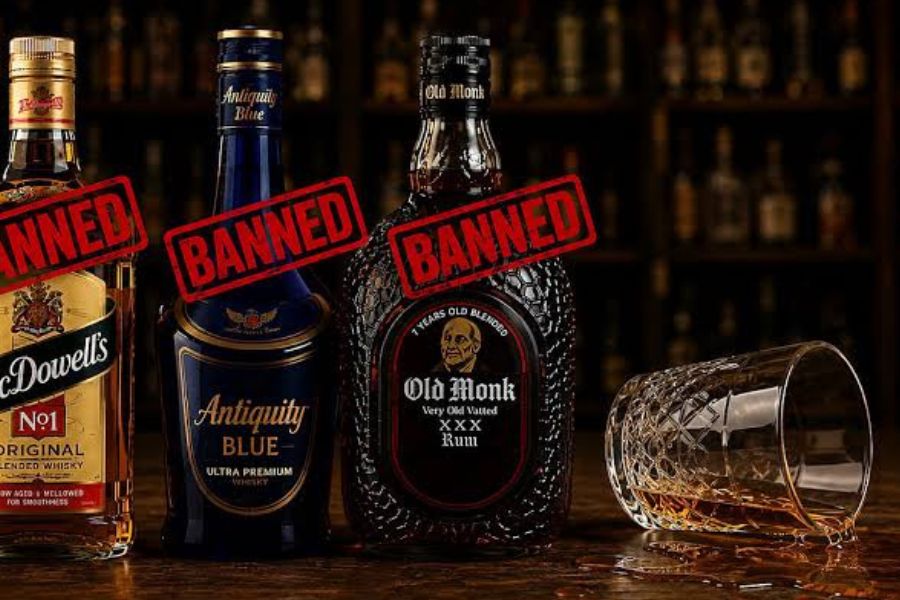

India’s food-safety regulator has taken action against selected rum and whisky products linked to Old Monk, McDowell’s No. 1, Antiquity Blue, Royal Challenge and other familiar brands. Laboratory tests cited by the Food Safety and Standards Authority of India found artificial or nature-identical flavours in sampled products, while an Old Monk age declaration was also questioned.
This is not a blanket ban on every bottle carrying these brand names. The orders concern specified products manufactured at identified facilities. Consumers should check the complete variant and manufacturing address instead of relying only on the main brand name.
Is Old Monk completely banned in India?
No nationwide prohibition covering every Old Monk product has been announced. FSSAI named three variants manufactured by Mohan Rocky Springwater at its Khopoli unit in Maharashtra:
- Old Monk The Legend
- Old Monk Gold Reserve
- Old Monk XXX Matured Rum
Other Old Monk products should not automatically be treated as banned unless their variant and manufacturing details match the regulatory action.
Full list of products facing FSSAI action
- Old Monk The Legend, Gold Reserve and XXX Matured Rum: Mohan Rocky Springwater, Khopoli, Maharashtra.
- McDowell’s No. 1 Rum: United Spirits, Baramati, Maharashtra.
- Bagpiper Deluxe Whisky and Old Cask Deluxe XXX Rum: INBREW Beverages, Madhya Pradesh.
- Central Province Whisky and McDowell’s No. 1 Celebration Matured XXX Rum: Associated Alcohol & Breweries, Madhya Pradesh.
- Antiquity Blue Whisky and Royal Challenge Whisky: United Spirits, Madhya Pradesh.
FSSAI also inspected Mandexi Distilleries & Breweries in Goa and served notices on six additional manufacturers in Maharashtra. An inspection or notice does not necessarily mean a final ban; further action depends on laboratory findings and regulatory proceedings.
Why were the products flagged?
Rum and whisky are standardised alcoholic beverages whose recognised characteristics normally come from ingredients, fermentation, distillation, blending and maturation. According to FSSAI, some tested products contained external flavours that imitated the drink’s defining character—for example, rum flavour added to rum or whisky flavour added to whisky.
The regulator said these substances could mask the natural profile and make a product substandard if it continued to be sold as conventional rum or whisky. It may instead require a description such as flavoured or premixed spirit.
This does not mean every flavour in alcohol is prohibited. Coffee, vanilla and other permitted flavours may be used where legally allowed and accurately declared. India’s official Alcoholic Beverages Regulations set the applicable composition and labelling standards.
Why was Old Monk’s seven-year claim questioned?
Old Monk XXX Matured Rum reportedly carried a “7 years old blended” declaration. FSSAI’s investigation found that neutral, unmatured spirit was the main component, while matured rum spirit accounted for less than 5%.
Under the regulations, the age declared for a blended spirit must correspond to the youngest spirit in the blend. FSSAI therefore considered the seven-year presentation misleading. Accurate age and ingredient declarations are central to consumer protection against misleading product claims because they can influence perceptions of quality and price.
Does “substandard” mean unsafe or poisonous?
The disclosed action concerns composition, flavouring and labelling compliance. Authorities have not described it as a methanol, toxic-contamination or poisoning incident.
“Substandard” means that a tested product allegedly failed to meet the prescribed requirements for the category in which it was sold. It should not automatically be interpreted as evidence of an immediate health emergency, although alcohol consumption carries its own established health risks.
Can existing bottles still be sold?
Following appeals by two manufacturers, FSSAI reportedly conditionally revoked prohibition orders covering their existing stock. The products could be sold only if their true nature was prominently disclosed on the front of the package.
For future production, manufacturers were directed not to add flavours identical to the beverage itself. This conditional relief should not be assumed to cover every product or manufacturer. Availability may differ by batch, producer, retailer and state-level excise arrangements.
AliExpress Hit With €550 Million EU Fine: What the Record Penalty Means for Shoppers
Wise’s U.S. Banking Licence Rejected: Why Regulators Said No and What Happens Next
Visit the homepage for the latest business news, fintech updates and global market stories
How can consumers check a bottle?
- Match the full variant name with the affected list.
- Check the manufacturer and production address.
- Look for the batch number and manufacturing date.
- Check for a revised flavoured or premixed declaration.
- Ask the licensed retailer about the product’s sale status.
A bottle remaining on a shop shelf does not necessarily prove that the order has been ignored. It may be existing stock cleared for sale after corrected disclosure.
What have the companies said?
United Spirits, Diageo India’s listed subsidiary, filed a Bombay High Court petition on August 1 challenging an FSSAI order dated June 29 concerning a product from its Baramati unit. The company maintains that its labels comply with applicable law and reflect longstanding industry practice. Associated Alcohols & Breweries has also challenged the regulator’s action.
The dispute arrives during broader changes at the global drinks company, including Diageo’s 2026 restructuring and planned role reductions.
Will the affected products return?
A restriction over formulation or labelling does not necessarily mean a permanent disappearance. Manufacturers could reformulate products, remove disputed flavouring, change the product category, revise labels or secure relief through regulatory appeals or court proceedings.
FSSAI has taken action against select Old Monk rum variants over alleged artificial flavouring and misleading age claims. The restrictions apply only to identified variants and are not a ban on the entire brand.#OldMonk #FSSAI #Rum #FoodSafety #India pic.twitter.com/Sw9xRlCwKM
— Cloud TV (@cloudTV_NEWS) August 5, 2026
No common return date had been announced as of August 5. The most accurate position is that selected products from named manufacturing units face FSSAI action—not that every Old Monk, McDowell’s, Antiquity Blue, Royal Challenge or Bagpiper product has been permanently banned across India.
The Food Safety and Standards Authority of India (FSSAI) has cracked down on specific variants of popular liquor brands including Old Monk, McDowell’s No. 1, Royal Challenge, Antiquity Blue, and Bagpiper for regulatory violations. According to the regulator, manufacturers were… pic.twitter.com/lPC7p1rh2g
— Pune Mirror (@ThePuneMirror) August 5, 2026

Make Swikblog your go-to source on Google for reliable updates, smart insights, and daily trends.