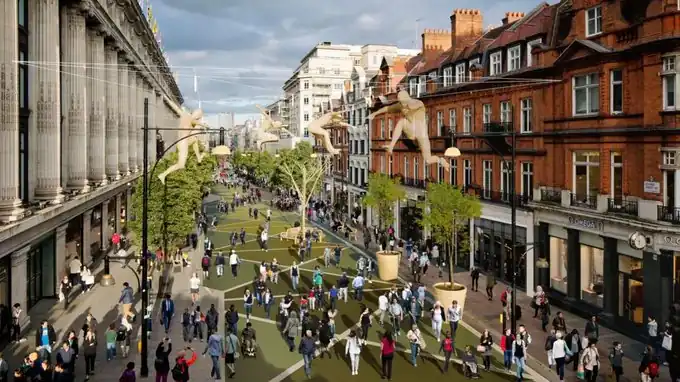

LONDON — Oxford Street will undergo a major change from October 26, with almost a kilometre of the famous shopping street becoming traffic-free as London begins its long-planned pedestrianisation project ahead of the Christmas shopping rush.
🚨 NEW: Oxford Street will officially be pedestrianised from Monday 26 October pic.twitter.com/5X6Oj4PJUl
— Politics UK (@PolitlcsUK) September 28, 2026
The new traffic-free zone will run between Orchard Street and Great Portland Street, including Oxford Circus. Buses, taxis, private-hire vehicles, bicycles, scooters, pedicabs and private motor vehicles will be excluded during the main pedestrian period. Emergency services will retain access. :chatgpt-content-reference{index=”0″}
Oxford Street will be traffic-free from 7am to midnight
The restrictions are planned to operate every day from 7am until midnight. Between midnight and 7am, delivery and servicing vehicles will be allowed to enter using designated access routes so shops, restaurants and other businesses can continue receiving stock and essential services. :chatgpt-content-reference{index=”1″}
Goods can still be moved into the area on foot or using pedestrian trolleys outside the vehicle-servicing window. TfL says businesses may need to change delivery schedules before the new arrangements begin.
The October launch will not immediately create the finished permanent plaza. Temporary layouts and servicing routes will be used first while authorities monitor how pedestrians, businesses and surrounding roads respond.
Five daytime bus routes are directly affected
Bus passengers will face some of the most noticeable changes. Routes 7, 94, 98, 139 and 390 currently use the western section of Oxford Street during the day. Night routes including N7, 94, N98, N113, N137, 139, N207 and 390 also use the street. TfL has planned route changes and diversions while maintaining surrounding connections. :chatgpt-content-reference{index=”2″}
Travellers should check TfL’s latest Oxford Street travel advice before travelling because preparatory works and bus changes are being introduced in stages.
Tube and rail services around Oxford Street are continuing to operate normally during the current preparation works. :chatgpt-content-reference{index=”3″}
Cyclists and taxis will need alternative routes
Cycling will also be prohibited within the traffic-free section during pedestrian hours. Delivery riders arriving by bicycle will need to dismount before entering and complete deliveries on foot. Cargo bikes can use designated servicing routes during permitted overnight hours. :chatgpt-content-reference{index=”4″}
Black cabs and private-hire vehicles will no longer travel directly along the pedestrianised stretch during restricted hours, increasing the importance of surrounding taxi ranks and nearby drop-off points.
Some north-south traffic crossings will remain open. TfL’s plans preserve vehicle crossings at locations including Duke Street, Davies Street and Stratford Place, Vere Street and New Bond Street, and Holles Street and Harewood Place. :chatgpt-content-reference{index=”5″}
UK State Pension Set for £488 Rise From April 2027
UK Student Loan Guidance Changes: What Borrowers Need to Know
Christmas shopping will provide an immediate test
The October 26 start puts the scheme into operation shortly before Oxford Street enters one of its busiest periods of the year.
More pedestrian space could make it easier for large numbers of shoppers to move through Oxford Circus and the surrounding retail district, but the first Christmas period will also test whether bus diversions, deliveries and displaced road traffic can be managed without creating serious congestion elsewhere.
The changes follow wider efforts to rethink movement through central London. Recent Victoria line disruption in central London also highlighted how changes affecting major West End transport links can quickly alter journeys across the capital.
Westminster raises accessibility and traffic concerns
Westminster City Council has continued to raise concerns about the project, particularly around accessibility, bus routes, traffic displacement, pollution, noise, waste management and public safety. The council has argued that vehicles removed from Oxford Street could increase pressure on nearby roads. :chatgpt-content-reference{index=”6″}
The council has also highlighted the potential impact on disabled people, older residents and parents with young children who may rely on buses or taxis instead of the Underground. It has specifically raised concerns about access to step-free routes, crossings, bus services, taxis and toilets. :chatgpt-content-reference{index=”7″}
Preparatory roadworks are already under way
TfL says work has begun around Oxford Street, Regent Street, Bond Street and Great Portland Street. Temporary closures, lane restrictions, diversions and parking changes are being introduced while road layouts are prepared for the traffic-free zone. :chatgpt-content-reference{index=”8″}
Drivers are being warned to expect longer journey times in some periods, while cyclists may encounter temporary diversions before the permanent restrictions take effect.
The scheme follows years of debate over Oxford Street’s future. A 2025 consultation received more than 6,000 responses, with around two-thirds of respondents who answered the pedestrianisation question supporting the principle, according to TfL. :chatgpt-content-reference{index=”9″}
Swikblog previously covered the Oxford Street pedestrianisation and vehicle-ban plans as the proposals moved toward implementation.
For shoppers, October 26 will bring the most visible change yet: a long central stretch of Oxford Street operating primarily as pedestrian space during the day. For commuters, retailers and nearby residents, the key question will be how smoothly London’s surrounding transport network adapts once the traffic disappears from Oxford Street itself.

Make Swikblog your go-to source on Google for reliable updates, smart insights, and daily trends.