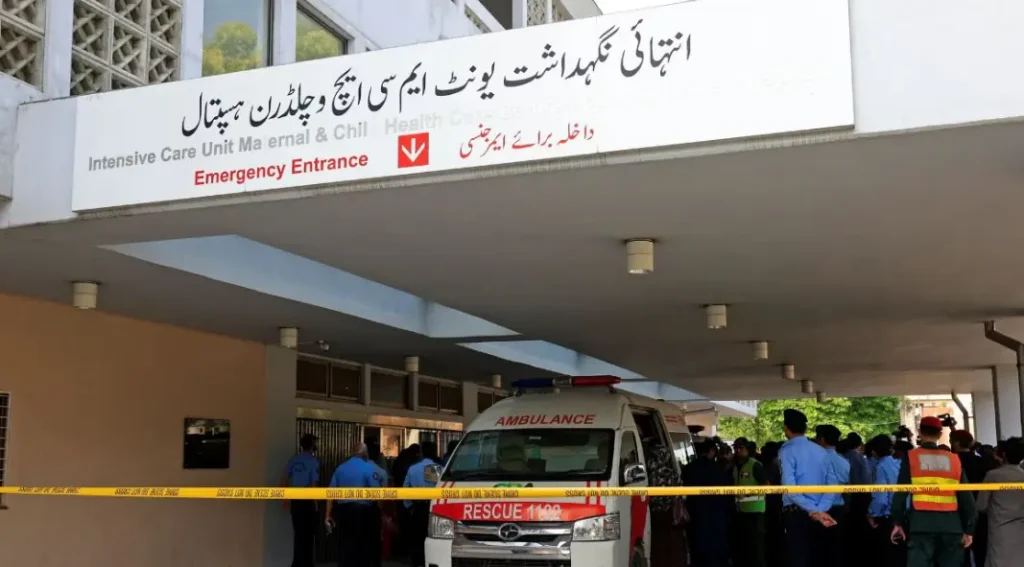

ISLAMABAD — A devastating fire at the Pakistan Institute of Medical Sciences (PIMS) killed 14 newborn babies early Wednesday, August 26, 2026, after flames swept through a nursery in Pakistan’s capital. Hospital officials said 15 infants were inside the affected unit and only one baby was rescued alive.
A FIRE AT A HOSPITAL IN PAKISTAN’S CAPITAL KILLS 14 NEWBORNS
— The Philippine Star (@PhilippineStar) August 26, 2026
The Pakistan Institute of Medical Sciences in Islamabad housed at least 15 newborns in the nursery and at least one baby was rescued from the fire that began about 6:45 a.m. after an air-conditioning unit compressor… pic.twitter.com/8YmhwcDhdz
The blaze broke out at about 6:45 a.m. on the third floor of the Mother and Child Health facility. The deaths have triggered an urgent investigation into the fire’s cause, safety arrangements and the emergency response at one of Pakistan’s largest public hospitals.
How the PIMS hospital fire started
Hospital and rescue officials said the fire began after an air-conditioning unit compressor exploded inside the nursery. Earlier accounts also referred to a possible electrical fault, leaving investigators to establish the precise technical failure.
A hospital spokesperson said the blaze spread rapidly around oxygen connections. Many of the newborns were in incubators or receiving oxygen support. Oxygen is not itself flammable, but an oxygen-rich environment can make other materials ignite more easily and burn more intensely.
The suspected equipment failure makes maintenance records an important part of the inquiry. A separate air-conditioning compressor explosion at a Kuala Lumpur university earlier in 2026 also prompted investigators to examine equipment condition and the circumstances surrounding the mechanical failure.
One newborn rescued as families gathered outside
PIMS spokesperson Dr Aneeza Jalil confirmed that 14 newborns died and one infant survived. Reports indicated that a doctor rescued the surviving baby.
Families gathered outside the hospital as emergency crews remained at the scene. Police said some victims were badly burned and DNA testing would be required in cases where visual identification was not possible before remains could be returned to relatives.
The emergency shows why evacuating patients who cannot move independently is especially difficult. During a major fire at a seniors’ residence in Mission, British Columbia, emergency teams similarly faced the challenge of rapidly moving vulnerable residents while arranging continued care and temporary accommodation.
Witnesses and officials give different accounts of response
Witnesses described thick black smoke, shattered glass and chaotic scenes. Some alleged that emergency crews were slow to reach the affected area, including one witness who claimed rescuers arrived almost two hours later.
Islamabad Chief Commissioner Sohail Ashraf disputed that account, saying rescue and police teams reached the scene immediately after the emergency call and brought the blaze under control.
The conflicting statements mean response time should not be treated as settled fact. The official inquiry has specifically been asked to assess how quickly emergency services responded and how effective the firefighting and rescue operation was.
Fire exits and nursery security face scrutiny
Questions have also emerged about fire protection inside the facility. One bereaved father criticised what he described as inadequate fire security and limited exits.
PIMS Executive Director Rana Imran Sikander denied claims that the maternity ward door was locked. He said it was manned for security because hospitals have previously faced cases involving babies being stolen.
The affected section was also undergoing renovation, according to current reporting. Investigators will need to determine whether construction or maintenance conditions had any connection to the fire rather than assuming they contributed to it.
24-hour inquiry and accountability measures ordered
Islamabad’s District Magistrate formed a multi-agency fact-finding committee and instructed it to report within 24 hours. Its mandate includes establishing the exact cause, checking whether functional fire-safety measures were in place and evaluating the rescue and firefighting response.
Prime Minister Shehbaz Sharif ordered an immediate investigation and later directed the removal of Federal Health Secretary Aslam Ghauri. President Asif Ali Zardari called for those responsible to be identified and for legal action where warranted.
Former federal ministers Fawad Chaudhry and Shireen Mazari separately called for Health Minister Mustafa Kamal to resign. The latest confirmed developments and official response have also been reported by the Associated Press.
PIMS is one of Pakistan’s largest public healthcare and teaching institutions, serving Islamabad and patients from surrounding regions. The hospital complex has more than two dozen specialist medical and surgical units and approximately 1,200 beds.
Fiona Stanley Hospital Fire Update: Surgeries Postponed After ICU Blaze
Port Adelaide Fire: Evacuation Map, Toxic Smoke Warning and Road Closures
Why the investigation matters for hospital safety
Neonatal units carry unusually high emergency risks because infants may depend on incubators, oxygen and continuous monitoring and cannot evacuate themselves. Fire alarms, electrical maintenance, oxygen management, accessible exits and trained staff therefore become critical safeguards.
The inquiry now has to determine whether the PIMS tragedy resulted solely from an unexpected equipment failure or whether weaknesses in maintenance, fire protection, renovation controls or emergency procedures increased the consequences. Establishing those facts will be central to accountability for the families and to preventing another disaster in a hospital unit caring for highly vulnerable patients.

Make Swikblog your go-to source on Google for reliable updates, smart insights, and daily trends.