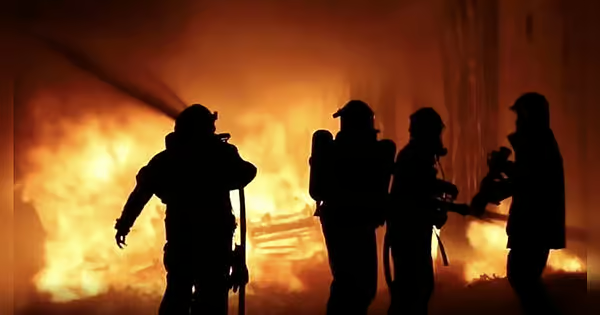

A factory fire in Saudi Arabia’s capital Riyadh has killed 16 Bangladeshi migrant workers, prompting an urgent response from authorities in Bangladesh as officials work to identify the victims and bring their bodies home.
The blaze broke out on Sunday, August 9, at a sofa manufacturing factory in the Musa Sanaiya industrial area of Riyadh. Bangladesh’s Ministry of Foreign Affairs confirmed the deaths on Monday and expressed condolences to the families affected by the disaster.
The incident carries wider significance for Bangladesh, where millions of households are connected to overseas employment. Saudi Arabia remains the largest destination for Bangladeshi migrant workers, with roughly 3.5 million Bangladeshis living and working in the kingdom.
Here’s what has been confirmed
All 16 confirmed victims were Bangladeshi nationals working in Saudi Arabia. Information released through Bangladesh’s authorities indicates that the victims came from Naogaon, Natore and Rajshahi.
Ten of those killed were reported to be from Naogaon district. The deaths have therefore brought the impact of a workplace disaster in Riyadh directly to communities and families in several parts of Bangladesh.
Officials from the Bangladesh Embassy in Riyadh have been working with the relevant Saudi authorities to identify the deceased and complete the formalities required to repatriate their remains.
Bangladesh’s Expatriates’ Welfare and Overseas Employment Minister Ariful Haque Choudhury has instructed officials to bring the bodies home as quickly as possible and ensure necessary government assistance and compensation for the bereaved families.
The cause remains a critical unanswered question
What started the fire has not been officially established in the information released so far.
That leaves one of the most important parts of the investigation unresolved. Claims that an electrical fault, machinery, combustible materials or specific safety failures caused the blaze should not be treated as fact unless confirmed by Saudi investigators.
The confirmed picture at this stage is narrower: a fire struck a sofa factory in Riyadh’s Musa Sanaiya area on Sunday and killed 16 Bangladeshi migrant workers.
Reuters reported that Bangladesh’s foreign ministry was monitoring the situation while embassy officials worked with Saudi authorities on repatriation formalities.
Read More
A $2.7 billion link between Saudi Arabia and Bangladesh
The tragedy also underscores how closely the two countries are connected through migration and remittances.
Bangladeshi workers in Saudi Arabia sent more than $2.7 billion home last year. Spread evenly across a year, that would be more than $225 million a month flowing back to Bangladesh.
For individual families, remittances can help pay for food, housing, education, healthcare and other everyday expenses. Losing a relative working abroad can therefore mean both an immediate personal tragedy and the loss of an important source of household income.
Workplace protection is part of a much wider conversation about the treatment and welfare of employees. The history behind Labour Day and workers’ rights reflects how working hours, conditions and safety have remained central labour issues across generations.
Those concerns can become even more complicated when people work thousands of kilometres from home. Similar welfare challenges are visible among workers supporting global trade far from their families, where occupational safety and access to support can have an international dimension.
Attention now turns to repatriation and compensation
For the families affected, the investigation is only one part of what happens next.
Bangladesh Embassy officials must work through identification and documentation requirements with Saudi authorities before the victims’ remains can be returned. As of Monday, no final timetable for bringing all 16 bodies back to Bangladesh had been publicly confirmed.
The government has also promised necessary assistance and compensation, although an exact compensation amount for each family has not been announced. Any eventual entitlement may depend on government support, employment arrangements and applicable procedures.
The next updates will be important on four fronts: confirmation of all victims’ identities, the return of their bodies to Bangladesh, details of financial assistance for their families, and an official determination of what caused the Riyadh factory fire.
Until investigators provide that explanation, the human impact is already clear. Sixteen migrant workers who had travelled to Saudi Arabia for employment have died, while their families in Bangladesh now face the difficult process of bringing them home.

Make Swikblog your go-to source on Google for reliable updates, smart insights, and daily trends.