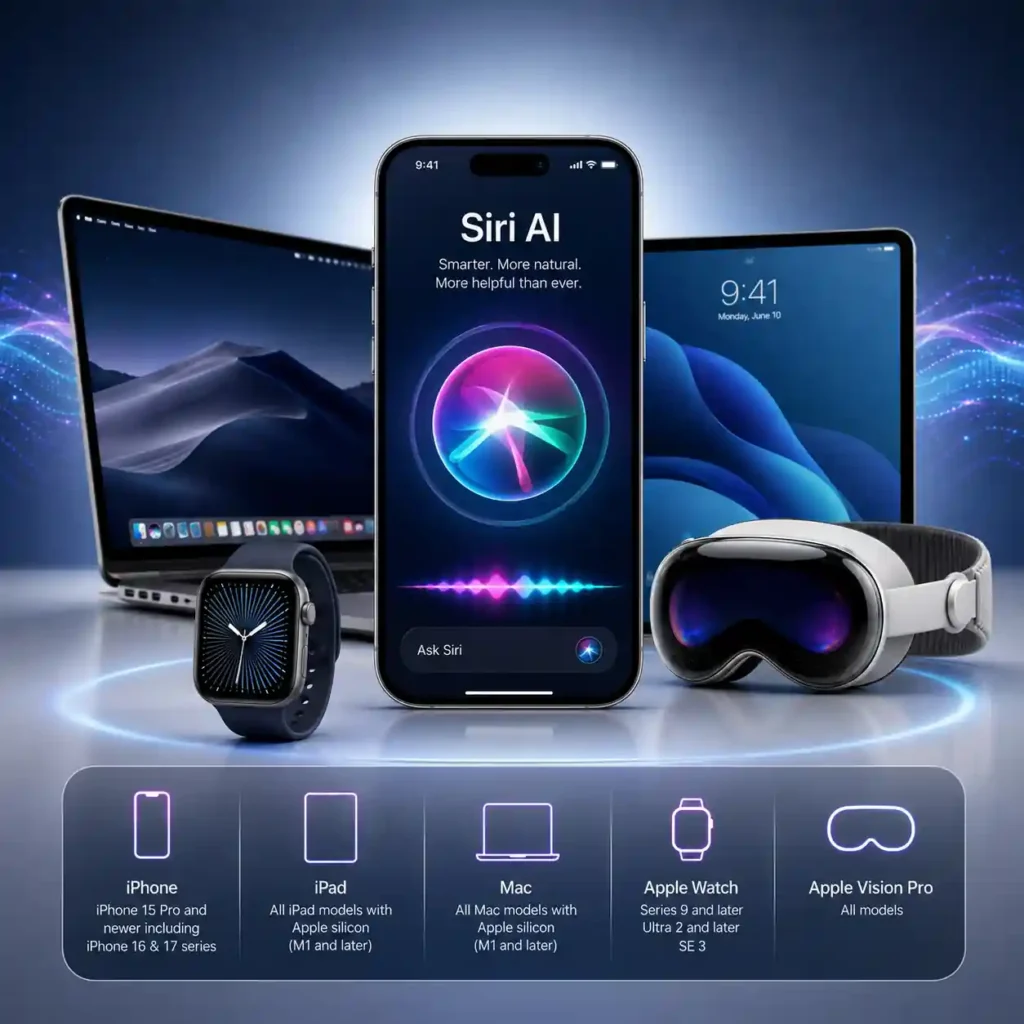

Apple is preparing to launch its biggest Siri upgrade in years as part of iOS 27, macOS Golden Gate, watchOS 27 and related software updates. The new Siri AI experience is currently available in beta and is expected to reach the public this fall.
The upgraded assistant is expected to bring a more natural Siri experience, stronger AI responses and better integration across Apple devices. However, Apple is limiting Siri AI to newer hardware, which means many older iPhones, iPads and Macs will not receive the feature.
Siri AI is reportedly powered by Gemini models, but it is not Gemini itself. In simple terms, Apple is using advanced AI model support while keeping the assistant inside Apple’s own Siri experience and broader Apple Intelligence system.
Full Siri AI compatible devices list
iPhone models expected to support Siri AI:
- iPhone 17 Pro
- iPhone 17 Pro Max
- iPhone Air
- iPhone 17
- iPhone 17e
- iPhone 16 Pro
- iPhone 16 Pro Max
- iPhone 16
- iPhone 16 Plus
- iPhone 16e
- iPhone 15 Pro
- iPhone 15 Pro Max
iPad: All iPad models with Apple silicon, including M1 chip and later, along with A17 Pro chip and later.
Mac: All Mac models with Apple silicon, including M1 chip and later, and models using A18 Pro-class silicon.
Apple Watch: Siri AI support on Apple Watch requires pairing with an AI-supported iPhone. Compatible models include Apple Watch Series 9 and later, Apple Watch Ultra 2 and later, and Apple Watch SE 3.
Apple Vision Pro: All models are listed as compatible.
Read More
Some Siri AI features need even newer hardware
Although all of the devices above are expected to support Siri AI, some advanced parts of the experience will be limited to select hardware. Apple is reserving the ability to fully customize Siri AI’s voice pace and expressivity for iPhone 17 Pro, iPhone 17 Pro Max, iPhone Air, iPad models with M4 or later and at least 12GB of unified memory, Mac models with M3 or later and at least 12GB of unified memory, and Apple Vision Pro with M5.
Apple’s most powerful on-device AI model is also expected to be restricted to a similar group of newer products. It is still unclear how much this will affect the everyday Siri experience, but users with newer high-end devices are likely to get the most complete version of Siri AI.
The hardware limits show how important AI-ready chips and memory have become for Apple’s software roadmap. Siri is no longer just a voice assistant feature; it is becoming part of a wider AI system that depends on faster neural processing and stronger privacy controls.
Apple has detailed its broader approach to artificial intelligence through Apple Intelligence, which combines on-device processing with Private Cloud Compute for more demanding requests. More information is available on the official Apple Intelligence page.
The arrival of Siri AI also comes as Apple faces growing pressure from Google, Microsoft and OpenAI in consumer AI. Reports around Google’s potential role in Apple’s AI future have added more attention to how Siri may evolve beyond traditional voice commands.

Make Swikblog your go-to source on Google for reliable updates, smart insights, and daily trends.