
Updated: August 23, 2026
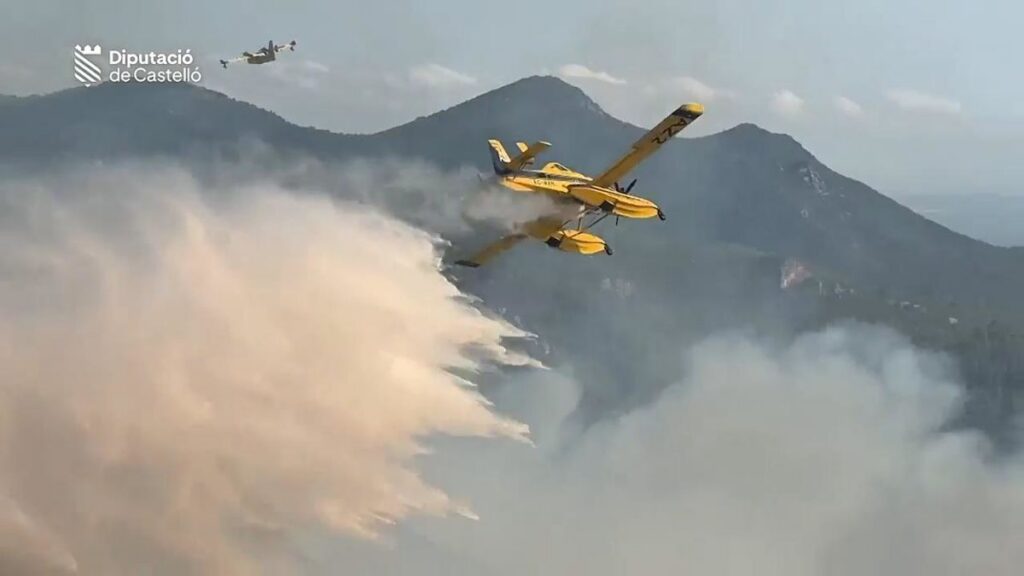
The major wildfire burning through Spain’s Sierra Calderona Natural Park has been declared stabilized, allowing around 1,000 evacuated residents of Gátova to begin returning home after spending two nights away.
Emergency officials confirmed the Segorbe-Gátova fire was stabilized at approximately 7:25 a.m. on Sunday, August 23. The declaration marks a significant improvement, but the wildfire is not yet controlled or extinguished, and crews remain deployed across the perimeter to tackle remaining hot spots.
Latest Sierra Calderona wildfire figures
- Status: Stabilized, but not yet controlled
- Estimated area affected: About 633 hectares
- Fire perimeter: Approximately 18 kilometres
- Gátova residents evacuated: Around 1,000, now allowed to return
- Personnel still deployed: Around 130
- Aircraft operating Sunday: 10
- Emergency classification: Reduced from Situation 2 to Situation 1
The latest provisional mapping puts the affected area at around 633 hectares, with an approximately 18-kilometre perimeter. About 395 hectares, or 62%, are in Segorbe municipality, while roughly 235 hectares, or 38%, are in Gátova.
The affected landscape is within the Sierra Calderona Natural Park, a protected mountainous area spanning parts of Castellón and Valencia provinces.
Gátova residents allowed to return home
Authorities authorised the return of evacuated Gátova residents on Sunday after the fire’s overnight behaviour improved significantly. The town had been evacuated on Friday as flames threatened the municipality and emergency traffic intensified along the CV-25.
Residents can return to their homes, but they have been instructed to remain confined indoors while firefighting operations continue. Officials said streets must remain clear so fire engines, emergency crews and other response vehicles can move safely through the town.
People who are not residents, including tourists and cyclists, are being asked to stay away from the affected area.
Gátova tap water should not be consumed
Returning residents also face a temporary drinking-water restriction. Authorities have advised people not to consume water from the municipal supply until health officials complete safety tests.
The wildfire affected the area surrounding the spring and well supplying Gátova. Bottled water is being provided while officials await laboratory analysis of the water supply.
The restriction is precautionary and does not mean contamination has been confirmed.
CV-25 remains closed
The CV-25 remains closed to normal traffic between the affected areas while emergency operations continue. Guardia Civil checkpoints are controlling access around Olocau and Altura.
Residents returning to Gátova are being allowed through controlled access points, but authorities have asked people not to park vehicles on public roads because emergency crews need unrestricted access.
Fire downgraded to Situation 1
Following the stabilization of the wildfire, the Valencian Emergency Coordination Centre ended Situation 2 under the region’s Special Forest Fire Plan and downgraded the emergency to Situation 1.
The improved conditions have also allowed Spain’s Military Emergency Unit (UME) to begin withdrawing. UME teams had helped patrol the perimeter overnight and used drones to identify possible flare-ups.
Approximately 130 emergency personnel and 10 aircraft were still involved Sunday, concentrating on cooling remaining hot spots and preventing fresh outbreaks.
Why stabilized does not mean extinguished
A stabilized wildfire is behaving within expected control lines and is no longer spreading unpredictably. It does not mean firefighters have completely secured or extinguished the blaze.
Officials said only a small number of hot spots remain, but crews will continue monitoring them because burning vegetation, roots and embers can reignite under changing weather conditions.
High overnight humidity helped firefighters make progress, with the fire perimeter now considered clearly defined and the risk of major spread significantly reduced.
Was anyone injured or were homes destroyed?
No deaths have been reported in connection with the Sierra Calderona wildfire, and officials have not reported homes destroyed inside Gátova’s main residential area.
The mayor of Gátova said some isolated structures and a warehouse outside the main town area were affected, but they were not primary residences.
What caused the Sierra Calderona wildfire?
The fire began at approximately 8:20 p.m. on Thursday, August 20, in the Segorbe area before spreading toward Gátova.
Investigators have attributed the ignition to lightning during a dry thunderstorm. There has been no official indication that human activity started the blaze.
Wānaka Fire Update: Albert Town Evacuations and Latest Developments
Cleveland Church Fire: Friendship Baptist Church Blaze Latest
What happens before the fire is declared controlled?
Firefighters will continue cooling hot spots and monitoring the 18-kilometre perimeter. Officials have indicated that the fire will not be declared controlled until crews are satisfied there is no significant risk of it escaping established containment lines.
Residents should continue following instructions from emergency authorities, particularly the confinement measures, CV-25 restrictions and temporary drinking-water precautions.
For official developments, readers can follow the latest wildfire and emergency updates from RTVE.
The incident remains separate from the Los Gallardos wildfire in Almería, and casualty, evacuation and burned-area figures from the two incidents should not be combined.

Make Swikblog your go-to source on Google for reliable updates, smart insights, and daily trends.