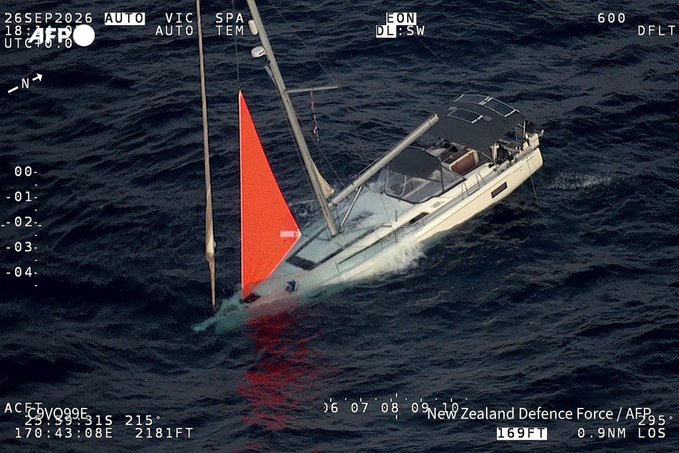

What began as another day of sailing across the South Pacific turned into an overnight fight to stay alive after a sperm whale struck an Australian yacht, tearing open its hull and eventually sending the vessel to the bottom of the ocean.
Four sailors aboard the 51-foot yacht Tai Tam survived the ordeal after battling incoming seawater, abandoning their damaged vessel and spending hours in a life raft before a cargo ship reached them early the following morning.
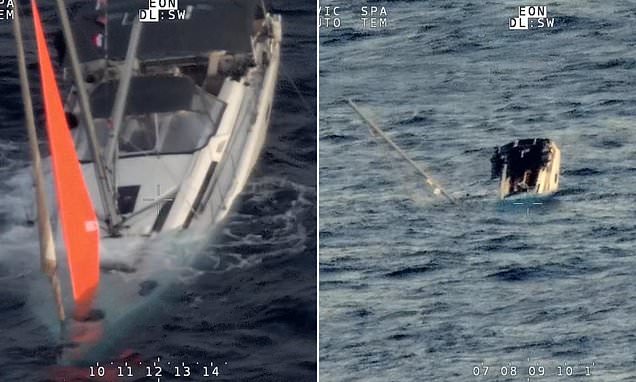
The incident unfolded on Saturday, September 26, about 250 nautical miles north of Norfolk Island, according to the New Zealand Defence Force.
A heavy impact — then water started coming in
The crew included Australians Jeremy and Jemma Cooper, New Zealander Terry Hetherington and French sailor Martin Jaffre.
Jemma Cooper was reportedly at the helm when there was a sudden, heavy impact. The yacht was pushed sideways and the crew quickly realised something serious had happened beneath them.
When they looked across the water, they could see a group of sperm whales nearby. Later accounts from the sailors described roughly six to eight whales in the area, including several large animals.
The crew believed one of the whales had collided with Tai Tam.
Damage below the waterline quickly became the bigger problem. Fibreglass had cracked, the hull had been breached and steering equipment on the starboard side had also been damaged.
Water began pouring inside.
Rather than immediately abandoning the yacht, the sailors tried to save it. Jaffre reportedly used expanding foam in an effort to seal damaged sections and even entered the water to inspect the hull while the others bailed seawater from inside.
But the flooding continued.
At approximately 1 p.m. New Zealand time, Maritime New Zealand’s Rescue Coordination Centre received an alert from the yacht’s emergency position-indicating radio beacon, known as an EPIRB.
That decision would prove critical.
Rescue Coordination Centre operations manager Mike Clulow later said the crew had done “all the right things,” adding that early activation of the emergency beacon was key to getting them safely located.
They watched their yacht disappear beneath the Pacific
A Royal New Zealand Air Force P-8A Poseidon surveillance aircraft was sent toward the yacht as the emergency operation gathered pace.
Conditions included seas of up to two metres, while several vessels travelling through the region were asked to divert toward the sailors’ position.
The Poseidon crew established two-way radio communication with the sailors and with ships responding to the emergency, according to the NZDF account of the rescue.
For the people aboard Tai Tam, however, the yacht was becoming impossible to save.
They eventually climbed into a life raft as darkness settled across the Pacific. For a period, the sinking yacht remained attached to their raft by a line.
That created another danger.
As Tai Tam settled deeper into the water, the sailors feared the vessel could pull their life raft down with it. They cut themselves free and watched the yacht disappear beneath the surface.
The group then faced hours of waiting in open water.
Shortly before dawn, the 143-metre cargo ship MV Sofrana Surville, which had diverted to help, finally reached their position.
At around 6 a.m. on Sunday, all four sailors were taken aboard. None was reported injured.
The rescue came roughly 17 hours after the emergency beacon was detected and close to 18 hours after the ordeal began.
The Sofrana Surville had been travelling from Auckland toward Nouméa when it joined the operation. The survivors then faced the difficult task of climbing from their small life raft onto the much larger cargo vessel.
Jeremy Cooper later reflected on how quickly the voyage had changed, but stressed the outcome that mattered most: everyone had survived.
The incident also underlined why offshore sailors carry emergency beacons. Clulow described the rescue as an example of how preparation at sea can save lives.
The dramatic operation comes amid several recent large-scale maritime rescues, including the rescue of more than 100 people during an English Channel boat emergency.
Sperm whales are among the largest toothed predators on Earth. Large males can reach around 18 metres in length, meaning an adult animal can be comparable in size to — or longer than — the yacht involved in Saturday’s collision.
There is currently no evidence suggesting the whale deliberately attacked Tai Tam. Official New Zealand accounts describe the incident as the yacht striking or colliding with a whale.
What is clear is how little margin for error existed once the hull was breached: a remote stretch of the Pacific, a sinking yacht and nearly an entire night between the initial emergency and the moment the four sailors finally reached the safety of a cargo ship.

Make Swikblog your go-to source on Google for reliable updates, smart insights, and daily trends.