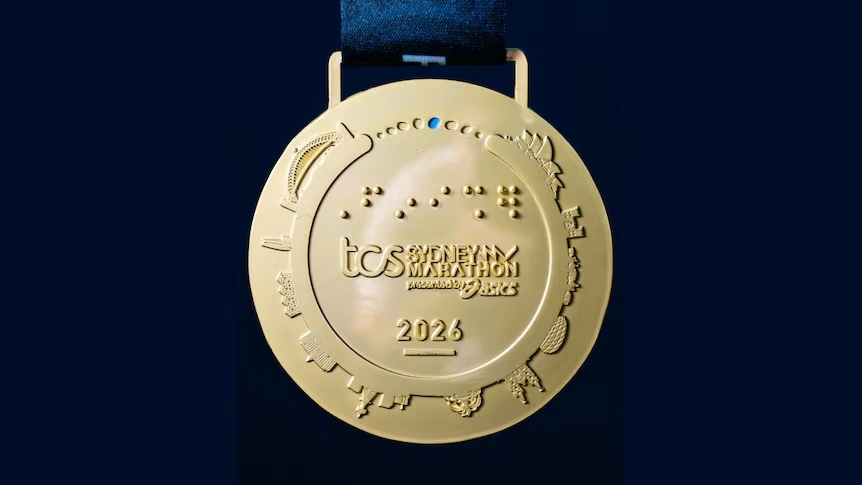

Sydney Marathon organisers have confirmed an unusual mistake on the 2026 finisher medal: a stadium intended to represent Sydney’s Allianz Stadium instead depicts the Allianz Arena in Munich, Germany.
The error emerged a week before the TCS Sydney Marathon on Sunday, August 30, when 40,000 entrants are preparing to participate. Organisers say the medals will not be replaced, so finishers will receive the existing design.
What is wrong with the Sydney Marathon medal?
The reverse of the medal was designed around the Sydney course, with a skyline featuring landmarks runners experience along the way. These include the Sydney Harbour Bridge, Sydney Tower Eye and St Mary’s Cathedral.
But one structure intended to depict Allianz Stadium at Moore Park is actually Allianz Arena in Munich, the distinctive home stadium of German football club Bayern Munich.
The venues share the Allianz name but look substantially different. Munich’s arena is particularly recognisable for its rounded, panel-covered exterior, which helped observers identify the mistake.
Will the incorrect medals be replaced?
No replacement has been announced. Sydney Marathon organisers acknowledged the incorrect stadium and called it an “unfortunate error.”
With the event only a week away, organisers confirmed that the existing version is the medal finishers will receive. They have taken a light-hearted approach, saying a little too much “international flavour” made its way onto the design and describing the medal as now being slightly more unique.
The organisers’ response and details of the error were reported by ABC News Australia.
The mistake does not affect race entries or how runners receive their medals. Those completing the marathon are still expected to receive the existing 2026 medal at the finish.
Why are there eight circles on the medal?
The medal contains eight circles representing the Abbott World Marathon Majors. Sydney joined the prestigious series in 2025, significantly increasing the event’s international profile.
That context makes the error particularly ironic. The medal was intended to celebrate Sydney and landmarks connected with its course, but one of the supposed local structures came from Germany.
Runners interested in another event on the international marathon calendar can check the Tokyo Marathon 2027 lottery and entry details for information about securing a place in the Japanese race.
Ambrose Killian says he did not design the incorrect section
First Nations artist Ambrose Killian has clarified that he was not responsible for the section containing the incorrect stadium.
Killian said his creative contribution was specifically for the lanyard and front side of the medal, which features his blue and white Indigenous design. He had no involvement in the design or production of the reverse side where Allianz Arena appears.
He stressed that the story, importance and originality of his artwork remain unchanged. The distinction is important because the finished medal combines separate creative elements.
40,000 entrants preparing for Sydney Marathon
This year’s Sydney Marathon has a record 40,000 entrants preparing to take to the start line, highlighting the race’s growing international profile.
For participants, the medal represents months of training rather than simply a souvenir. Organisers have emphasised the work behind reaching the finish line while confirming they will proceed with the existing design.
For more international distance-running context, the Paris Marathon 2026 results and Yemaneberhan Crippa’s victory provide a look at another major marathon event from this year.
Manitoba Marathon 2026 Draws Record 14,000 Runners as Winnipeg Roads Close
London Marathon 2027 Could Become Two-Day Race With 100,000 Runners
When and where is the Sydney Marathon 2026?
The TCS Sydney Marathon takes place Sunday, August 30, 2026, over the standard 42.2-kilometre marathon distance.
The course starts at North Sydney Oval before runners cross the Sydney Harbour Bridge, loop through the city, head south towards Kingsford and make their way back through Centennial Park. Participants ultimately cross the finish line at the Sydney Opera House.
The course explains why the skyline design matters. The landmarks around the medal were intended to bring the runners’ journey through Sydney to life, making the accidental inclusion of a Munich stadium more than a simple spelling or naming mistake.
Will the medal become a collector’s item?
There is currently no verified evidence that the mistake will make the medal financially valuable. Any claims about future resale prices or rarity would be speculation.
What is confirmed is that organisers are not replacing the medals before race day. The Munich stadium will therefore remain part of the official 2026 finisher design handed to thousands of runners.
For participants, the mistake may eventually become an unusual part of the story attached to their achievement: after completing 42.2 kilometres through Sydney, their medal will commemorate the city — with one unexpected architectural detour to Munich.

Make Swikblog your go-to source on Google for reliable updates, smart insights, and daily trends.