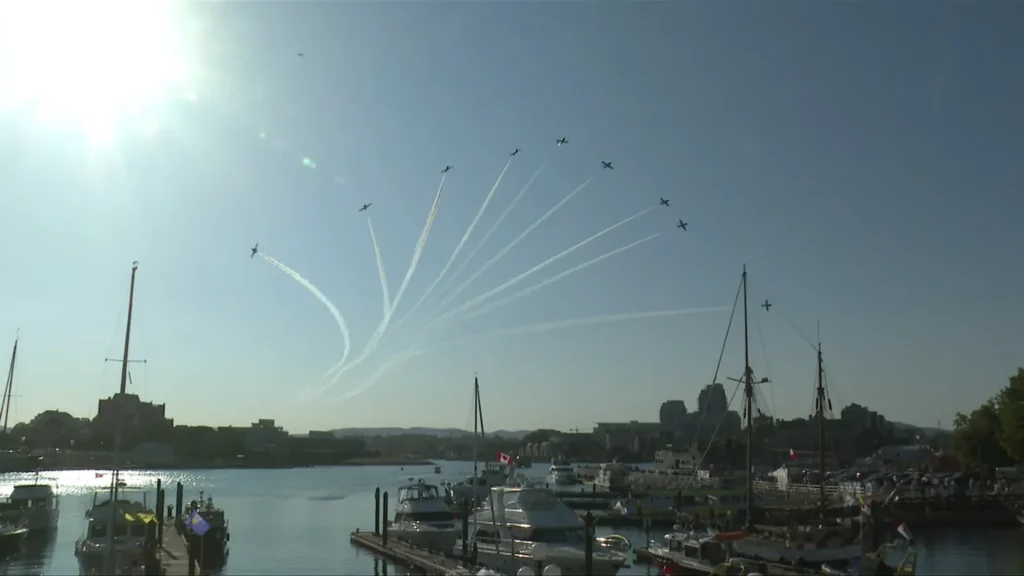

Victoria residents and visitors heading to the waterfront on Tuesday, August 4, should plan around an early road shutdown and a temporary drone ban before the Snowbirds begin flying at 5 p.m.
The 45-minute performance above Dallas Road is expected to attract about 30,000 people. It will also be the Snowbirds’ final full Victoria display using the CT-114 Tutor jets before the aircraft are retired.
Event: Canadian Forces Snowbirds aerial demonstration
Start time: 5 p.m. on August 4
Expected finish: About 5:45 p.m.
Location: Dallas Road waterfront, Victoria
Expected attendance: Approximately 30,000
Drone restriction: 4:45 p.m. to 6:30 p.m.
Road closures: 3 p.m. to 7 p.m.
Arrive before the main waterfront roads close
Dallas Road will close to vehicles between Douglas Street and Memorial Crescent at 3 p.m. Access to Clover Point will also be restricted.
Police may close Cook Street and side roads north of Dallas Road from approximately 4 p.m. if traffic or crowd levels require additional controls. Drivers should expect delays throughout Fairfield before and after the performance.
The City of Victoria’s official event guidance recommends walking, cycling or using public transit. Some BC Transit stops will close temporarily, and affected routes may be diverted.
A free bike valet will open at Cook Street and Dallas Road at 3:30 p.m. and remain available until all bicycles have been collected after the show.
Clover Point will not be a viewing location
Although much of the demonstration will take place near Clover Point, the point itself will be closed to spectators during the air show.
Public viewing will be concentrated along Dallas Road and the waterfront pathway between Clover Point and Finlayson Point. Ogden Point is another suggested location, although the exact view will depend on the flight path.
Pre-show programming, including a land acknowledgement, begins along Dallas Road at 4 p.m. Spectators should arrive early, remain outside controlled areas and follow instructions from Victoria Police and event staff.
No personal drones between 4:45 p.m. and 6:30 p.m.
NAV Canada says personal drones of every size and weight are prohibited inside the designated restriction area unless the operator has received prior authorization.
That includes microdrones weighing less than 250 grams. A drone’s small size, registration or the owner’s pilot certificate does not provide permission to enter restricted airspace.
The temporary restriction falls under Section 5.1 of Canada’s Aeronautics Act. Drone pilots should review the complete active NOTAM before flying anywhere near Victoria during the event.
Drone operators could receive multiple fines
An individual can be fined up to $3,000 for operating a drone where flight is prohibited. Another fine of up to $3,000 may apply if the flight puts aircraft or people at risk.
Corporations face penalties of up to $15,000 for each of those violations. Transport Canada notes that breaking several rules can result in several fines.
The restriction is not limited to the waterfront crowd. Snowbirds pilots perform at speeds approaching 600 kilometres per hour and may fly about one metre apart during close-formation manoeuvres. A small drone entering the display area could create a collision risk or force the performance to stop.
What happens immediately after the show?
The demonstration is expected to finish at approximately 5:45 p.m., but the drone restriction will remain active until 6:30 p.m. Dallas Road is scheduled to remain closed until 7 p.m.
The largest traffic buildup will likely occur as spectators leave together. People without urgent travel plans may find it easier to remain near the waterfront briefly while the initial congestion clears.
Ottawa Fireworks 2026 Schedule: Show Times, Road Closures and Best Viewing Spots
Wales Airshow 2026 Timetable: RAF Typhoon, Afterburn Show and Road Closures
Visit the homepage for the latest travel, events and breaking news
Why this Snowbirds appearance is significant
The Snowbirds are celebrating their 55th anniversary in 2026. Since their first show in Moose Jaw, Saskatchewan, on July 11, 1971, the team has performed more than 2,700 times for over 140 million spectators.
The CT-114 Tutor entered Royal Canadian Air Force service in 1963 and has been used by the Snowbirds since 1971. The aging fleet will leave the demonstration role after the 2026 season.
The August 4 event is the team’s last full Victoria show with the Tutor, although another flypast is planned over the Inner Harbour on Saturday during the David Foster Foundation’s 40th-anniversary concert.
When will the Snowbirds return?
The Snowbirds are expected to remain on hiatus until the early 2030s while Canada introduces the CT-157 Siskin II, its designation for the Pilatus PC-21. The future fleet will continue to operate from 15 Wing Moose Jaw.
A separate breakdown explains why replacing the Snowbirds’ Tutor jets will take several years.
The PC-21 is already used by other military operators for training and public appearances, including aircraft featured in the RAAF’s 2026 PC-21 flypast program. Canada intends to restore the Snowbirds’ traditional nine-aircraft formation once its new planes, trained crews and support systems are ready.

Make Swikblog your go-to source on Google for reliable updates, smart insights, and daily trends.