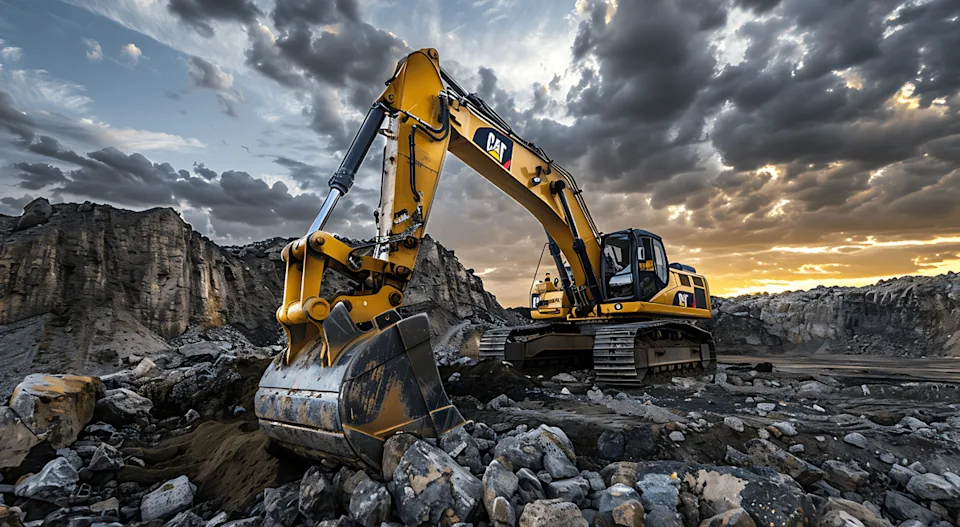

Caterpillar delivered the strongest quarterly sales performance in its history, sending CAT shares as much as 10% higher on Tuesday, August 4. Revenue exceeded $20 billion for the first time, profit beat expectations and the equipment maker’s backlog climbed to $72.1 billion.
The rally was driven by broad industrial demand rather than one isolated business. Construction, mining and power-generation sales all increased, while demand for equipment used in AI data centres strengthened Caterpillar’s position as an indirect beneficiary of the technology investment boom.
CAT earnings snapshot
Quarterly revenue: $20.5 billion
Annual revenue growth: 24%
Adjusted earnings: $8.17 per share
Operating margin: 20.9%
Order backlog: $72.1 billion
Operating cash flow: $4.4 billion
The two numbers behind the market reaction
Caterpillar’s $20.5 billion in second-quarter sales and revenue compared with $16.6 billion one year earlier. Reported profit increased to $7.77 per share from $4.62, while adjusted profit rose to $8.17 per share from $4.72.
Market forecasts had pointed to adjusted earnings of approximately $6.22 per share and revenue near $19.3 billion. Caterpillar exceeded both estimates, giving investors a clear reason to reassess its near-term growth prospects.
Higher sales volume added $3.1 billion to revenue, while favorable pricing contributed $595 million. The larger contribution from volume indicates that customers purchased substantially more equipment and services during the quarter.
Where Caterpillar found its growth
All three principal operating segments reported higher sales:
- Construction Industries: Up 35% to approximately $8.35 billion
- Resource Industries: Up 20% to roughly $4.65 billion
- Power and Energy: Up 17% to about $8.24 billion
The balance matters. Caterpillar was not relying entirely on one region, product or end market to produce its record quarter. Investors comparing high-profile corporate results can also examine the latest SpaceX earnings and Starlink outlook.
What does a $72.1 billion backlog mean?
Caterpillar’s backlog rose 92% from a year earlier. It represents orders received from customers that have not yet been recorded as completed sales.
A growing backlog provides visibility into future factory activity and deliveries. It also suggests orders arrived faster than Caterpillar could fulfil them, even as quarterly revenue reached a record.
There is an important limitation: backlog is not guaranteed income. Projects may be delayed, delivery schedules can change and customers may modify or cancel orders. The key test will be how quickly Caterpillar converts its order book into profitable sales and cash.
Caterpillar CEO Joe Creed said strong order rates reflected widening momentum across the company’s three main segments. The underlying figures can be reviewed in Caterpillar’s official second-quarter earnings materials.
Why CAT is now connected to the AI trade
Caterpillar is not an AI developer or semiconductor manufacturer. Its role lies deeper in the infrastructure chain.
AI data centres consume large amounts of electricity and require dependable power for computing and cooling. Caterpillar supplies generator sets, reciprocating engines, gas turbines and support services that can provide primary, supplementary or backup electricity.
This creates an opportunity for Caterpillar to benefit from data-centre construction without competing directly in chips or software. However, conventional construction, mining, energy and transportation customers remain essential to its results.
Which Reddit Thread Made Wendy’s Stock Soar 25% This Week? The Viral Story Explained
IBM Q2 2026 Results: Revenue Rises While Infrastructure Business Continues to Decline
Visit the homepage for the latest business news, stock market updates and technology stories
Margins, cash and shareholder returns
Operating margin improved to 20.9% from 17.3%, while adjusted operating margin rose to 21.9% from 17.6%. The expansion shows that Caterpillar converted its higher revenue into profit more efficiently despite ongoing cost pressures.
The company generated $4.4 billion in enterprise operating cash flow and ended the quarter with $6.7 billion in enterprise cash. It spent $1.5 billion on share repurchases and $700 million on dividends, returning $2.2 billion to shareholders.
Share buybacks can support earnings per share by reducing the number of shares outstanding. By contrast, transactions that may increase share supply can pressure a stock, as seen in the recent GameStop decline following its debt exchange.
What could change the CAT outlook?
Caterpillar raised its 2026 sales outlook from low-double-digit growth to growth in the mid-to-high teens. That upgrade signals management expects demand to remain stronger than previously anticipated.
Investors still face risks from Caterpillar’s estimated $2.2 billion in annual tariff costs, higher material expenses, interest rates, commodity prices, supply constraints and possible delays to construction, mining or data-centre projects.
The reported 10% jump reflects CAT’s peak or early-session reaction. Because stock prices move continuously, the final daily gain may differ. More important for the longer-term outlook will be whether Caterpillar can preserve its improved margins and turn the record backlog into delivered revenue.

Make Swikblog your go-to source on Google for reliable updates, smart insights, and daily trends.