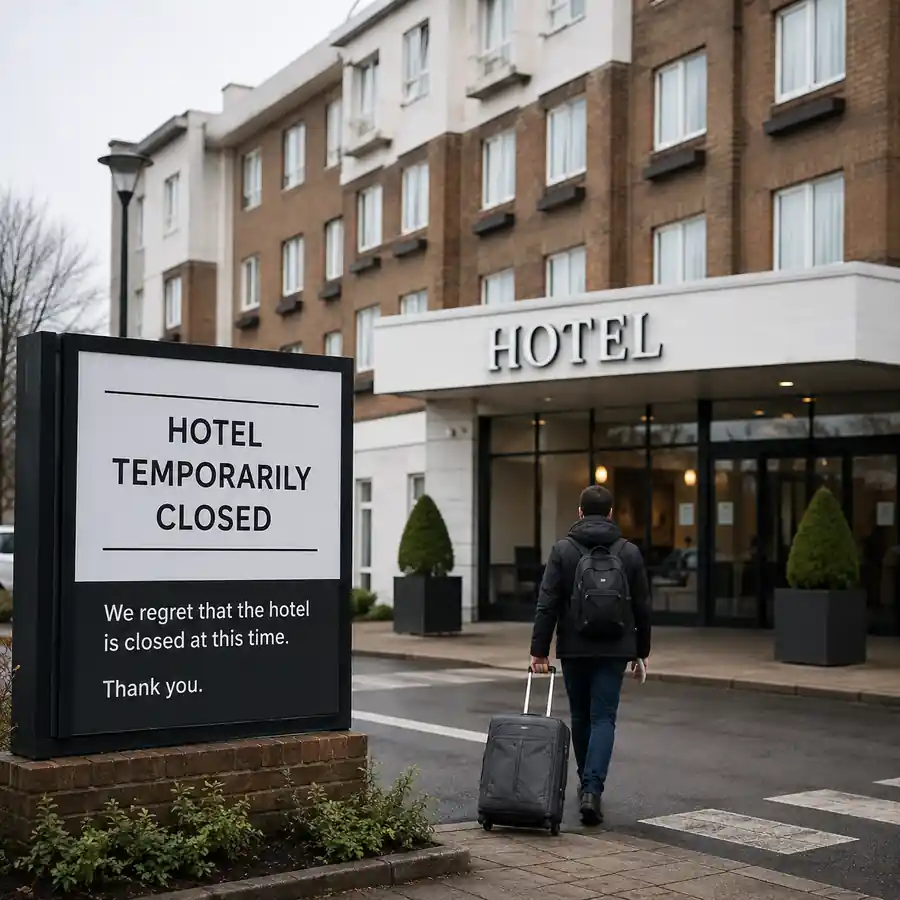

Thirteen more hotels across England are no longer being used to house asylum seekers as the government steps up efforts to reduce its reliance on expensive hotel accommodation. The latest closures affect communities from Blackpool and Bradford to Norwich, Loughborough and Lewisham and are expected to save about £51 million.
The announcement also raises an important question for residents: where will asylum seekers go after these hotels close? The government is increasingly using alternative accommodation, including larger sites and former military facilities. Houses in Multiple Occupation (HMOs) can also form part of asylum dispersal accommodation, but there is no evidence that everyone leaving these 13 hotels will be moved into HMOs.
Full list of the 13 asylum hotels closing
- Ramada Jarvis Hotel — Loughborough
- Chimney House Hotel — Sandbach
- Britannia Ashley Hotel — Hale
- Gold Thorn Hotel — Wolverhampton
- Grand Metropole Hotel — Blackpool
- Nottingham Hotel — Nottingham
- Grosvenor Hotel — Stratford-upon-Avon
- Staycity Apartments Deptford Bridge — Lewisham
- Needham House — Hitchin
- Holiday Inn — Bridgwater
- Holiday Inn Express — Dunstable
- Dubrovnik Hotel — Bradford
- Best Western Brook Hotel — Norwich
The latest 13 follow 11 closures announced in April and another 20 in June, taking the reported number closed during 2026 to 44. Fewer than 160 hotels are now reported to remain in use for asylum accommodation. Expected savings from this year’s hotel closures are around £224 million.
Where will asylum seekers be moved?
Closing an asylum hotel does not necessarily mean its residents immediately leave government-supported accommodation. People who remain eligible for asylum support can be moved elsewhere while their claims or appeals are dealt with.
Immigration Minister Anna Turley has said the government wants to end asylum hotel use and move towards larger, more basic accommodation, including former military sites. Earlier in 2026, the government said up to 350 people had been moved to the Crowborough military site.
The Home Office asylum accommodation policy explains how accommodation is allocated and how individual circumstances can affect placement decisions.
Could migrants leaving hotels be moved into HMOs?
An HMO, or House in Multiple Occupation, is generally a property occupied by people from more than one household who share facilities such as kitchens or bathrooms.
Shared residential properties are already used within asylum dispersal accommodation, alongside houses and self-contained flats. It is therefore possible for some asylum seekers to be accommodated in HMOs.
However, the latest announcement does not confirm that residents of all 13 closing hotels will be transferred into HMOs. Some could enter other dispersal accommodation or larger sites. Individual placements depend on availability, suitability and personal circumstances.
The HMO issue has attracted greater attention following disorder in Thetford, Norfolk, where properties believed to house asylum seekers became the focus of protests. As hotel use declines, councils and residents may increasingly focus on how smaller residential properties are selected and managed.
Why is the government closing asylum hotels?
Cost is a major factor. At the height of hotel use, the government said around 400 hotels were being used and costs had reached approximately £9 million a day.
Hotels are substantially more expensive than conventional dispersal accommodation. Closing them can therefore save money even when asylum seekers continue receiving accommodation elsewhere.
The changes form part of a wider overhaul of Britain’s asylum system. The government is also considering how accommodation and support costs should be funded, including proposals examined in the proposed £10,000 refugee repayment rules under the UK’s new asylum bill.
Read More
🚨13 more asylum hotels have closed and are being returned to local communities:
— Home Office (@ukhomeoffice) August 12, 2026
Ramada Jarvis Hotel, Loughborough
Chimney House Hotel, Sandbach
Britannia Ashley Hotel, Hale
Gold Thorn Hotel, Wolverhampton
Grand Metropole Hotel, Blackpool
Nottingham Hotel, Nottingham
Grosvenor…
Asylum appeal waiting times are also changing
The hotel closures coincide with efforts to speed up asylum and immigration appeals. A new 24-week target applies to certain appeals involving people in accommodation and foreign national offenders, compared with a reported average wait of around 67 weeks.
Faster final decisions could eventually reduce pressure on temporary accommodation because people would spend less time waiting for appeals to be resolved.
The pressure on Britain’s asylum system has also influenced other immigration routes. The Home Office has introduced tougher measures in response to asylum claims from people who initially entered the country legally, including UK student visa restrictions affecting four countries as asylum claims increased.
What should local residents understand?
Residents should not assume that closing an asylum hotel means an HMO will automatically replace it in the same town. People leaving a hotel may be relocated elsewhere, and different forms of accommodation can be used.
The Grand Metropole in Blackpool is particularly significant because ministers have also discussed distributing asylum accommodation more fairly between areas. Turley has argued that communities such as Blackpool have already taken their “fair share”, putting greater attention on where future accommodation is located.
Claims circulating online about particular houses should also be treated cautiously. A property listing, photograph or accommodation-provider vehicle does not prove that people from one of these 13 hotels are being moved to a specific HMO.
What is clear is that the government is reducing hotel use. The next issue for affected communities will be not simply how many hotels close, but what replaces them, where alternative accommodation is located and how local authorities are involved in those decisions.

Make Swikblog your go-to source on Google for reliable updates, smart insights, and daily trends.