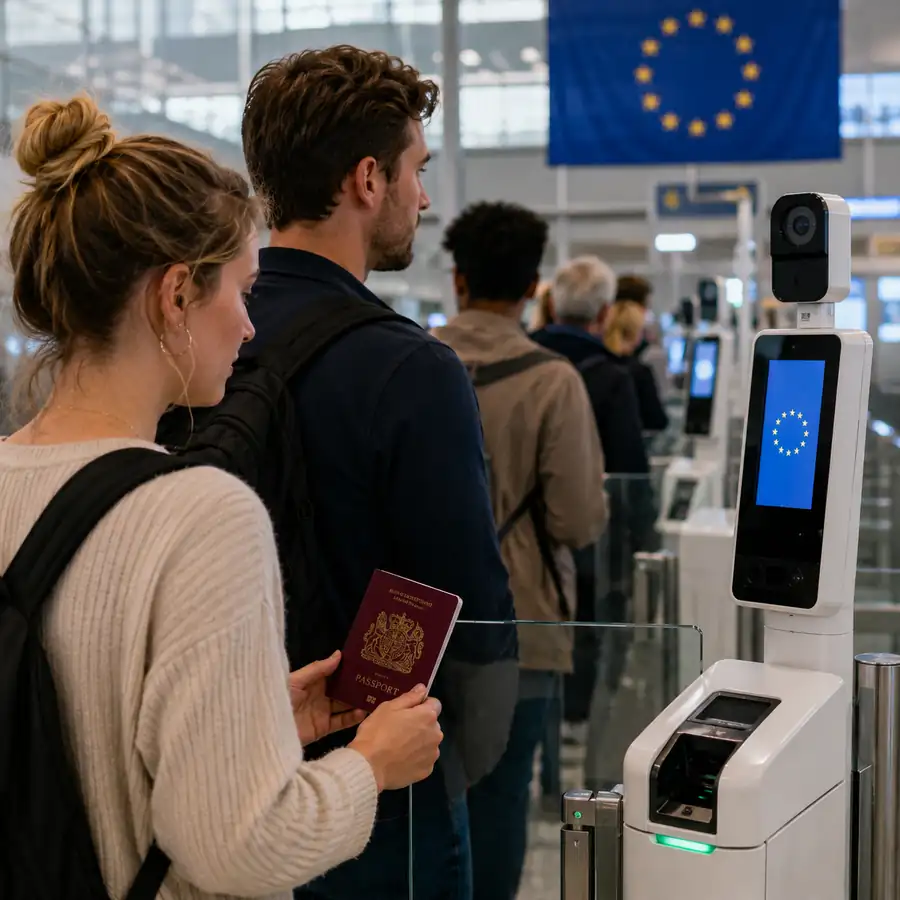

British travellers heading to Europe face fresh uncertainty over the EU’s Entry/Exit System (EES), as officials consider keeping temporary flexibility around biometric border checks beyond September 6.
The key point for holidaymakers is that EES is not being cancelled or postponed. The system is already operational. What could change is the ability of border authorities to temporarily ease parts of biometric processing when passenger queues become difficult to manage.
The issue matters during the busy travel season because peak border waits have reportedly reached around 120 minutes at Frankfurt and Amsterdam, while Munich has experienced maximum waits of around 60 minutes. These are peak figures rather than typical waiting times, but they illustrate why airports and governments want flexibility when congestion builds.
What could change after September 6?
The current flexibility is due to expire on September 6, 2026. Reports indicate European Commissioner for Sustainable Transport and Tourism Apostolos Tzitzikostas has discussed the issue with UK Transport Secretary Heidi Alexander as concerns grow about disruption.
Nine European countries — Belgium, France, Germany, Greece, Italy, Malta, the Netherlands, Portugal and Switzerland — have reportedly sought continued flexibility.
An extension would not exempt British citizens from EES. Instead, it could allow authorities to temporarily ease some biometric procedures when additional processing threatens to create excessive queues.
What British travellers need to know about EES
EES covers short visits by eligible non-EU nationals, including most British holidaymakers travelling to the Schengen area. It digitally records entries and exits instead of relying on routine passport stamps.
The EU’s official Entry/Exit System guidance explains that information collected can include passport details, a facial image and fingerprints.
On their first EES registration, British travellers can expect their passport to be scanned and a facial image recorded, with fingerprints collected where required. Children under 12 are exempt from fingerprint collection, although they remain covered by EES.
There is no separate EES application fee for ordinary travellers, and registration normally takes place as part of the border process.
Which countries are covered?
EES operates across 29 European countries, including major British holiday destinations such as Spain, France, Italy, Greece, Portugal, Germany and the Netherlands.
Ireland and Cyprus are not part of EES. Travellers should therefore check the rules for their specific destination rather than assuming the same procedure applies everywhere in Europe.
British visitors should also remember the existing short-stay limit: generally no more than 90 days in any 180-day period across the Schengen area.
Why airport queues are causing concern
Biometric registration can add extra steps at passport control, particularly when many international flights arrive close together. Frankfurt and Amsterdam have reportedly recorded peak waits around two hours, while Munich has experienced waits of about one hour at its busiest periods.
Concerns over delays emerged well before the latest September debate, with earlier warnings that British tourists could face lengthy airport queues under the EU entry checks highlighting the pressure that biometric processing could create during peak travel periods.
However, travellers should not assume those maximum figures represent normal conditions. Waiting times can vary significantly by airport, staffing levels, passenger volumes and time of arrival.
Dover, Eurostar and LeShuttle work differently
Some British travellers encounter European border procedures before leaving the UK. French border controls operate at Dover, while passengers using LeShuttle at Folkestone and Eurostar from London can also go through EES-related procedures on the UK side.
The UK government has announced £20 million in additional funding to increase passport-check capacity at Dover and improve vehicle processing, following earlier investment in EES preparations.
Travellers planning Channel crossings can also follow updates on Europe’s changing EES travel requirements before departure, particularly as the September deadline approaches.
Read More
Who may be exempt?
Not every British passport holder will need normal EES registration. Certain UK nationals protected by the EU-UK Withdrawal Agreement, qualifying residents and some long-stay visa holders can be exempt when the relevant conditions are met.
British-EU dual nationals should generally use the passport reflecting their EU citizenship when travelling under EU free-movement rights. Anyone relying on an exemption should carry the appropriate documents.
EES is different from ETIAS
EES and ETIAS are separate systems. EES records eligible travellers when they cross participating European borders and includes biometric checks. ETIAS is a separate travel-authorisation scheme.
Travellers should therefore avoid websites suggesting that paying for EES registration or obtaining an unofficial service will bypass border procedures. An EES record does not replace any future ETIAS requirement.
What travellers should do now
People with European holidays booked around or after September 6 do not need to change their plans simply because an extension is being discussed.
Travellers should check their passport and destination requirements, carry any documents supporting an exemption, follow instructions from their airline, ferry company, Eurostar or LeShuttle, and allow additional time for their first biometric registration.
Most importantly, a possible extension of flexibility should not be interpreted as EES disappearing. Unless EU authorities announce otherwise, British visitors should travel expecting EES requirements to remain in force after September 6.

Make Swikblog your go-to source on Google for reliable updates, smart insights, and daily trends.