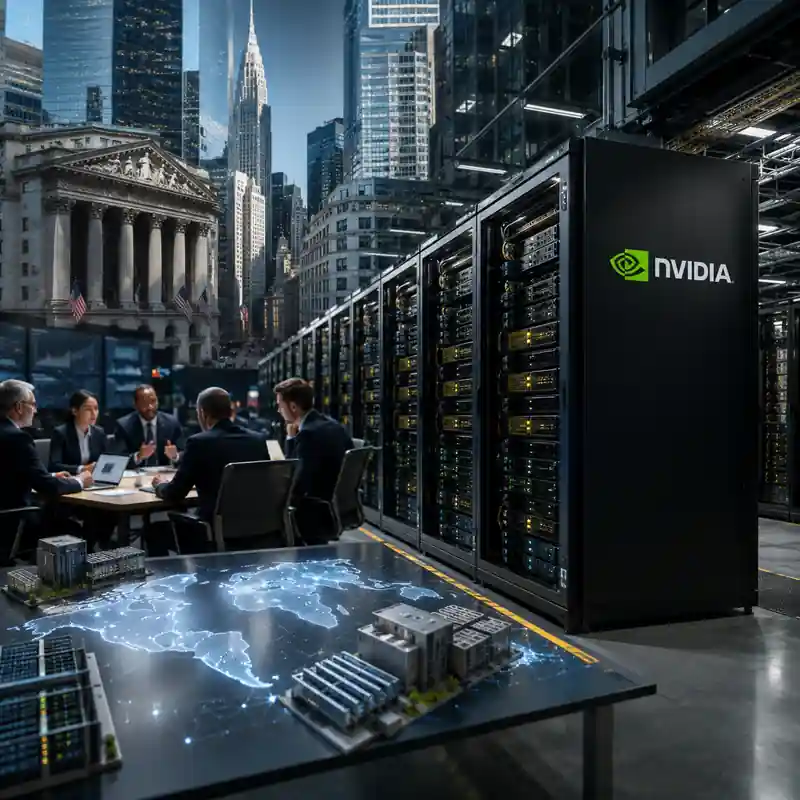

Nvidia is bringing some of Wall Street’s biggest financial institutions into the global AI infrastructure race, with a plan designed to mobilize more than $500 billion in third-party capital for computing infrastructure. For NVDA investors, however, another figure deserves attention: CEO Jensen Huang says Nvidia has the option to backstop up to $125 billion, or 25% of potential transactions.
The chipmaker has signed memorandums of understanding with Apollo, BlackRock, Blackstone, Brookfield, Goldman Sachs and KKR to establish compute-financing platforms. The goal is to help frontier AI developers, enterprises, governments and cloud providers finance increasingly expensive Nvidia-powered infrastructure.
The crucial distinction is that Nvidia is not spending $500 billion itself, and $500 billion has not already been committed. It is a target for third-party capital the platforms aim to mobilize over time.
How Nvidia’s $500 billion financing plan works
Building AI capacity involves far more than buying GPUs. Operators need servers, networking, storage, cooling, land, buildings and enormous amounts of electricity. Financing can therefore become a bottleneck even when demand for computing power is strong.
Nvidia wants to connect customers that need this infrastructure with major pools of institutional capital. According to Nvidia’s official announcement, the platforms are intended to provide access to capital at scale while creating longer-duration, usage-linked investment opportunities.
The initiative arrives as Big Tech companies continue pouring money into AI, with combined spending expected to surpass $730 billion this year. The enormous capital requirement reflects the wider AI and technology infrastructure investment cycle, where money is flowing beyond processors into networking, power, cooling and data-center construction.
For Nvidia, easier financing could translate into more customers capable of deploying its systems. The company increasingly sells an entire accelerated-computing platform spanning GPUs, networking and CUDA software rather than simply individual chips.
The move also extends an investment theme visible throughout 2026. Earlier developments around Nvidia stock and rising AI infrastructure demand showed how computing capacity, data-center expansion and access to capital are becoming increasingly connected.
What Nvidia’s $125 billion backstop means
The $125 billion figure does not represent money Nvidia has already committed. Huang said the company has the option to backstop as much as 25% of potential transactions.
That could provide financial support to deals under specified circumstances, depending on how final agreements are structured. Investors therefore need more information before determining Nvidia’s actual financial exposure.
Nvidia has not disclosed how much Apollo, BlackRock, Blackstone, Brookfield, Goldman Sachs or KKR will individually contribute. It has also not announced detailed financing terms or a timetable for deploying the planned $500 billion.
The agreements are memorandums of understanding, making it important not to treat the headline number as $500 billion sitting in a fund ready for immediate deployment.
Wall Street wants to make AI compute an asset class
The initiative could also change how investors think about computing infrastructure. Large asset managers and private-capital firms could potentially finance AI capacity and earn returns linked to its usage rather than gaining AI exposure solely by owning technology stocks.
KKR co-chief executives Joe Bae and Scott Nuttall described compute as a critical infrastructure asset. If the model develops successfully, financing Nvidia-powered computing capacity could increasingly resemble other infrastructure investments where outside investors provide upfront capital and receive returns from the asset’s use.
That would benefit Nvidia if financing allows customers to build GPU clusters sooner. Institutional capital could fund infrastructure, customers could deploy more computing capacity, and Nvidia could supply the hardware, networking and software required for those projects.
Read More
The risks NVDA investors should watch
The strategy introduces questions alongside the opportunity. Investors have increasingly scrutinized financial relationships across the AI industry when companies finance, invest in or support businesses that also purchase their technology.
That raises a circular-financing concern: financing can help customers buy more equipment, but the underlying projects still need enough workloads and revenue to justify their costs.
Overbuilding is another risk. AI data centers are expensive, while computing hardware improves rapidly. A GPU cluster financed today must remain sufficiently utilized even as newer systems arrive. Electricity costs, interest rates, construction delays and weaker-than-expected AI demand could all affect investment returns.
The involvement of major independent financial institutions could add another layer of scrutiny because individual projects will still need to satisfy investment and underwriting requirements.
For shareholders, the next milestones will be final agreements and actual funded transactions rather than the $500 billion headline alone. Investors will want details on individual commitments, financing costs, the first projects funded and the circumstances under which Nvidia’s backstop could be used.
Who ultimately carries the risk if a customer cannot meet its obligations will also matter. That will help determine whether Nvidia is mainly facilitating financing or assuming substantial financial exposure itself.
The initiative could remove a major obstacle to continued AI expansion by giving more customers access to capital. But its success will depend on how much of the targeted $500 billion becomes real infrastructure and whether those assets generate enough demand to justify their cost.
For NVDA investors, that makes the $125 billion backstop just as important to follow as the much larger headline number.
Disclosure: This article is for informational purposes only and does not constitute investment advice.

Make Swikblog your go-to source on Google for reliable updates, smart insights, and daily trends.