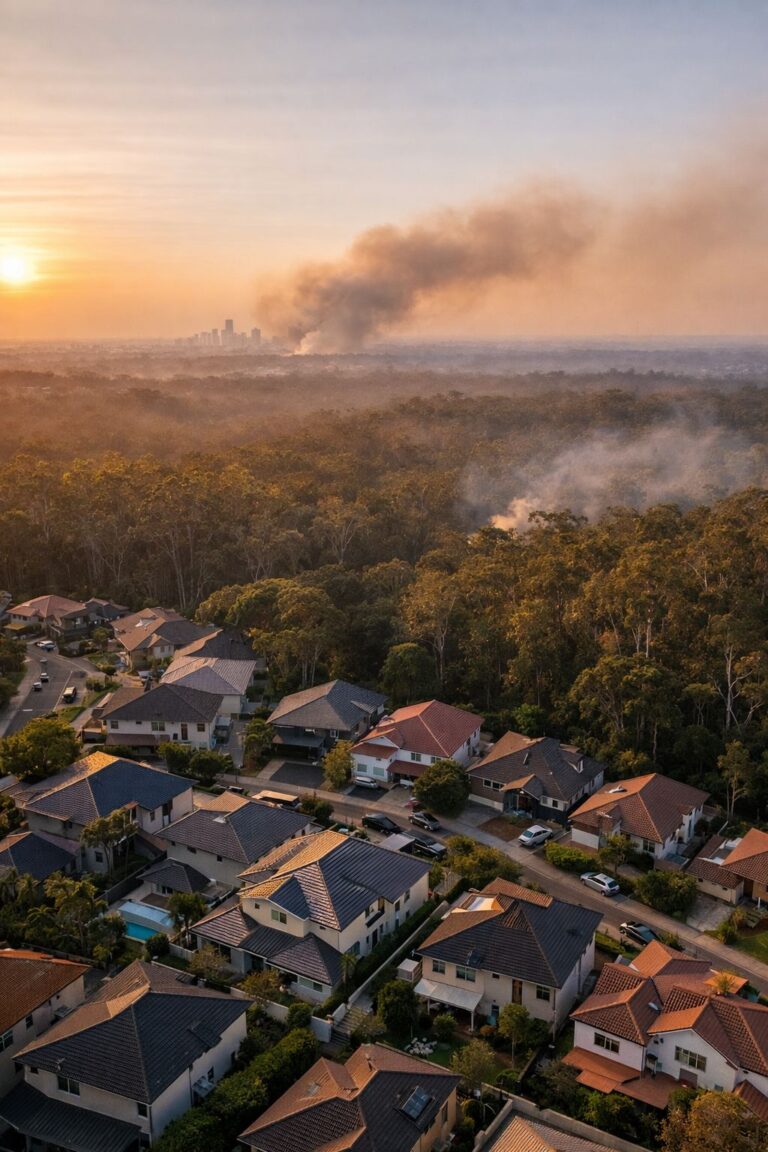

Suburbs on the fringes of Australia’s biggest cities face a growing risk of “LA-style” catastrophic bushfires, according to fire and climate experts who say the combination of expanding urban development, highly flammable vegetation and more extreme weather is raising the chances of fast-moving blazes reaching dense residential areas.
The warning comes as emergency agencies across the country prepare for another summer of elevated fire danger, with hotter conditions and strong winds capable of turning small ignitions into major incidents. Experts say the threat is no longer limited to remote bushland: it is increasingly concentrated where housing and vegetation meet — the urban fringe.
A recent assessment from the Climate Council and Emergency Leaders for Climate Action said about 6.9 million Australians live in areas described as exposed to high bushfire risk along the edges of capital cities, particularly where suburbs border bush or grassland. The report argues that many Australians still view bushfires as a rural issue, even as the risk profile shifts toward metropolitan outskirts.
Comparisons to Los Angeles are intended to capture how rapidly conditions can change when severe weather aligns with heavy fuel loads and built-up neighbourhoods. In major wildfire events, embers can travel ahead of the main fire front, igniting spot fires on rooftops, in gutters and in gardens, while smoke and poor visibility complicate evacuations and response efforts.
Why the urban fringe is vulnerable
Fire behaviour specialists say city edges create a difficult environment for suppression because they mix two different worlds: the unpredictable spread of bushfire in natural fuels, and the close-set structures of suburbia. When fire crosses into housing, risk can escalate quickly through ember attack and house-to-house spread, particularly where homes are close together or where vegetation is unmanaged.
Older housing stock is a key concern. Experts say many properties in high-risk fringe suburbs were built before modern bushfire construction standards became widespread. That can mean more vulnerable roof designs, insufficient sealing against embers, and materials that ignite more readily under radiant heat. In a severe event, those weaknesses can turn a street-level incident into a multi-suburb emergency.
Urban expansion is another factor. As new estates push into bushland-adjacent areas, more households enter zones where evacuation routes may be limited and where the time between a warning and a fire front arriving can be short, especially under strong winds. Emergency leaders say that planning decisions — including where and how communities grow — will influence the severity of future seasons.
Weather, fuels, and “climate whiplash”
Fire agencies track a range of conditions that can increase danger: heat, low humidity, sustained winds, and dry fuels. Experts also point to “climate whiplash,” where wetter periods drive vegetation growth followed by hotter, drier stretches that leave more fuel available to burn. In practical terms, that can mean heavier grass and scrub loads in the same areas that sit close to housing.
Climate change is widely cited as a compounding pressure. Higher average temperatures and more frequent extreme heat events can dry fuels more quickly, extend the period when severe fire weather is possible, and increase the likelihood that multiple fires burn at the same time. That can stretch firefighting resources and force difficult choices about where crews and aircraft are deployed.
Emergency planners say a city-edge bushfire poses additional challenges beyond the flames. Power disruptions can knock out traffic signals and impair communications. Smoke can reduce visibility and increase road crash risks during evacuations. And in dense suburbs, heavy traffic can slow both residents leaving and emergency vehicles arriving.
What residents can do now
Authorities stress that individual preparation still matters, even as broader policy debates continue. Residents in high-risk areas are urged to understand local warning systems, check their evacuation routes, and keep basic supplies ready during high danger days. Clearing combustible material around homes — such as dry leaf litter, overgrown shrubs, and clutter near walls — can reduce the chance that embers find easy ignition points.
Home hardening measures can also help. This may include sealing gaps where embers can enter, maintaining gutters, installing metal mesh screens where appropriate, and ensuring fences or decks are not acting as a pathway for fire. Experts note that no single action guarantees safety, but multiple small steps can reduce vulnerability in a high-pressure event.
At a community level, the report’s authors argue that stronger building standards, better land-use planning and infrastructure resilience — including road access and reliable communications — are essential if Australia is to reduce the probability of a worst-case suburban fire scenario.
For more detail on the assessment and its findings, read the Climate Council’s release here: Experts sound alarm for Australia on urban fire risk like LA.
You can also follow Swikblog’s latest Australia coverage and updates here: Swikblog.

Make Swikblog your go-to source on Google for reliable updates, smart insights, and daily trends.