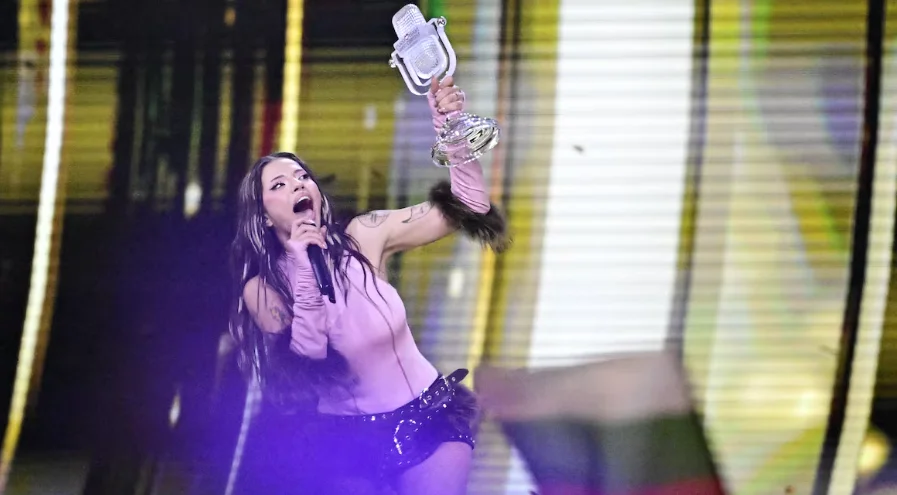

Bulgaria created Eurovision history on Saturday night after singer Dara won Eurovision 2026 with her energetic party anthem Bangaranga, giving the country its first-ever victory in the competition. The grand final, held at Vienna’s Wiener Stadthalle arena, featured performers from 25 countries and ended with Bulgaria ahead of Israel after a dramatic public vote and jury count.
The result immediately became one of the biggest entertainment stories across Europe. Search interest for “Dara Bulgaria,” “Bangaranga,” “Eurovision 2026 results,” and “Eurovision winner 2026” surged after the final as fans reacted to Bulgaria finally securing the Eurovision trophy after years of participation.
Dara’s performance combined fast-paced choreography, infectious dance-pop beats and strong crowd interaction, making Bangaranga one of the night’s standout entries. Eurovision has long rewarded memorable stage performances, and Bulgaria’s entry delivered exactly the kind of high-energy spectacle that works with television audiences and live voters.
The singer beat 24 competitors from across Europe and Australia in a contest that mixed pop, rock, rap, folk and ballads. The 70th anniversary edition of Eurovision also became one of the contest’s most politically debated years because of protests linked to Israel’s participation amid the ongoing Gaza conflict.
Bulgaria’s first Eurovision win after years of near misses
Bulgaria had never previously won Eurovision despite several strong finishes in earlier years, making Dara’s victory especially significant for the country’s music industry and Eurovision fan base.
Her song Bangaranga stood out because it balanced commercial pop appeal with a visually memorable performance. The staging used synchronized dancers, colourful lighting and fast transitions without overwhelming the song itself. Eurovision viewers often remember performances that are easy to follow visually while still feeling exciting, and Bulgaria managed to strike that balance.
The public response inside the arena was strong throughout the performance, and online reaction quickly turned the song into one of the most discussed Eurovision entries of the night. Within minutes of the result announcement, clips from Dara’s performance began circulating widely across social media platforms.
According to the Associated Press coverage of the Eurovision 2026 final, Bulgaria’s victory came after the entry impressed both viewers and national juries during the grand final in Vienna.
The result also means Bulgaria is expected to host Eurovision 2027 unless alternative hosting arrangements are made with the European Broadcasting Union. Hosting Eurovision typically brings major tourism attention, sponsorship opportunities and international media coverage to the winning country.
Read More
Israel finishes second as protests and boycotts dominate headlines
While Bulgaria celebrated a historic win, Eurovision 2026 was heavily overshadowed by political controversy surrounding Israel’s participation. Israeli singer Noam Bettan finished second with his multilingual rock ballad Michelle, performed in Hebrew, French and English.
The contest faced protests throughout Eurovision week in Vienna, with demonstrators criticizing Israel’s inclusion because of the war in Gaza. Hundreds marched near the contest venue before the final carrying pro-Palestinian banners and signs calling for Israel to be removed from Eurovision.
Five countries — Spain, Ireland, Iceland, Slovenia and the Netherlands — boycotted the contest entirely in protest, creating one of Eurovision’s most politically tense editions in recent years.
Swikblog recently examined the wider debate around Eurovision eligibility and broadcaster rules in this breakdown of the Israel Eurovision 2026 controversy, which explains why the European Broadcasting Union continued allowing Israel to compete despite growing boycott calls.
Despite the tension, Eurovision organizers pushed forward with the grand final and repeatedly encouraged viewers to focus on music instead of politics. Eurovision director Martin Green urged audiences to enjoy what he described as a “brilliant, heartfelt show,” even as protests continued outside the arena.
The controversy surrounding Israel became impossible to ignore during the week. Earlier in the competition, four people were reportedly removed from a semifinal event after attempting to disrupt Bettan’s performance.
Memorable performances, UK disappointment and Eurovision milestones
Beyond Bulgaria’s win and the political headlines, Eurovision 2026 delivered several moments that quickly became talking points among fans.
Ukraine made Eurovision history after its entry was credited with holding the contest’s longest-ever note during a live performance. Female solo artists dominated much of the competition, with entries ranging from Sweden’s techno-pop sound to Germany’s emotional power ballad and Poland’s gospel-inspired R&B performance.
Australian singer Delta Goodrem also drew major attention with her dramatic ballad Eclipse, performed while being lifted above a glitter-covered piano. Serbia’s heavy metal band Kravina added a harder rock sound to the lineup, while Moldova’s rapper Satoshi brought politically themed party rap to the stage.
Meanwhile, the United Kingdom suffered another disappointing Eurovision result. British act Look Mum No Computer finished last after receiving zero points from the public vote despite their novelty performance of Eins, Zwei, Drei.
The final itself reflected Eurovision’s reputation for musical unpredictability. Audiences watched everything from fiery violin performances and folk rap to retro techno and operatic vocals during the nearly four-hour broadcast.
Still, Dara’s Bangaranga managed to rise above a crowded field because it felt immediate, energetic and accessible. Eurovision songs that succeed often create instant audience recognition, and Bulgaria’s entry achieved that from the opening seconds.
For Dara, the victory could become a major international career breakthrough. Eurovision winners often gain new touring opportunities, streaming growth and wider European recognition after the contest. With online interest already exploding after the final, Bangaranga now has a strong chance of becoming one of the year’s biggest Eurovision crossover hits.
For Bulgaria, Eurovision 2026 will be remembered as the moment the country finally captured Europe’s biggest music competition. In a year dominated by political debate, protests and boycotts, Dara delivered a performance that connected directly with millions of viewers and secured a historic Eurovision win.

Make Swikblog your go-to source on Google for reliable updates, smart insights, and daily trends.