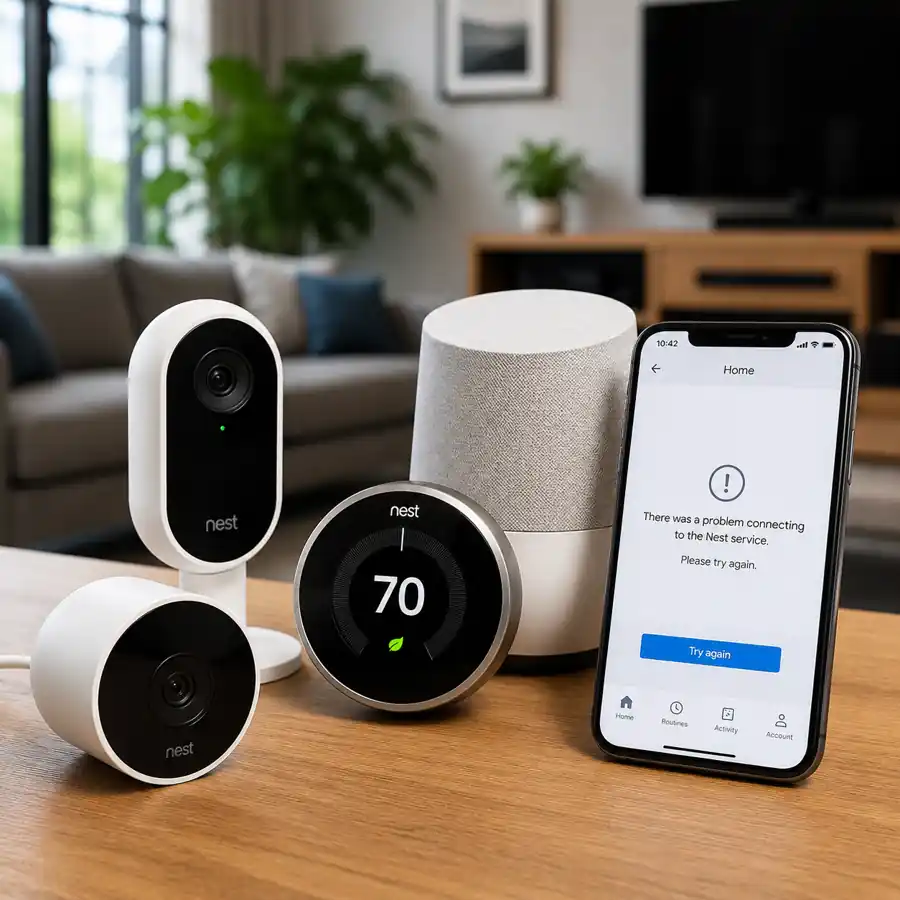

Google Nest users were left dealing with a frustrating smart home outage on Friday, May 15, as reports of offline cameras, failed app connections and unresponsive devices spread across the United States and parts of Europe.
The disruption affected users who depend on Google’s Nest ecosystem for home security, temperature control and everyday automation. Many said their Nest cameras, doorbells, thermostats and other connected devices suddenly stopped responding inside the Nest and Google Home apps, even though their home Wi-Fi networks appeared to be working normally.
Reports began rising during the morning hours in the US and continued into the afternoon. Outage monitoring platforms showed a sharp increase in complaints, while users on Reddit and X described similar problems across different regions. Complaints came from several US states, including Texas, New York, California, Ohio, Colorado and Florida.
The most common issue reported by users was a connection failure inside the Nest app. Some users said they were repeatedly shown the message: “There was a problem connecting to the Nest service.” Others said devices appeared as “offline” despite being powered on and connected to stable internet.
The outage was not limited to one type of device. Users reported problems with Nest Cam live video, video history playback, thermostat controls, doorbell feeds, app login access and device synchronization. In some cases, push notifications were delayed or failed completely.
That made the disruption more serious for people who rely on Nest products for security monitoring. A camera outage may seem like a small technical issue, but for users checking on homes, deliveries, children, pets or elderly family members, losing live access can become a real concern.
Some users said they could not view live feeds from indoor or outdoor Nest cameras. Others said video history would not load, making it difficult to review recent activity around their homes. Doorbell users also reported trouble checking visitors or motion alerts through the app.
Thermostat users faced a different kind of inconvenience. Several people said they were unable to adjust home temperatures remotely, which can be especially frustrating for users managing heating or cooling while away from home.
The issue also affected users with fully connected smart home setups. Automated routines linked to cameras, thermostats, alerts and other devices reportedly failed or became unreliable during the disruption. For households that use Nest as part of a larger connected home system, the outage created problems across multiple daily routines at once.
One of the biggest points of frustration was the mismatch between user reports and Google’s official status page. Google’s Nest status dashboard continued to show services as operational during the reporting window, even as users were actively reporting widespread app and device failures.
That gap left many users unsure whether the problem was caused by Google’s servers, their own Wi-Fi network, or individual devices. However, the volume of similar complaints across multiple states and regions suggested that the problem was likely not limited to isolated home network issues.
Google Nest support reportedly advised affected users to try basic troubleshooting steps, including restarting routers, updating apps, checking firmware and rebooting devices. Those steps can help with local connection problems, but many users said they did not resolve the outage.
When repeated resets fail across many households at the same time, it often points toward a cloud-side problem. Nest products depend heavily on Google’s backend services for remote access, app control, camera streaming, notifications and synchronization. If those services become unstable, devices may still be physically working at home but appear unavailable inside the app.
Some users also linked the timing to broader pressure across Google services earlier in the week, when reports of disruption affected other Google products. Google has not confirmed any connection between those events and the Nest outage, so the exact cause remains unclear.
Read More
- Visit Swikblog Homepage
- Maldives Diving Horror: Five Italians Die in Underwater Caves at Vaavu Atoll
- Sunday Times Rich List 2026: David Beckham Billionaire Sportsman
- Spaghetti House Closes All London Restaurants After 70 Years
- HSBC Halts $4 Billion Private Credit Investment After $400 Million Loss
- Australia Quarantines Cruise Ship Travellers After Hantavirus Outbreak
By late afternoon, some users began reporting partial recovery. Camera feeds and app access appeared to return for certain households, though others continued to see offline devices, slow loading screens or intermittent errors.
The outage highlights a growing problem with modern smart homes. Devices like cameras, smart doorbells, thermostats and smoke detectors are sold as convenience and security upgrades, but many of their most useful features depend on cloud services staying online.
When those cloud services fail, users can lose remote access to important parts of their home. A smart camera may still be installed on the wall, but without reliable app access, live video and notifications may become unavailable when users need them most.
This is why service transparency matters. If a large number of users are reporting the same failure, fast acknowledgement from the company can help reduce confusion and prevent users from wasting time resetting routers or removing devices unnecessarily.
For affected users, the best approach is to first check whether other internet-connected devices at home are working. If Wi-Fi is stable and multiple Nest products are failing at the same time, it may be better to wait for service recovery rather than performing factory resets.
Users can also monitor the official Nest status page, outage trackers such as Downdetector, and verified Google support channels for updates. Once services begin recovering, restarting the app or power cycling a single affected device may help restore normal access.
Similar platform outages have affected other major connected services in recent months. Swikblog recently covered the Claude AI outage that caused widespread login and API failures, showing how cloud-based tools can disrupt users quickly when backend systems become unstable.
As of the latest reports, Google had not issued a detailed public explanation for what caused the Nest disruption. The outage appears to have eased for some users, but the incident adds to wider concerns about reliability in cloud-connected home devices.
For Nest customers, Friday’s outage was a reminder that smart home systems are only as dependable as the services behind them. When cameras, thermostats and doorbells all rely on remote servers, even a short outage can leave users disconnected from their own homes.

Make Swikblog your go-to source on Google for reliable updates, smart insights, and daily trends.