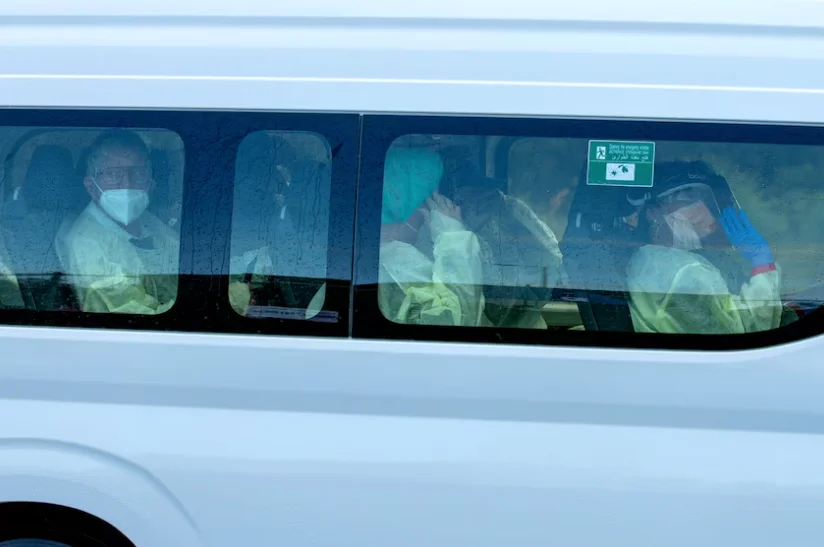

Australia has placed six cruise ship travellers into strict quarantine near Perth after a deadly hantavirus outbreak linked to the expedition vessel MV Hondius triggered international health concerns. The passengers arrived aboard a repatriation flight from the Netherlands on Friday after disembarking the cruise ship, which has already been linked to multiple deaths and confirmed infections.
The group included four Australian citizens, one Australian permanent resident, and one New Zealand national. Authorities confirmed the travellers landed at RAAF Base Pearce, about 40 kilometres north-east of Perth, before being escorted by police to the Bullsbrook Centre for National Resilience.
Television footage from the arrival showed passengers dressed in full-body protective equipment waving from inside a secured minibus while police vehicles escorted them to the quarantine facility. Even the driver transporting the passengers wore full PPE during the transfer.
Australian Health Minister Mark Butler said all six travellers tested negative for hantavirus before boarding the repatriation flight and had remained symptom-free throughout the journey. Officials added that the passengers would now undergo further PCR testing and detailed health assessments during quarantine.
The quarantine period is expected to last at least three weeks, although Australian authorities have already indicated the monitoring process could continue longer because hantavirus has an incubation period that can stretch to around 42 days.
Why Australia Is Taking Extra Precautions
Despite the passengers testing negative before arrival, Australian officials said the response was designed to prevent even the smallest risk of community transmission. Authorities confirmed everyone onboard the repatriation flight, including a doctor and two flight crew members, remained in full protective gear throughout the trip from Europe.
The doctor and flight crew are also expected to voluntarily quarantine for two weeks at the Bullsbrook facility. Meanwhile, Department of Agriculture and Fisheries personnel are scheduled to fully decontaminate the aircraft used for the repatriation operation.
Health officials stressed the decision reflects lessons learned during the COVID-19 pandemic, where early containment and strict border health measures became central to outbreak prevention strategies worldwide.
The Bullsbrook Centre for National Resilience itself was originally built during the pandemic as a large-scale quarantine facility capable of housing around 500 people. Although it remained mostly unused for years, the hantavirus incident has now activated the site for one of its first major health responses since construction.
According to officials, the passengers will stay in rooms equipped with balconies, internet access, televisions, and medical supervision while undergoing observation.
For official information about hantavirus symptoms and transmission, readers can review guidance published by the World Health Organization.
Read More
WHO Monitoring Cruise Ship Outbreak Closely
The World Health Organization’s latest update linked to the MV Hondius outbreak confirmed 11 reported cases connected to the cruise ship, including three deaths. Health authorities said eight infections had been laboratory-confirmed, while two were classified as probable cases and another remained inconclusive.
The latest confirmed infections were reported in France and Spain, with both individuals identified as passengers who had travelled aboard the ship.
Hantavirus infections are relatively rare but can become extremely serious depending on the strain involved. The virus is commonly associated with exposure to infected rodents or contaminated environments. Early symptoms often resemble flu-like illness before potentially progressing into severe respiratory complications.
The outbreak has once again placed cruise ship safety and infectious disease management under intense scrutiny. Cruise vessels can create heightened risks during outbreaks because passengers often spend extended periods in enclosed shared environments, including dining halls, cabins, and communal activity areas.
Expedition cruises, including polar and remote-region voyages like those operated by the MV Hondius, may face additional challenges because medical evacuation and specialist healthcare access can be limited depending on location.
Australian authorities said they would continue working with state governments in New South Wales and Queensland, where the Australian passengers are from, to manage the later stages of the monitoring period after the initial Perth quarantine ends.
The situation has also sparked broader discussions around international travel health screening and emergency outbreak response systems. Public health experts say governments are now far quicker to activate quarantine measures following the global experience of COVID-19.
Swikblog recently reported on another Australian public health alert involving a Sydney clinic virus testing warning, reflecting how health authorities are increasingly taking precautionary action even before widespread infections emerge.
For now, Australian officials continue to insist the current quarantine measures are precautionary and that no confirmed infections have been detected among the returned travellers. However, with the incubation period still ongoing and global monitoring continuing, health authorities are refusing to take risks.
The coming weeks will determine whether the response remains a preventive success story or whether additional cases linked to the MV Hondius outbreak emerge internationally.

Make Swikblog your go-to source on Google for reliable updates, smart insights, and daily trends.