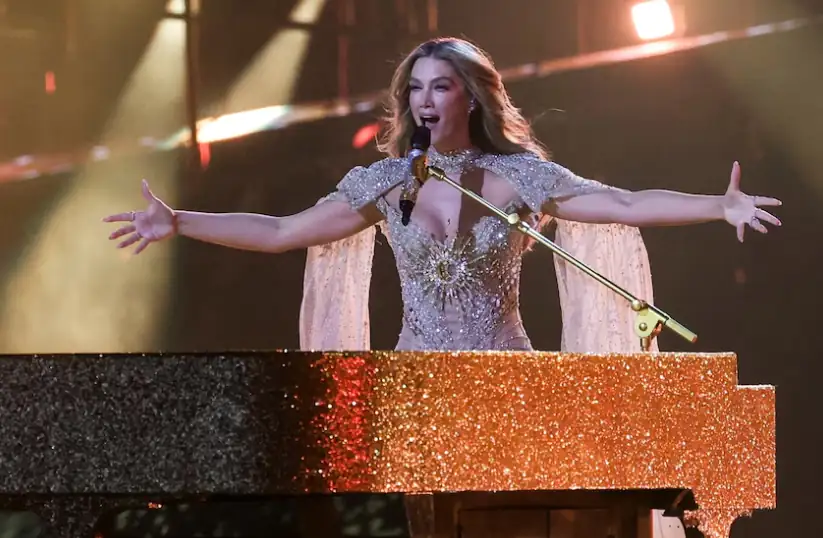

Delta Goodrem has officially qualified for the Eurovision 2026 grand final after delivering a dramatic live performance that instantly became one of the biggest talking points of this year’s competition. Representing Australia with her emotional power ballad Eclipse, the singer impressed both the live crowd in Vienna and viewers watching around the world, with many fans already calling the performance Australia’s strongest Eurovision entry in years.
The 41-year-old singer took to the stage during the second semi-final at the Wiener Stadthalle arena in Austria, combining soaring vocals, pyrotechnics, cinematic lighting and a theatrical piano sequence that quickly spread across social media platforms. Within hours of the performance, “Delta Goodrem Eurovision 2026” was trending online as Eurovision fans praised her vocals and staging.
Official Eurovision updates, voting information and country standings are available through the Eurovision Song Contest official website.
Delta Goodrem’s ‘Eclipse’ performance becomes a Eurovision talking point
Goodrem’s Eurovision staging leaned heavily into visual drama. Wearing a crystal-covered gown surrounded by wind effects and fire bursts, the Australian singer opened the performance beneath a giant glowing crescent moon before walking across the stage toward a gold piano positioned at the centre of the arena.
After performing a short piano section, the production escalated into one of the semi-final’s standout moments. A hidden platform inside the piano lifted Goodrem high above the stage as she delivered the final chorus and powerful closing notes of Eclipse. The combination of flames, lighting and the elevated piano sequence created one of the most visually memorable endings of the night.
Eurovision viewers reacted immediately online. Clips from the semi-final quickly circulated across X and Instagram, where fans described the act as “Australia’s winning moment” and predicted Goodrem could secure the country’s best Eurovision result since Dami Im’s runner-up finish in 2016.
One viewer wrote that “Delta just smashed the stage,” while another posted: “Australia might have finally done it.” The performance also earned praise from Eurovision commentators who highlighted Goodrem’s live vocal control and the confidence of the staging.
The positive reaction matters because Australia has struggled to consistently reach the Eurovision grand final in recent years. In 2024, Electric Fields failed to progress despite making history with a performance featuring Yankunytjatjara language. Last year, Go-Jo’s energetic entry also missed out on qualification. Goodrem’s success therefore represents a significant moment for Australia’s Eurovision campaign.
The singer’s entry also arrives with strong momentum outside the competition itself. Eclipse, which was released earlier this year, reached number one on the Australian AIR Independent Singles Chart and has become one of the country’s most internationally discussed Eurovision songs in recent memory.
Read More
Australia returns to the Eurovision grand final with momentum
Goodrem advanced from the semi-final alongside countries including Ukraine, Norway, Denmark, Romania, Bulgaria, Cyprus, Malta, Albania and Czechia. Her qualification marks the 11th time Australia has appeared at Eurovision since first joining the competition.
The performance has already positioned Australia among the most closely watched countries heading into the grand final. While Eurovision betting markets and fan rankings continue to shift, Goodrem has emerged as one of the most talked-about acts because of the scale of the staging and the reliability of her live vocals.
Still, the final outcome remains difficult to predict. Eurovision voting combines professional jury scores with public televotes, and Australians are unable to vote for their own country. That means Goodrem will need continued support from European viewers as well as strong jury backing if Australia hopes to challenge for the top positions.
Eurovision analysts have noted that Eclipse stands out because it embraces classic Eurovision spectacle without feeling chaotic. Instead of relying on novelty staging or gimmicks, the Australian entry focused on a polished vocal performance supported by cinematic visuals and a clear emotional build.
Goodrem previously explained that the song is about “alignment” and moments in life when “everything comes into the right place.” She also said representing Australia at Eurovision was something she felt “deeply in my heart.”
The performance arrives during a busy year for the singer. Earlier this week, Goodrem announced her upcoming studio album Pure, which is scheduled for release in November and will become her seventh studio album overall.
Outside the music itself, Eurovision 2026 has faced political controversy after several nations boycotted this year’s competition over Israel’s participation amid the Gaza conflict. Protests have also taken place in Vienna during contest week.
For now, however, much of the conversation surrounding Australia is focused on whether Delta Goodrem can transform semi-final momentum into a genuine grand final challenge. Her performance has already delivered something Australia has been missing at Eurovision recently — a memorable live moment capable of cutting through globally.
The Eurovision 2026 grand final will air on May 17, with millions expected to watch worldwide. Whether or not Australia ultimately wins, Goodrem has already succeeded in putting the country back at the centre of Eurovision conversation.

Make Swikblog your go-to source on Google for reliable updates, smart insights, and daily trends.