
Swikriti Dandotia · Jan 16, 2026 · Canada / China
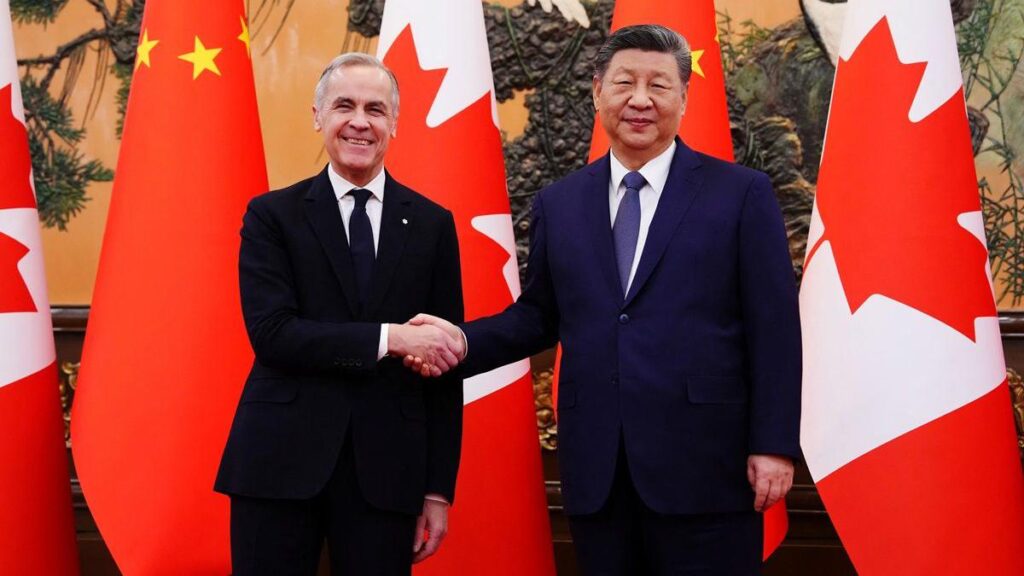
A high-stakes Beijing meeting between Prime Minister Mark Carney and President Xi Jinping has produced a rare tariff truce — but Ontario Premier Doug Ford says Canada may be paying too high a price in the electric-vehicle fight.
Canada and China have signalled a sharp reset in relations after a breakthrough agreement that lowers trade barriers on two politically sensitive fronts: electric vehicles and canola. Under the plan outlined after talks in Beijing, Canada will apply a most-favoured-nation tariff rate of 6.1% to a capped volume of Chinese EVs — down from a punitive rate introduced in 2024 — while China is expected to reduce steep duties on Canadian canola to around 15% by March 1. The announcement was framed as a pragmatic step toward “stable” ties, but it landed like a thunderclap back home.
Ontario Premier Doug Ford — whose province is the heart of Canada’s auto manufacturing base — warned the move risks becoming a “one-sided” arrangement that could leave Canadian workers and suppliers exposed. His critique: easing access for cheaper Chinese EVs may undercut local investment just as Canada tries to build an end-to-end EV supply chain, from batteries to assembly plants.
For Canadians trying to make sense of what changed overnight, the central question is simple: is this a smart trade pivot that protects farmers and opens markets — or the start of a policy U-turn that invites a flood of imports and political blowback?
What the tariff deal actually does
- EVs: Canada moves Chinese electric vehicles onto a 6.1% most-favoured-nation tariff rate, with imports limited to a defined annual cap (reports have cited a cap near 49,000 units initially).
- Canola: China is expected to cut effective tariffs on Canadian canola from punitive levels near 85% to about 15% by March 1, offering meaningful relief to exporters.
- Broader reset: Both sides describe this as part of a wider effort to restore predictable dialogue after years of tit-for-tat moves and diplomatic strain.
Credible reporting has also suggested the package is tied to wider cooperation — including potential investment conversations and renewed ministerial contact — though the details will matter more than the headlines in the weeks ahead. (You can read additional reporting from The Associated Press and the Financial Times.)
Why Doug Ford is furious
Ford’s warning isn’t only political theatre — it reflects a real economic anxiety: the EV transition is already a high-cost race, and price competition can become brutal when new entrants arrive with scale. Ontario has spent years selling itself as North America’s EV manufacturing corridor, attracting battery and auto investments that depend on stable policy and protected market access.
From Ford’s perspective, reducing tariffs risks three immediate outcomes:
- Downward pressure on prices that makes it harder for local projects to hit profitability targets.
- Supply-chain uncertainty for parts makers who’ve banked on a protected Canadian market.
- Political risk if factories and unions argue Ottawa traded away industrial leverage too quickly.
In other words: farmers may get near-term relief, but the auto sector wants guardrails — and Ford is positioning himself as the loudest defender of that line.
Why Carney is doing it anyway
Carney’s argument is rooted in leverage and reality. Canada’s trade picture has become increasingly volatile, especially as tariff threats and election-cycle economics shape policy in Washington. Ottawa wants options — and China, despite deep disagreements on security and human rights, remains one of the world’s largest markets.
The deal also fits a classic political calculus: canola relief is tangible, measurable, and time-bound (tariffs drop by March 1), while industrial risks are more diffuse and unfold over months. It’s a bet that a cap on EV imports can prevent a market shock while still delivering enough goodwill to thaw the wider relationship.
Carney has also been explicit that cooperation does not mean alignment — and that Canada still intends to enforce “red lines” on issues such as interference concerns and human-rights disagreements. But critics will ask whether tariff relief is the kind of concession that’s difficult to reverse once the door is opened.
What happens next
Watch three things closely over the next few weeks:
- The fine print on the EV cap — how it’s enforced, which models qualify, and whether quotas rise over time.
- China’s tariff timeline on canola — whether the March 1 reduction is implemented cleanly and whether other agri-food categories follow.
- Domestic backlash — especially from Ontario’s auto sector, unions, and opposition parties framing the deal as a strategic misstep.
For now, Canada has chosen a controversial middle path: reopening one door to China while promising it won’t swing fully open. Whether that balance holds will decide whether this becomes a diplomatic success story — or the headline Ford says Canadians will regret.
More updates: Browse more stories on Swikblog.
Quick FAQ
When do China’s canola tariff cuts take effect?
Canada says the new rate should apply by March 1, 2026.
How much did Canada cut EV tariffs?
The plan moves to the 6.1% most-favoured-nation rate for a capped volume of Chinese EVs.
Why is Ford calling it “one-sided”?
He argues Canada is risking its auto and EV industrial strategy by lowering barriers for Chinese EVs.

Make Swikblog your go-to source on Google for reliable updates, smart insights, and daily trends.