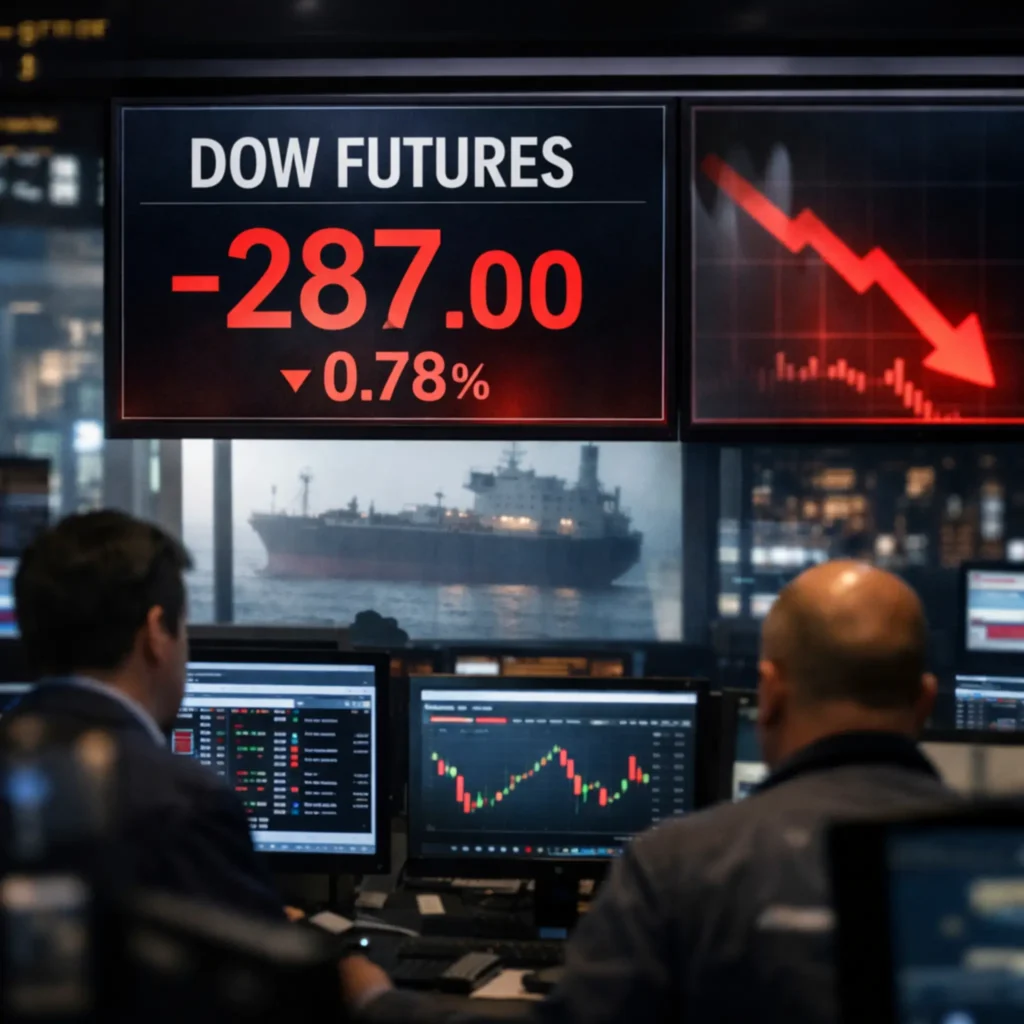

Dow futures were down 287 points, or 0.6%, as traders moved back into risk-off mode after President Donald Trump signaled a tougher U.S. response in the Strait of Hormuz following the collapse of fresh talks with Iran. For Wall Street, the issue is not only geopolitics. It is the immediate possibility of another oil shock feeding back into inflation expectations, rate-cut bets and corporate margin fears just as a critical earnings week begins.
The market already knows how quickly this trade can reverse. The Dow had surged on ceasefire optimism earlier in the week, then gave back momentum as the Middle East picture darkened again. That is why futures are reacting so sharply now. Investors are no longer trading only headlines about diplomacy. They are trading the possibility that a vital energy chokepoint could become an even bigger pressure point for global shipping, crude supply and overall risk sentiment.
Key numbers in focus
Dow futures: -287 points Dow futures move: -0.6% Hormuz oil flow share: ~20% of world consumption Global seaborne oil trade through Hormuz: 25%+
Why the Strait of Hormuz matters to Dow futures
The Strait of Hormuz is one of the market’s most sensitive macro flashpoints because it carries an enormous share of global energy flows. Any escalation there tends to hit stocks through three immediate channels: higher crude prices, renewed inflation anxiety and a faster move into defensive positioning. That combination can weigh on cyclical sectors and large-cap industrial sentiment even before the cash session opens.
For Dow futures specifically, the concern is straightforward. If oil prices move higher again, investors start recalculating the outlook for transport costs, consumer demand, input inflation and the Federal Reserve path. In that setup, even a modest futures decline can feel more important than the raw point move suggests, because traders are responding to a macro event with global spillover potential rather than a company-specific headline.
The broader background matters too. Earlier relief in markets was driven by hopes that the ceasefire framework would hold and that Hormuz disruption would ease. Instead, the latest turn revives the same fear trade that had pushed energy sharply higher in recent sessions. For context on the strategic importance of the shipping route, the U.S. Energy Information Administration notes that flows through Hormuz account for more than a quarter of global seaborne oil trade and roughly one-fifth of global oil and petroleum-product consumption.
Market snapshot as futures weaken
The premarket picture in your source image showed a mixed tape beneath the Dow-futures headline. Alphabet (GOOGL) was down 0.39%, Nvidia (NVDA) was up 2.55%, Goldman Sachs (GS) gained 0.45% and JPMorgan Chase (JPM) slipped 0.15%, while the Dow indicator itself showed a 0.56% decline. That mix tells its own story. Traders were not dumping everything. Instead, they were rotating selectively, with AI-linked leadership still finding buyers while financials and index sentiment stayed more cautious.
Premarket-style move graph from the market snapshot
Graph note: Bar lengths are scaled to the percentage moves shown in the source image for a quick visual comparison.
That divergence is important for a Dow-futures story because it keeps the piece focused on index-level tension rather than suggesting a full-blown market panic. A falling Dow futures contract alongside selective strength in names like NVDA usually points to a market wrestling with macro risk rather than abandoning growth entirely. It also raises the odds of a choppy cash open, with investors quickly repricing sentiment as oil, yields and geopolitical headlines move together.
Financial names deserve extra attention here. Goldman Sachs (GS) and JPMorgan Chase (JPM) are both closely watched in a week when bank earnings and macro commentary can influence the broader tape. If oil volatility stays elevated and risk appetite weakens, investors may look beyond headline earnings and focus more on what management teams say about deal activity, market conditions and consumer resilience.
There is also a recent context that makes this futures drop more charged than it might look at first glance. The Dow had just come off a dramatic swing period, including a 1,325-point rally on ceasefire relief before momentum cooled again. That kind of reversal-prone backdrop tends to magnify the psychological effect of any new geopolitical headline. When traders have already seen triple-digit point swings tied to the same region, a fresh 287-point futures loss becomes easier to extrapolate into broader volatility.
In practical terms, the market is now trying to answer three questions at once: whether the Strait of Hormuz situation worsens, whether oil extends higher from here, and whether that would complicate the inflation story just as earnings season begins. Until there is more clarity, Dow futures are likely to remain highly sensitive to every development tied to Iran, shipping security and U.S. military posture. That is why this latest move feels less like a routine dip and more like a warning that headline-driven volatility is back in control.
You May Also Like
- Nvidia Stock Price Today: AI Momentum Keeps NVDA in Focus
- Tesla Stock Price Today: EV Giant Stays in Focus as Traders Watch Next Move
- Alphabet Stock Price Today: Google Parent Stock Remains on Watch After Market Shift

Make Swikblog your go-to source on Google for reliable updates, smart insights, and daily trends.