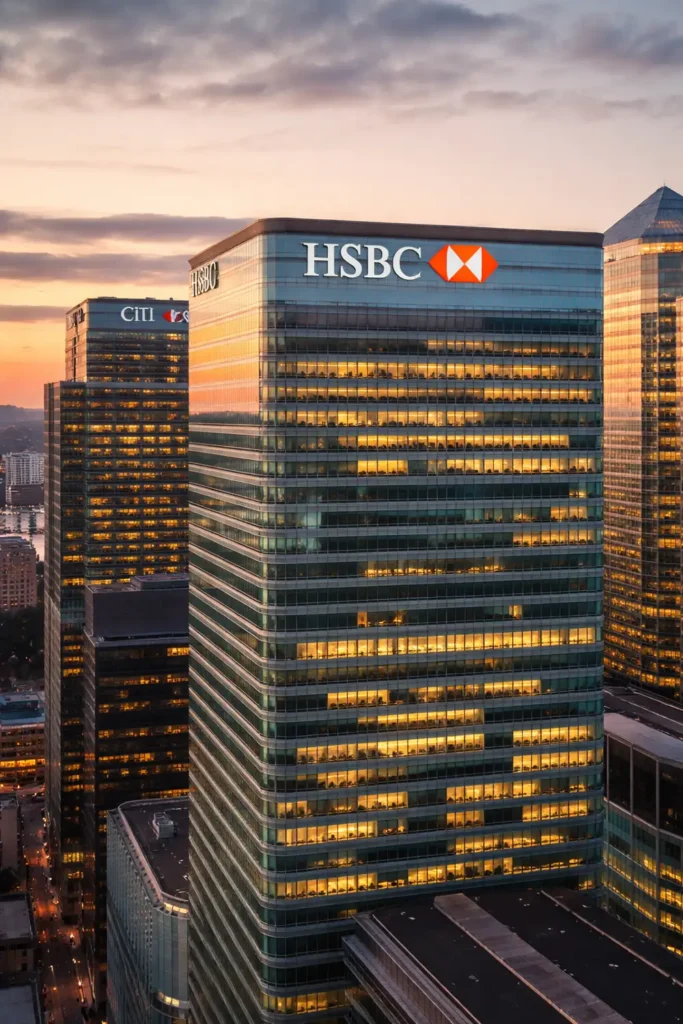

HSBC (HSBA.L) shares were trading around 1,330p on Tuesday, slipping marginally by about -0.11%, but the bigger picture remains firmly bullish with the stock up a striking 82% over the past year and an impressive 206% over five years. Despite the slight dip today, investor attention remains strong as the banking giant continues to deliver robust profits, rising dividends, and strategic global expansion.
The modest decline in today’s session does little to dent the longer-term rally. HSBC has been one of the standout performers in the FTSE 100, driven by a powerful mix of high interest rates, strong earnings, and its dominant position across Asia and global financial markets. The stock’s consistent upward trajectory has been complemented by steady dividend payouts, making it attractive for both growth and income-focused investors.
Strong financial performance supports rally
HSBC’s latest financials underline why the stock has seen such a sharp re-rating. The bank reported pre-tax profits of $29.9bn for the last year, a solid figure despite being 7% lower than the previous year’s record $32.3bn. This decline was largely attributed to one-off factors such as impairments, legal provisions, and restructuring costs rather than weakness in core operations.
Shareholder returns have been a key highlight. HSBC completed $6bn worth of share buybacks in 2025, reinforcing confidence in its capital strength. In addition, the stock currently offers a dividend yield of around 4.2%, with expectations that it will rise to 4.5% this year and further to 4.9% by 2027. This growing income stream has played a major role in attracting long-term investors.
Valuation also remains relatively reasonable. With a forward price-to-earnings ratio of around 11.6, HSBC does not appear significantly overvalued, even after its strong rally. This has allowed investors to justify continued exposure to the stock despite its recent gains.
Key drivers behind the stock movement
The primary driver behind HSBC’s rise has been the global interest rate environment. Higher rates have allowed banks to expand their net interest margins — the difference between what they earn on loans and pay on deposits. This has significantly boosted profitability across the banking sector, and HSBC has been one of the biggest beneficiaries.
Another major factor is its geographic diversification. While HSBC is listed in the UK, it generates roughly 75% of its profits from Asia. This gives it exposure to faster-growing markets compared to domestically focused UK banks like Lloyds and NatWest. Emerging regions such as China and the Middle East continue to offer long-term growth opportunities, supporting the bank’s strategic positioning.
HSBC has also been actively strengthening its business lines. According to recent developments, the bank is hiring a senior metals trader from ICBC Standard Bank to lead its global metals trading division. This move is significant as HSBC is already a key player in London’s over-the-counter gold trading market, one of the largest bullion trading hubs globally. Strengthening this segment could enhance revenue streams from commodities trading.
In addition, HSBC is pushing ahead with digital innovation. The bank recently expanded its Tokenized Deposit Service (TDS) to the United States, allowing corporate clients to move funds 24/7 across borders using blockchain-based infrastructure. The service is already available in regions including Hong Kong, Singapore, Luxembourg, and the UK, and supports multiple currencies such as USD, GBP, EUR, HKD, and SGD. This move reflects HSBC’s efforts to stay competitive in the evolving financial ecosystem and improve global liquidity management.
More details about this service can be found on HSBC’s official platform here.
Risks and concerns investors are watching
Despite the strong fundamentals, investors remain cautious about several risks. HSBC’s heavy reliance on Asia means it is exposed to the slowing Chinese economy. Concerns around China’s property sector and shadow banking system continue to weigh on sentiment and could impact future earnings growth.
Geopolitical tensions are another key risk factor. Ongoing global uncertainties, including tensions between the US and China and the possibility of conflict involving Iran, could disrupt markets. While higher energy prices might support inflation and interest rates, they could also reduce demand for banking products such as loans and mortgages, potentially leading to an increase in bad loans.
Operational complexity is also a concern. HSBC is a vast global institution, and managing such scale comes with challenges. The bank incurred around $1bn in restructuring costs last year, highlighting the ongoing need to streamline operations and improve efficiency.
Additionally, HSBC has paused its share buyback programme for approximately nine months as it focuses on acquiring the remaining 36.5% stake in Hang Seng Bank. While this move could strengthen its position in Asia, the temporary halt in buybacks removes a key support factor for the stock in the short term.
Investor sentiment and outlook
Investor sentiment toward HSBC remains broadly positive. The combination of strong earnings, rising dividends, and global diversification continues to attract attention. Even after a significant rally, many investors do not view the stock as overly expensive, particularly given its income potential.
However, some caution is emerging. After such a strong run, there are expectations that the stock may consolidate in the near term. Investors are increasingly mindful of macroeconomic risks and the possibility that earnings growth could moderate if global conditions weaken.
Looking ahead, HSBC’s performance will likely depend on several factors. Continued strength in interest margins, successful execution of its restructuring strategy, and growth in key regions like Asia and the Middle East will be crucial. At the same time, the bank’s ability to navigate geopolitical risks and economic uncertainty will play a major role in shaping its future trajectory.
For now, HSBC remains a compelling story in the banking sector. A stock trading near 1,330p, backed by multi-billion-dollar profits, a dividend yield approaching 5%, and a strong global footprint, continues to offer a balanced mix of growth and income. While risks persist, the overall investment case remains intact, keeping HSBC firmly on investors’ watchlists.

Make Swikblog your go-to source on Google for reliable updates, smart insights, and daily trends.