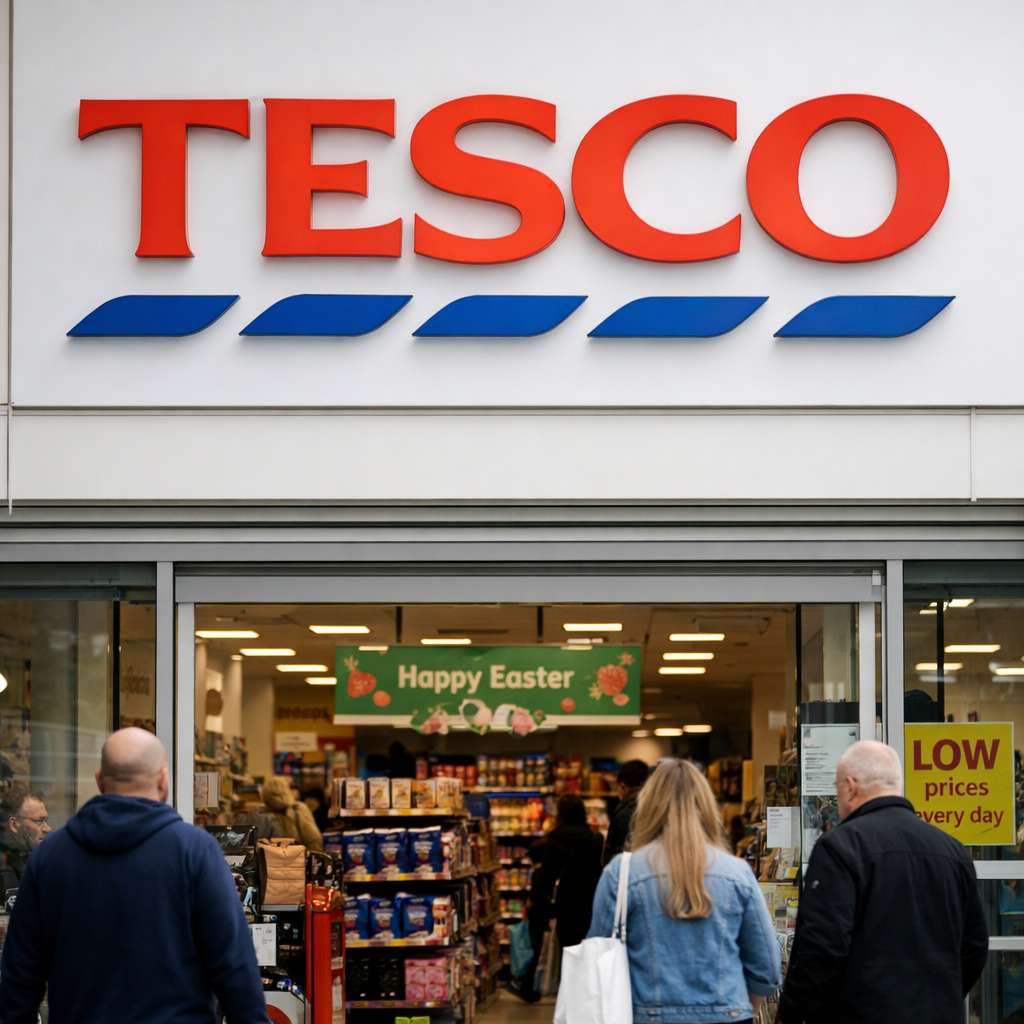

Tesco (TSCO.L) gave investors both sides of the story on Thursday, and the market still chose the upbeat half first. The supermarket giant’s share price jumped 3.5% to 488p after annual results showed resilient sales, steady profit growth and another year of market-share gains. But the rally came with an important warning attached. Tesco said the conflict involving Iran had increased uncertainty around the year ahead, forcing management to widen its profit outlook just as households, retailers and the wider UK economy face a fresh wave of global risk.
For readers searching Tesco share price today, Tesco earnings, TSCO.L results and the latest Tesco profit warning, the main numbers explain the move. Tesco reported adjusted operating profit of £3.15 billion for the year to February 28, slightly ahead of the £3.13 billion recorded a year earlier. Group sales excluding VAT and fuel rose 4.6% to £66.6 billion, while statutory pre-tax profit climbed 8.5% to £2.4 billion. Those are strong enough figures to support a positive first reaction in the stock, especially after a year in which Tesco said customers kept shifting more of their spending to the chain.
The headline risk, however, sat in the outlook. Tesco told investors it now expects adjusted operating profit for the current financial year to land between £3.0 billion and £3.3 billion. That range was wider than management had originally planned to give, and the company directly linked the broader guidance to uncertainty created by the war in the Middle East. The concern is not only about geopolitics in isolation. For a supermarket, any prolonged conflict can filter into consumer budgets through energy prices, transport costs, freight pressure, commodity volatility and wider economic sentiment. That is the link investors are watching.
Chief executive Ken Murphy tried to strike a careful tone. Tesco’s message was that it remains committed to keeping weekly shop prices down, even as it absorbs regulation-driven cost pressure and a more competitive grocery backdrop. That matters because Tesco’s recent momentum has been built on exactly that formula: tighter pricing, better availability, improving service and enough scale to keep defending volume while smaller rivals and discounters continue to fight hard for share.
Tesco earnings beat came with a clear signal on the economy
The earnings beat was real, but so was the warning. Tesco said the length of the conflict and its knock-on effects for UK households could play a major role in determining where profit lands inside that £3.0 billion to £3.3 billion range. In other words, the company is not saying business has suddenly weakened. It is saying the outside world has become harder to model. That distinction matters for anyone following Tesco stock, because it helps explain why the shares could rise sharply on the day even while management delivered a cautionary headline.
Tesco also underlined that trading momentum remains firm. The retailer said it has reached its highest market share in more than a decade, a sign that its price and loyalty strategy is still working. Murphy said customers are choosing to shop more with Tesco as the group puts more investment into value, quality and service. The company added that more than 10,000 products were cheaper at the year end than at the start, despite inflationary pressures across the grocery market.
That detail is especially important for users searching whether Tesco is gaining or losing market share, whether Tesco is cheaper now, and what is driving Tesco sales growth. The answer from these results is that Tesco is still winning enough baskets to grow, even while pressure on living costs remains a dominant issue in UK retail. It is not simply passing inflation through and hoping demand holds up. It is still spending to defend value perception.
Cost savings, AI tools and cash returns remain part of the Tesco story
Another part of the investment case is efficiency. Tesco said it plans to deliver a further £500 million of cost savings in 2026/27 after beating its previous savings target. Some of that work will come through greater use of AI, including systems designed to improve markdown timing and finance operations. Investors often search whether Tesco is using AI and whether cost cuts are supporting earnings. On the latest evidence, the answer is yes: management is still looking for margin support behind the scenes while publicly leaning into price investment on the shop floor.
The group also highlighted broader cash distribution and workforce spending. Frontline staff received a £65 million special performance award, while shareholders received £937 million in dividends over the year. That combination tells investors something useful about Tesco’s balance. This is not a company acting as though it is under immediate stress. It is still generating enough cash to reward staff, support shareholders and fund price competition, even while warning that the next twelve months may not be as straightforward.
Key numbers investors are tracking: Tesco share price around 488p, adjusted operating profit £3.15 billion, statutory pre-tax profit £2.4 billion, sales excluding VAT and fuel £66.6 billion, new profit guidance £3.0 billion to £3.3 billion, and planned fresh cost savings of £500 million.
For now, that is why Tesco shares rose. The market saw a retailer that is still executing well, still taking share and still producing big cash profits. But the Iran war angle is not a throwaway line. It is the reason the company widened guidance, and it is the factor that could shape Tesco’s share price story from here if it starts feeding more heavily into fuel, food and consumer confidence. Readers wanting the company’s full annual release can check Tesco’s official investor results page, where the full financial updates and presentations are published.
The sharp jump in TSCO.L therefore makes sense as an immediate reaction to a solid set of numbers. Whether that move builds from here will depend less on what Tesco just delivered and more on whether the wider economic fallout from the war remains contained. That tension between strong execution and a darker global backdrop is now the central Tesco share-price trade.
You May Also Like

Make Swikblog your go-to source on Google for reliable updates, smart insights, and daily trends.