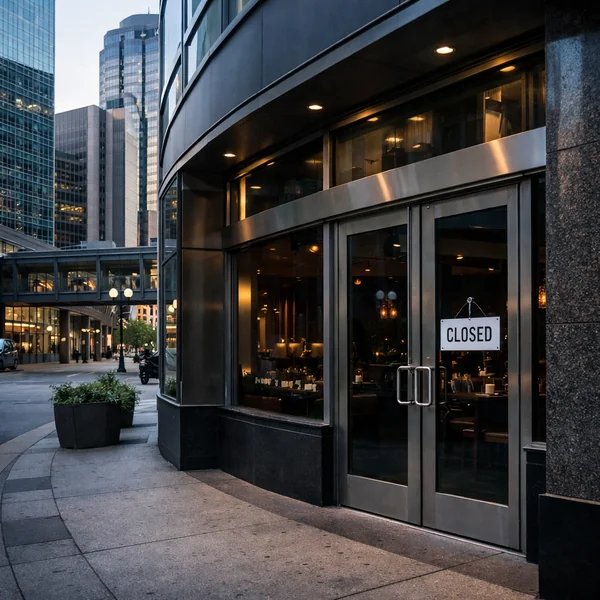

801 Restaurant Group has filed for Chapter 11 bankruptcy protection, leading to the closure of one of its two downtown Minneapolis locations in a move that reflects ongoing pressure on the city’s restaurant scene. The company has shut down 801 on Nicollet, located inside the U.S. Bancorp Center, while confirming that its other concept, 801 Chophouse, will remain open on Nicollet Mall.
The closure comes less than six months after 801 on Nicollet launched in November, making its sudden shutdown particularly notable. Signs placed at both entrances of the restaurant cited “extenuating circumstances,” offering little explanation to customers but pointing to broader operational or financial challenges behind the scenes.
The bankruptcy filing was first reported by the Minneapolis/St. Paul Business Journal, which noted that the out-of-state restaurant group filed for Chapter 11 protection last Friday. The filing allows the company to reorganize its debts while continuing some operations, a strategy commonly used by businesses trying to stabilize rather than shut down entirely.
Rapid concept changes at a key downtown location
The Nicollet Mall location has seen a series of rapid changes in recent years, raising questions about the long-term viability of large restaurant spaces in downtown Minneapolis. Before becoming 801 on Nicollet, the space was home to 801 Fish, another concept by the same group that opened in late 2023 but closed by mid-2025.
This means the location has gone through two different restaurant concepts in less than two years — a clear sign of the challenges operators are facing in attracting steady customer traffic in the area.
Even before 801 Restaurant Group took over, the site had a long history in Minneapolis dining. For years, it was occupied by McCormick & Schmick’s, a well-known seafood chain that exited during the COVID-19 pandemic. Its departure marked the beginning of a difficult period for many downtown businesses as office workers stopped commuting daily.
The pandemic fundamentally changed how people use downtown spaces. With fewer employees returning to offices full-time, restaurants that once relied on consistent lunch crowds have had to adapt to unpredictable demand patterns. In many cases, dinner and weekend traffic alone has not been enough to sustain large-format dining establishments.
Bankruptcy reflects wider industry pressure
The situation facing 801 Restaurant Group is not unique. Across the United States, restaurant operators have been dealing with rising costs, shifting consumer habits, and uncertain economic conditions. Higher prices for ingredients, increased labor costs, and elevated rents in prime locations have all contributed to tighter margins.
At the same time, diners have become more selective with spending, often choosing casual or quick-service options over upscale dining experiences. For concepts like 801 on Nicollet, which aimed to reposition itself after the 801 Fish closure, gaining traction quickly was critical — and ultimately, it appears that momentum did not materialize fast enough.
Chapter 11 bankruptcy gives the company breathing room to restructure and focus on its stronger-performing assets. In this case, that appears to be 801 Chophouse, a more established brand that continues to operate in downtown Minneapolis. Keeping that location open suggests the company still sees opportunity in the market, even as it scales back.
For readers looking to better understand how Chapter 11 works and why companies use it, this guide from Investopedia explains the process in detail.
The closure of 801 on Nicollet also highlights a broader shift in urban dining trends. Large, high-profile restaurant spaces that once thrived on corporate foot traffic are now among the most vulnerable. Many operators are experimenting with smaller venues, delivery-focused models, or suburban expansions where demand has proven more stable.
Downtown Minneapolis, in particular, continues to adjust to a new normal. While there has been some recovery driven by events, tourism, and a growing residential population, the area has not fully returned to its pre-pandemic activity levels. This has created an uneven business environment where some restaurants succeed while others struggle to stay afloat.
For now, the focus remains on how 801 Restaurant Group navigates its restructuring process. The decision to keep 801 Chophouse open indicates a strategic shift toward stability and brand strength rather than rapid experimentation with new concepts.
Still, the quick closure of 801 on Nicollet serves as a reminder of how fragile the restaurant business can be — especially in downtown districts undergoing major economic and behavioral changes. Even prime locations and established operators are not immune to the pressures reshaping the industry.
As Minneapolis continues to evolve, the fate of restaurants like those operated by 801 Restaurant Group will play a key role in defining the future of its downtown dining scene.
You may like Germany Must Work Harder, Merz Says as Sick Leave Pay Cuts Spark Debate.

Make Swikblog your go-to source on Google for reliable updates, smart insights, and daily trends.