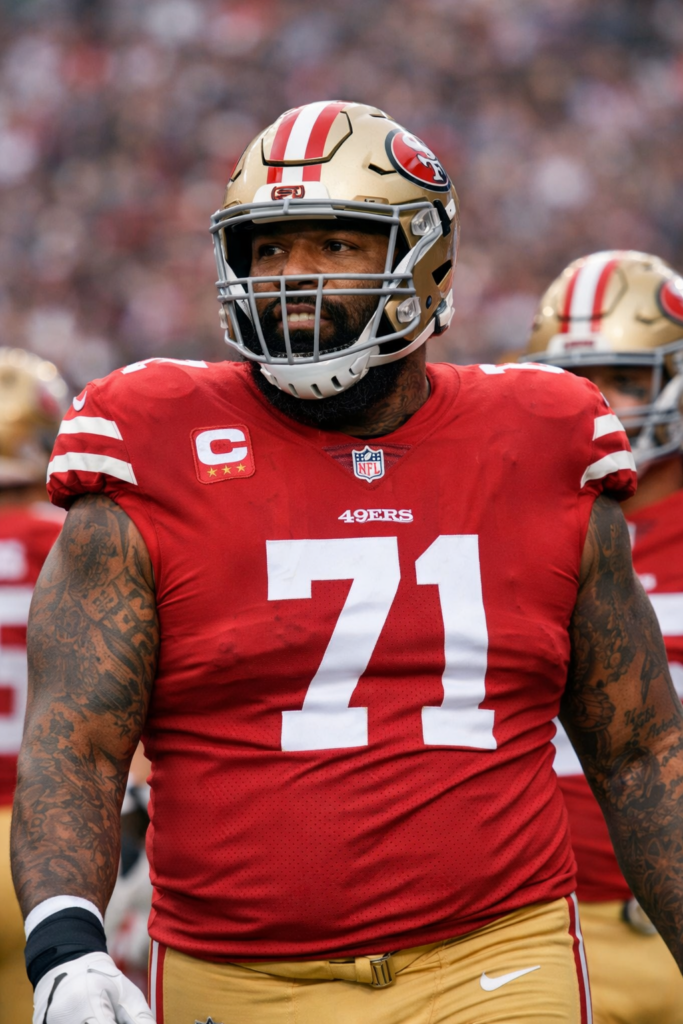

The San Francisco 49ers have removed one of the biggest question marks from their offseason by reaching a new agreement with Trent Williams, keeping the veteran left tackle tied to the franchise on a two-year, $50 million contract. On the surface, the headline is simple: one of the NFL’s best offensive linemen is staying in place. But the timing, structure and wider impact of the deal make it a much bigger story than a routine extension.
The agreement includes $37 million fully guaranteed and a $22 million signing bonus. It arrives after weeks of speculation that the relationship could become complicated enough to lead to a split. Earlier in the offseason, there were reports that the two sides were struggling to find a workable contract solution, with Williams carrying a massive cap figure for 2026 and free agency even being mentioned as a possible outcome if talks stalled.
In the end, the 49ers never publicly projected panic. Their message stayed consistent: they believed something would get done. That confidence now looks justified. Instead of heading into the 2026 NFL Draft with uncertainty surrounding one of their cornerstone players, the 49ers enter draft week with clarity on a position that could have completely altered their early-round thinking.
What makes this move especially notable is that the original issue never appeared to be Williams’ headline cap number alone. The more pressing concern was the underlying compensation package attached to his 2026 season. Before this new agreement, he was set to earn roughly $32–33 million in the final year of his previous contract, while carrying a number that became a talking point across the league.
This new arrangement appears designed to smooth out that tension while still rewarding a player whose résumé and importance to the team remain exceptional. Early indications suggest the deal functions as an extension, effectively creating a broader three-year financial picture worth around $80+ million. Interestingly, that structure results in a slightly lower average annual value on the new money compared to his previous deal — a rare outcome for a player of his stature.
Even at 37, with his 38th birthday approaching in July, Williams remains one of the NFL’s elite offensive tackles. He is coming off another Pro Bowl-caliber season and continues to anchor the 49ers’ offensive line in both pass protection and run blocking. His presence alone changes how defenses approach San Francisco’s offense.
Since arriving in San Francisco via trade during the 2020 NFL Draft, Williams has been a cornerstone of the franchise. The 49ers doubled down on that belief with a massive contract in 2021 and reworked his deal again in 2024. This latest agreement continues that pattern — whenever tension emerges, both sides ultimately find common ground.
From a team-building perspective, this deal directly impacts the 49ers’ draft strategy. San Francisco has rarely prioritized offensive linemen in the first round under general manager John Lynch and head coach Kyle Shanahan. However, entering this offseason, there were clear concerns along the line — particularly at left guard and with the long-term future at left tackle.
The 49ers currently lack a clear starter at left guard, and while their pass protection remained among the better units in the league last season, the run game saw a noticeable dip, averaging just 3.8 yards per carry — the lowest mark in Shanahan’s tenure. With Williams now secured, the urgency to draft a left tackle early may decrease, but the need to plan for succession remains very real.
San Francisco has already been linked with several offensive line prospects ahead of the draft. One possible approach is selecting a player who can begin at guard before eventually transitioning to tackle once Williams moves on. That strategy allows the team to remain competitive now while preparing for the future without rushing development.
There is also a leadership element to this decision. Williams is one of the most respected players in the locker room and a key voice within the offensive unit. His experience and consistency bring stability to a system that relies heavily on coordination across the line.
Of course, investing heavily in a player nearing 40 carries risk. Durability and long-term performance are always factors in such deals. But for a team with playoff ambitions, the alternative — losing a Hall of Fame-caliber left tackle without a clear replacement — would have posed a far greater challenge.
One clarification that surfaced after the deal announcement involved Williams’ total career earnings. Some early claims suggested he had surpassed $400 million in contracts, which would have been a historic milestone for a non-quarterback. That figure appears inaccurate, with his total closer to the $300 million range — still an extraordinary achievement.
Ultimately, this move reflects a calculated decision by the 49ers. They are prioritizing continuity, protecting their offensive core and buying time to develop the next phase of their line. It is not just about keeping Trent Williams — it is about maintaining a competitive window that the franchise clearly believes is still open.
For more detailed reporting, refer to the Associated Press NFL coverage. Additional team updates and roster insights are available on the San Francisco 49ers official website.

Make Swikblog your go-to source on Google for reliable updates, smart insights, and daily trends.