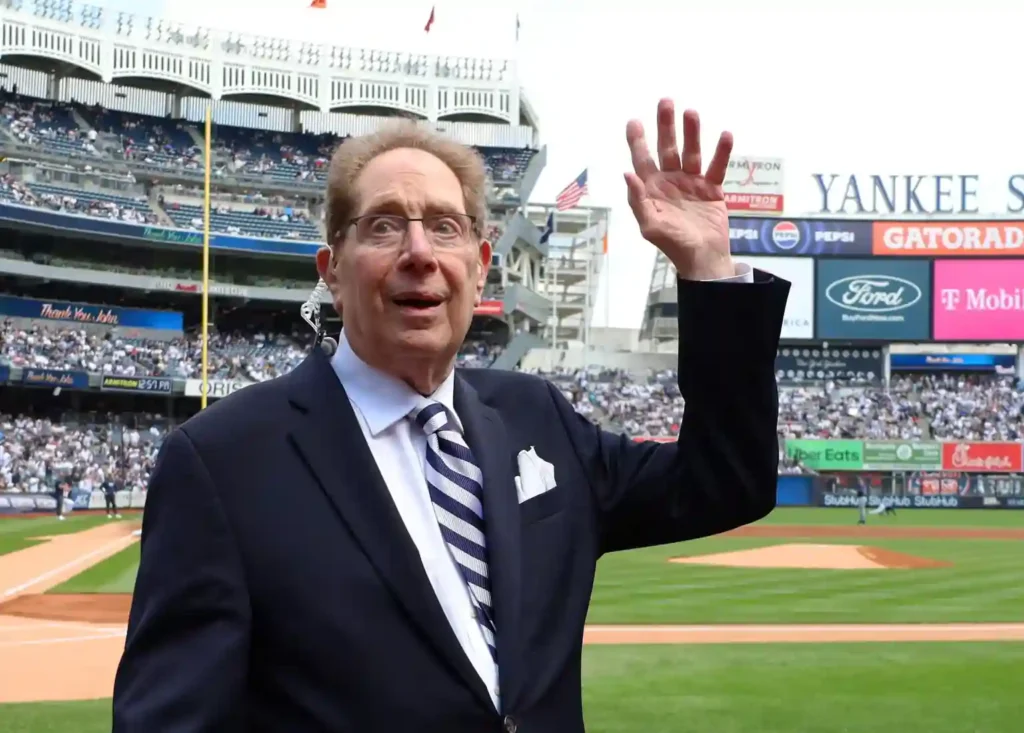

John Sterling’s death at 87 marks the end of a voice that helped define New York Yankees baseball for more than a generation. For 36 seasons, Sterling was not just describing games on radio; he was shaping how millions of fans remembered them.
His passing was announced by WFAN Sports Radio, the New York station closely associated with his long run in the Yankees booth. Sterling joined the team’s broadcast crew in 1989 and became one of the most familiar figures in Major League Baseball media, calling 5,420 regular-season games and 211 postseason games before retiring in April 2024.
Those numbers only begin to explain his place in Yankees history. Sterling was behind the microphone for 24 postseason appearances, seven World Series trips and five championship seasons. His voice followed the franchise through one of its most successful modern eras, including the dynasty years of the late 1990s and the 2009 title run.
For verified reporting on Sterling’s death and career milestones, ESPN’s obituary offers a detailed account of his long association with the Yankees: John Sterling, longtime radio voice of Yankees, dies at 87.
What made Sterling unforgettable was not only the length of his career, but the character of his broadcasts. He sounded different from almost anyone else in the booth. His delivery was bold, theatrical and deeply personal, carrying the feel of old New York with every dramatic pause and rising note.
For Yankees fans, his most famous call became a ritual: “Ballgame over. Yankees win. Thuuuuugh Yankees win.” It was simple, exaggerated and instantly recognizable. Over time, it became part of the team’s identity, the audio equivalent of a walk-off celebration or a packed Yankee Stadium roaring in October.
Sterling also turned home runs into miniature performances. His personalized calls for players became part of the fan experience, from “A Thrilla from Godzilla” for Hideki Matsui to “It’s an A-bomb from A-Rod” for Alex Rodriguez. Bernie Williams, Robinson Cano and Giancarlo Stanton all received the Sterling treatment, with wordplay that could be clever, corny or over the top — sometimes all at once.
That was the point. Sterling understood that baseball on radio needed more than accuracy. It needed color, rhythm and personality. A routine home run could become a signature moment because he gave it a phrase fans could repeat. His broadcasts lived not only in box scores, but in memory.
His endurance was just as remarkable. From September 1989 to July 2019, Sterling called 5,060 consecutive Yankees games, a streak that spoke to his discipline and deep attachment to the job. In an industry built around travel, late nights and long seasons, that kind of consistency was rare.
Read More
He missed games in 2019 because of illness and later stepped away briefly during the shortened 2020 season after dealing with a blood infection. Still, his reputation as one of broadcasting’s great workhorses was already secure.
Sterling spent the final 20 seasons of his Yankees career working alongside Suzyn Waldman, forming one of baseball radio’s most familiar partnerships. Their voices became part of the daily routine for listeners who followed the Yankees not through television highlights, but through the intimacy of radio.
His retirement in April 2024 came early in the season, when he said the constant travel had become too difficult. By then, Sterling had already built a career that stretched across eight decades, beginning in the late 1950s at a small radio station in Wellsville, New York.
He was also a distinctive personality away from the microphone. Sterling loved Frank Sinatra, Broadway songs, classic movies and soap operas, and those tastes often slipped into his broadcasts. He wore a jacket and tie to games and followed his own old-school rules, including white pants after Memorial Day but not beyond Labor Day.
Not everyone loved his style. Critics sometimes pointed to missed reads, dramatic exaggeration or home run calls that sounded certain before the ball had fully cleared the fence. Sterling never seemed overly concerned. He treated broadcasting as performance as much as reporting, and he accepted that any strong style would divide opinion.
That confidence helped make him last. Sterling did not chase trends or flatten his personality to fit a modern template. He remained himself, which is why his voice became so closely linked to Yankees baseball.
His death also comes at a time when sports media is changing quickly. Streaming, social clips and live updates now compete with traditional radio, but Sterling’s career is a reminder of what a great radio voice can still mean. He gave listeners companionship, imagination and emotion, especially on nights when they could not watch the game but could still feel every pitch through his call.
For readers following sports media, baseball business and major U.S. news stories, more coverage is available on Swikblog.
John Sterling leaves behind more than a list of games and championships. He leaves behind a sound connected to summer nights, postseason tension and the belief that every Yankees win deserved a little theater. The booth will move on, as baseball always does, but for many fans, the final out will never sound quite the same.

Make Swikblog your go-to source on Google for reliable updates, smart insights, and daily trends.